Vernal Equinox

equinox.jpg

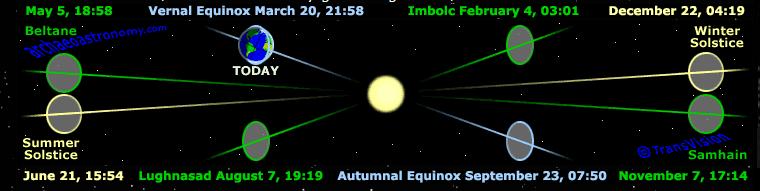
Archaeoastronomy‘s Earth Clock Graphic shows Earth’s current position relative to the cusps of equinoxes, solstices and cross-quarters. As you can see, Earth is crossing through the Vernal Equinox cusp along its orbit around the sun. As of 14:58 Arizona Time, we are now officially in the spring has sprung mode.

Our early signs of spring have started. Damsel’s Flowering Plum is full of blossoms and her Daffodils are opening, no thanks to the colder late winter weather here. Wickenburg actually had three or four days of snow this winter which is highly unusual. The high temperatures were seldom above 60 degrees F. for much of February to mid March.

The rest of the xeriscape garden is also showing signs of spring, albeit later than normal. We have several beavertail cacti which all are sprouting flower and paddle buds. The Argentine Giant out front is showing flower buds and a new arm sprouting, maybe two. The other prickly pear cacti will be getting flowers later in spring. The giant saguaro out front should also be getting flowers in late spring.

I’m sure that with the cactus flowers opening and other springtime events, Damsel’s (and my) camera will capture some of it for posting here. Stay tuned . . .

Celebrating Our Irish Heritage

stpaddyvb.png

Damsel’s sister is an Ancestry addict, having traced not only her roots, but also those of mine, and many of her other in-laws. Thanks to her, we were able to look back in our family tree to establish that, indeed, there were Irish ancestors in both Damsel’s and my lineage. In both cases, we have to go back quite a few generations to actually find someone who lived on the Emerald Isles.

Damsel’s birth surname is quite Irish-sounding, while mine is more of English derivation. In both cases, we each trace to that region of Europe with some Dutch showing up in my ancestry (e.g. Van Patten, Van Slyck). Damsel has some Native American in the Oklahoma region up her tree.

Regardless of our actual heritage, we’re both Irish today as we settle in to enjoy a traditional (to Irish Americans) Corned Beef and Cabbage boiled dinner this afternoon. We hope that you are enjoying the day as well, Irish or not.

Happy Pi Day – 3/14/2019

pi.png

Before there was a PI key on our Bowmar Brains, many of us would approximate the value of PI using the formula 355/113. Some of us also memorized the first nine digits of Pi – 3.14159265 and input that into our calculators. Either way, the result would be off by less than 1 part per million, good enough for most applications short of space launches.

Scientific American has this offering about How Much Pi Do You Need?:

You might have observed Pi Day on March 14. It gets its name from 3.14, the first three digits of the ratio of a circle’s circumference to its diameter. Always on the lookout for excuses to eat pie, some geeky math types also celebrate the number on July 22. The fraction 22/7 has a value of 3.142857, so it has the same first three digits as pi.

Both 3.14 and 22/7 are approximations of pi, so the two days deserve the same title. In fact, 22/7 is closer to pi than 3.14 is. So if you’re an aspiring pedant, you can choose to celebrate July 22 as Pi Day and March 14 as Not Quite as Close to Pi Day. (Either way, you’ll enjoy more pie.) But what does it mean to be an approximation of pi—and why does it matter?

[Continue Reading]

This interesting article goes on to discuss how many decimal places of PI accuracy are needed for space operations, navigation (GPS) and quantum mechanics.

Classic 1935 Ford Sedan

Classic 1935 Ford Sedan

Damsel captured this photo of a classic old Ford V8 this morning on our way back from the “environmental services” facility (a.k.a. dump) on the west side of town. I saw this guy the other day when I was getting ready to leave the chiropractor’s office. I had a camera then, but the classic went by before I could grab and shoot. I’m glad that we saw it again today. It’s a beauty.

We went to the dump to dispose of a mattress that we bought when we first moved into the house. The mattress was our first place to sleep until we took our time to acquire the house furnishings as the first year here went by. Now, the 8-year old mattress has seen better days and needed to be replaced with a new one.

The new mattress is similar to the one we got for the RV last year. Same brand but a queen instead of king size. The new mattress is intended to help me get over the lower back problems I have been having since mid-February. The visits to the chiropractor have helped a lot, but we’re still not a hundred percent on being able to function normally.

I’ve had back problems since I was a young man, but it usually would heal quickly and get back to normal, Not so, as a septuagenarian. It takes time and visits to the chiropractor now, but it will get better soon. And a new memory foam mattress will help too, I’m sure.

Rosemary Farm

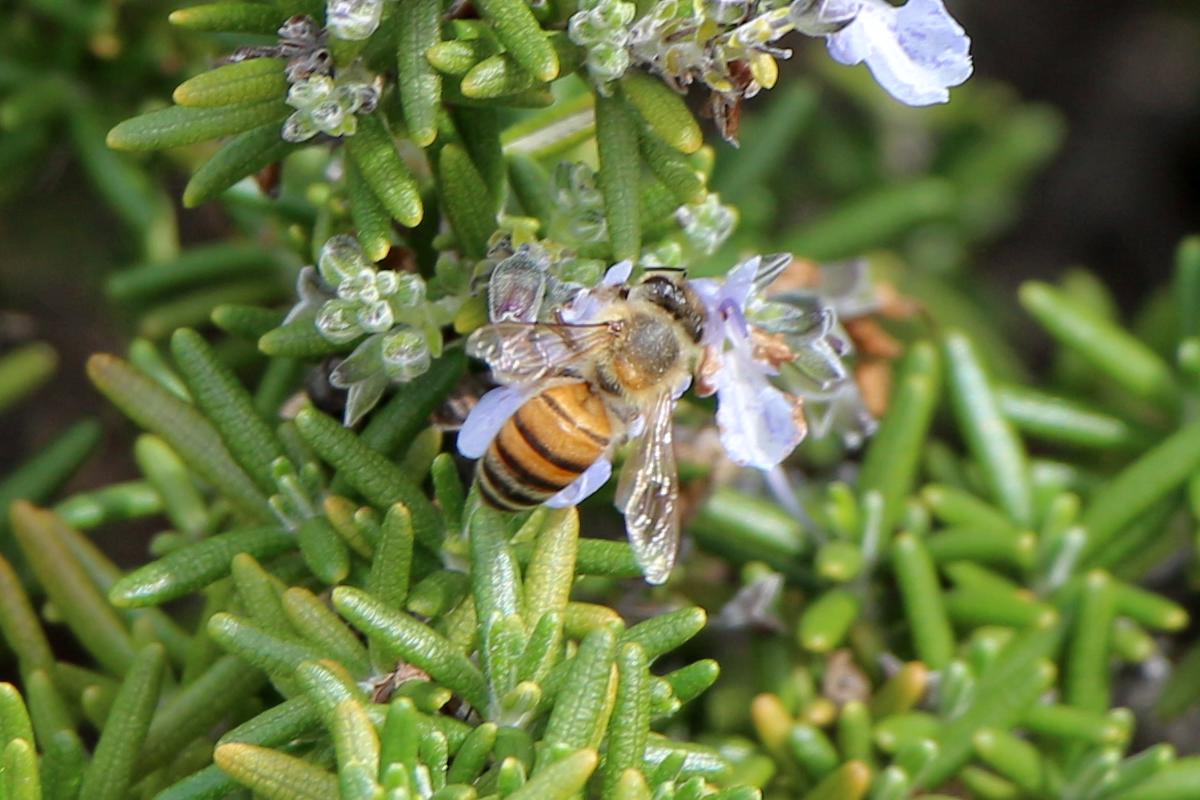
Bee Gathering Nectar

When we originally had the landscapers plant our yard along the back slope above the RV drive, they installed about fifty or sixty one-gallon rosemary shrubs with an irrigation system. The shrubs have been there for over seven years now, and have grown to mostly cover what once was bare slope behind the house.

I took this photo (click to enlarge) of a bee browsing some of the tiny flowers on the shrubs which have been blooming most of the winter. I can’t hear the buzzing anymore (tinnitus), but Damsel says the bees are quite loud as they busily gather nectar. Now, when the hummingbirds come by to do the same thing, I can hear them just fine.

When we need herbal rosemary for a recipe, we have no further to look than out behind the retaining wall on the north side of the RV drive. Damsel will send me out there with a pair of shears to snip off a couple of the freshly grown stems from one of the many bushes. I take the stems inside, wash them and pull the needles from the woody part. Damsel will either mince the needles or use them whole, depending on the recipe.

More on the Rosemary Herb from Wikipedia:

Rosmarinus officinalis, commonly known as rosemary, is a woody, perennial herb with fragrant, evergreen, needle-like leaves and white, pink, purple, or blue flowers, native to the Mediterranean region.

It is a member of the mint family Lamiaceae, which includes many other herbs. The name “rosemary” derives from the Latin for “dew” (ros) and “sea” (marinus), or “dew of the sea”. The plant is also sometimes called anthos, from an ancient Greek word meaning “flower.” Rosemary has a fibrous root system.

Rosmarinus officinalis is one of 2–4 species in the genus Rosmarinus. The other species most often recognized is the closely related, Rosmarinus eriocalyx, of the Maghreb of Africa and Iberia. The name of ros marinus is the plant’s ancient name in classical Latin. Elizabeth Kent noted in her Flora Domestica (1823), “The botanical name of this plant is compounded of two Latin words, signifying Sea-dew; and indeed Rosemary thrives best by the sea.” The name of the genus was applied by the 18th-century naturalist and founding taxonomist Carl Linnaeus.

My only observations regarding the text above is that (a) we’re a long way from the sea and (b) we don’t get much in the way of dew in the desert. I guess that the Rosemary herb likes it hot (it does get hot here), tolerates mild cold (rarely below freezing) and depends on the irrigation system we have here for moisture. And, clearly, the bees and hummingbirds pollinate them to their mutual benefit.

Limoncello Day 2019

Limoncello Day

Today was the day for bottling (Mason jars, actually) the finished Limoncello product that Damsel put away last December. The intermediate step was completed to remove the lemon rinds and add sweetener in January, so after maturing, the product was finally ready for putting up today, if not in bottles but in Mason Jars.

Image: Damsel dispensing the finished limoncello from the big brewing container to a mason jar. Click on the image to enlarge.

I don’t have any photos of this year’s lemon harvest in late November, but it was certainly as large as the haul we made in the lemon harvest of 2015. Our little dwarf lemon tree has reliably produced since we put it in the “Orchard” in 2011.

From Wikipedia:

Limoncello is an Italian lemon liqueur mainly produced in Southern Italy. In northern Italy, the liqueur is often referred to instead as limoncino. It is also a popular homemade liqueur, with various recipes available online and in print.

Although there is debate about the exact origin of the drink, it is at least one hundred years old

Visitors to our humble abode are usually given one or two bottles or jars of our brew. We also carry some with us when we’re on the road in the motorhome to give to friends and acquaintances. Sorry, we can’t ship it since it’s against USPS rules and other carriers don’t want it either. You will just have to come and get it or wait until we drive by for a visit.

New Glass for the Canon T6i and SL1 Cameras

Canon SL1 and EF-S 18-135 mm LensEarlier this month, Tam wrote about trying different glass to replace a zoom lens with not-so-great performance. That post gave us the idea that we too might benefit from lens upgrades for our two Canons – Damsel’s is an EOS Rebel T6i and mine (shown at right) is an EOS Rebel SL1 – both DSLR cameras.

Since the stock lens that came with both cameras was a zoom with a focal length range of 18 mm -55 mm, we decided in getting a better lens with the same starting focal length and stretching the maximum focal length out to 135 mm.

I took the above image of the SL1 with the EF-S 18-135 Lens attached with my little Kodak FZ152 Pocket Camera. Click on the image to enlarge.

Although we haven’t put the new optics through extensive evaluation, we see that the performance is pretty good. I went out this morning to get a few pictures to see how the performance was in general. The following two images of the RV and a hummingbird demonstrate the extreme wide and narrow focal length performance. Click on either image to enlarge.

18 mm zoom 135 mm zoom

As we put the new lenses into use we should get a feel for how the new optics performance will be. Just from today, I can generally see that the Image Stabilizer does an effective job of keeping the camera steady and I can’t readily detect a lot of chromatic aberration at maximum zoom.

We hope everyone had good St. Valentines and Presidents Days.