Something Shiny

Rare Sighting — Caterham R400


The Damsel took this (clickable) photo of a Caterham Seven Superlight R400 (or simply “Caterham R400”), a lightweight, high-performance British sports car. We were pulling out of the parking lot at our local Basha’s and saw this beauty parked on the street in front of St. Anthony’s Church.

It seems that there are only a few hundred of these in the entire United States, so it is extremely rare (a.k.a. Sasquatch sighting) to see one of these in Wickenburg, a town known for it’s Cowboy and retirement cultures and not too many sports cars, let alone this rare beast.

About this car:

The Caterham Seven is a modern evolution of the classic Lotus 7 from the 1950s. It’s an ultra-minimalist, open-top, two-seater roadster designed for pure driving thrills—think raw handling, minimal weight, and maximum engagement. The “R400” (or Superlight R400) is a performance-oriented variant from the mid-to-late 2000s, known for its excellent power-to-weight ratio. The “400” name comes from its ~400 bhp per ton power-to-weight figure, which gives it supercar-like acceleration despite modest horsepower.

Caterhams like the R400 are legendary for telepathic steering, razor-sharp handling, and go-kart-like agility. They’re track weapons that are (barely) road-legal. Expect wind-in-the-face excitement, a loud exhaust note, and a firm ride. They’re not for commuting or comfort—getting in/out is a gymnastic exercise—but they’re addictive on twisty roads or circuits.

More at this SuperGrok link.

2025 Cops Who Care
 Classic Car Run

Today, we attended the annual Cops Who Care Car Show and Toy Drive. The weather was great and the show was well attended by both cars and visitors. The toy table wasn’t doing too bad either — gonna be a lot of happy kids this Christmas.

When I was a kid in the late 1940s, my folks had one of these Ford Coupes modified with a bench seat for their three little boys to sit behind the driver/passenger seat. It’s a 1933 Year Model, same as Dad and Mom’s.

Also, when I was a kid, there were a lot of these Studebakers on the road as I recall. This Convertible is a member of the local Studebaker Club in the Hassayampa Valley.

We enjoyed the time spent at the Wickenburg Community Center today and look forward to attending again next year.

Flag Day 2025

About Flag Day

Flag Day is a national holiday in the United States, celebrated on June 14th to commemorate the adoption of the U.S. flag on June 14, 1777. The flag has a rich history and is a symbol of freedom and justice, with its design representing the 13 original colonies and the 50 states. The flag’s colors have specific meanings: red represents valor and bravery, white represents purity and innocence, and blue represents vigilance, perseverance, and justice.

The first flag of this design was carried into battle on September 11, 1777, during the Battle of Brandywine. Flag Day is not a federal holiday, but it is observed nationally, and Pennsylvania recognizes it as a state holiday. The largest Flag Day celebration in Michigan takes place in Three Oaks, which claims to be the nation’s largest Flag Day celebration.

Donald J. Trump, the 45th and 47th President of the United States, was born on June 14, 1946. This date coincidentally coincides with Flag Day, which is celebrated on June 14th to commemorate the adoption of the U.S. flag.

June 14 is also the 250th anniversary of the Commissioning of the United States Army. Hooah!


About our Flags

In the image above, we proudly fly the American Flag on most days of the year. The flag shown in the image was manufactured in the USA by Grace Alley Flags, a company that produces high quality flags available from their website or through Amazon. Their flags have embroidered stars and sewn stripes. No cheap printed colors.

We have recently procured another high-quality American Flag, also produced in the USA, from Alliance Flags, who produce the similar quality as the Alley flags, but cost about three times as much. As of this writing, Alliance is offering a 25% discount across their product line. You may have seen Alliance advertising on TV in recent weeks.

2024 Cops Who Care
   Classic Car Run

Damsel and I attended the annual “Cops Who Care” Toyz for Totz Car Run and Show today. We were early, and the entire field had not yet shown up, but since we were both a little under the weather, we did not stick around too long. However, Between Damsel’s Camera and my Samsung phone, we managed a few good shots of some of the action.

First, who can remember 55¢ Big Boys and 30¢ shakes from Bob’s Chain in the 60s? Good times.

And how about this good lookin’ 1957 Ford Panel Truck?

And there were many other old classics, most notably this old red and yellow roadster …

… and a seldom seen REO roadster. Click on any image to enlarge.

Before leaving, we deposited a couple of unwrapped toys for the kids that benefit from the Car Run.

Watching the ISS Fly Over

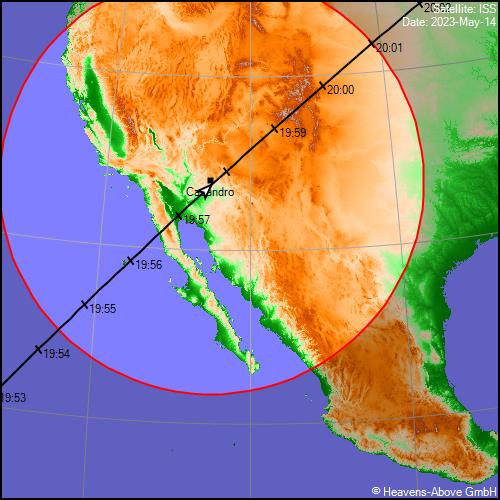
One of our activities is, and has been for quite a while (since living in California) watching the International Space Station fly over when visible. Last Sunday night’s pass was quite a treat in that it had nearly everything going for it: cloudless skies, convenient timing and an almost direct overhead pass.

In the image above, you can see the ground track of the ISS as it passed over the Southwestern US. The maximum predicted elevation for this particular pass was 88° which barely missed our exact location to the southeast, but watching the fly-over, one could not perceive any difference from a direct overhead pass. Image credit Heavens Above.

Another attribute that is not always the case during a pass is that the ISS remained sunlit during the entire pass. We live in a slight hollow below surrounding terrain and saw the ISS rise in the southwest above some local hills and it few over us and set in the northeast behind some other terrain. We always enjoy watching the ISS and other satellites flying over, but this one was unusually spectacular.

Solar Astrophotography

In anticipation of the Annular Solar Eclipse on October 14, 2023, I got out the Canon SL1 camera and associated accessories to photograph the solar disk. I used the Canon EF 100-400mm lens along with a Thousand Oaks Optical threaded SolarLite® filter to get the (clickable) image above. I had to experiment with the camera settings to get the image and further had to adjust it using a photo processing app.

The setup resolved the solar disk and a couple or three sunspots currently visible; the two larger sunspots visible are 3297 and below that 3294. Those numbers are according to SpaceWeather.com.

As I mentioned above, I had to experiment with the camera settings a bit. Using the camera’s Programmed (P) setting, the images were overexposed. I switched to the shutter speed priority setting and tried several exposure times from 1/1000 second, 1/2000 second, and 1/4000 second. The latter, which is the fastest shutter speed on the camera, captured enough of the details needed to produce the image seen above and will certainly be good enough for the annular eclipse. For the total eclipse in April of 2024, it will be necessary to remove the attenuating filter during totality in order to capture the details of the solar limb and the spectacular appearance of the solar corona.

Tutankhamun Tomb
100th Anniversary

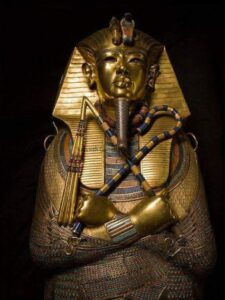
Today, February 16, 2023, marks the 100th anniversary since 20th Century Archaeologist Howard Carter opened the inner tomb of the renowned Pharaoh Tutankhamun. The following is from Art Net

Despite discovering King Tutankhamun’s tomb in late 1922, it took several months for archaeologists to work their way through and catalogue the contents within the outer chambers. On February 16, 1923, Carter finally came face-to-face with the doorway leading to the tomb’s inner burial chamber and unsealed it. What he and his team were met with was the most well-preserved and intact pharaonic tombs ever found. Over the following eight years, the items and goods contained therein were carefully catalogued and removed, and today are held in the collection of the Egyptian Museum in Cairo.

Damsel and I are interested in all things Ancient Egypt and we were able to see many of the King Tutankhamun artifacts in 2005 on display at the Los Angeles County Museum of Arts (LACMA).

From Wikipedia:

Tutankhamun was the antepenultimate pharaoh of the Eighteenth Dynasty of ancient Egypt. He ascended to the throne around the age of nine and reigned until his death around the age of nineteen. Historically, Tutankhamun is primarily known for restoring the traditional polytheistic ancient Egyptian religion, after its suppression by Akhenaten in favor of the Atenist religion. Also, Tutankhamun was one of few kings worshipped as a deity during his lifetime; this was usually done posthumously for most pharaohs. In popular culture, he is known for his vastly opulent wealth found during the 1922 discovery of his tomb, KV62, the only such tomb to date to have been found in near-intact condition. The discovery of his tomb is widely considered one of the greatest archaeological discoveries of all time.

One might have thought that after Moses led the Hebrew Slaves out of Egypt that Pharaoh Rameses would get a clue about who Almighty God really is and should have passed it down to the masses in Egypt, but I guess I give Rameses too much credit; he remained clueless.