Two Types of Fishhook Cactus Flowers

Mammillaria sheldonii

Mammillaria yaquensis

Both of these cacti have open flowers today. On top, open in the back patio area, is a local native mammillaria sheldonii fishhook cactus we rescued from a construction area down the road a year or two ago. Below, open in the courtyard out front is a mammillaria yaquensis fishhook cactus that was a gift from our friend Crotalus.

Click on either image to enlarge.

Update: Crotalus advises us that the top panel specimen might actually be mammillaria tetrancistra. The one we quoted above typically is found only in Mexico.

Genealogy Research Nets a Treasured Photo

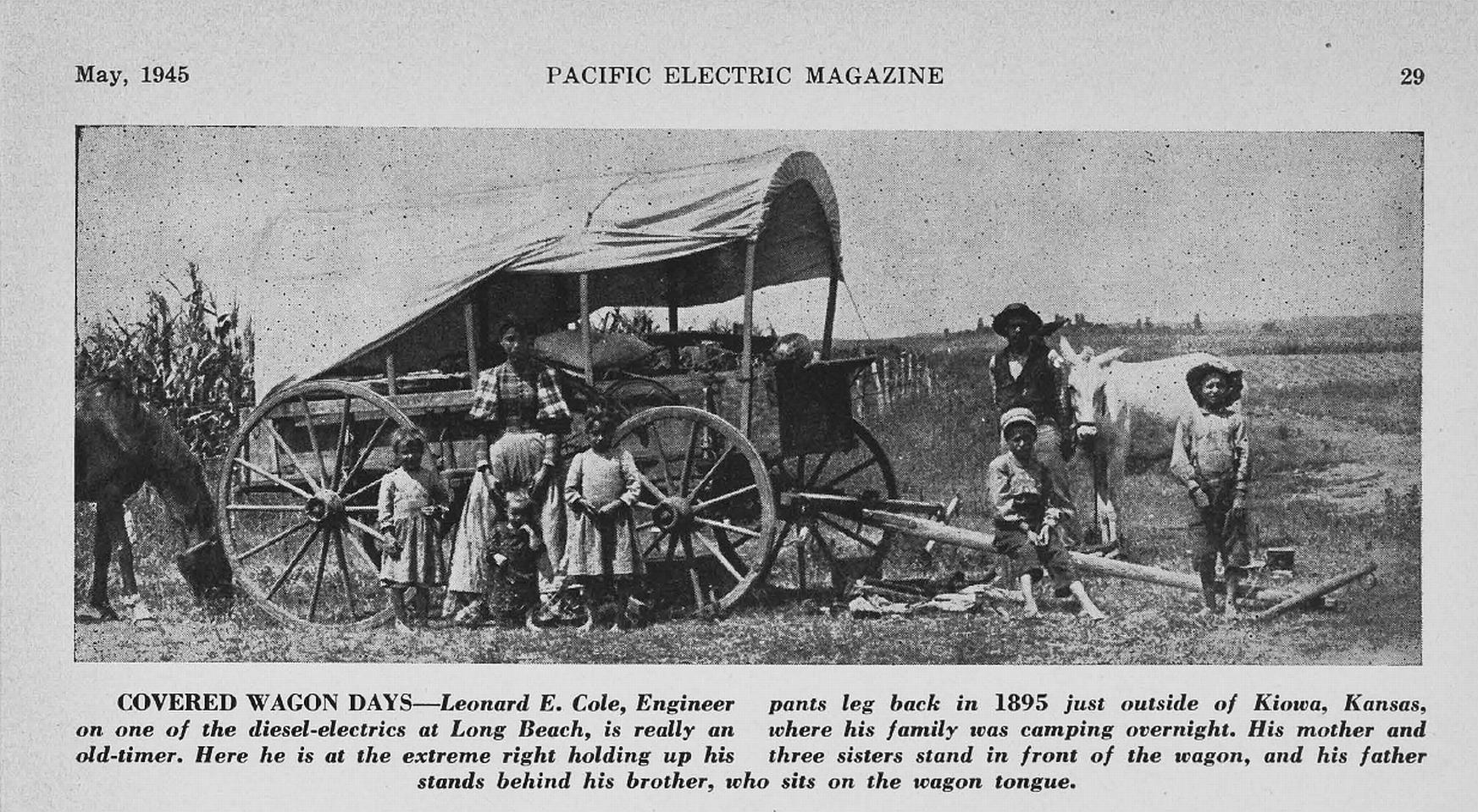
Prairie Schooner

Having made the decision to locate and visit the graves of some of our ancestors before and after the eclipse, we have been doing some research using several genealogy websites. We have plans to visit two different cemeteries in Colorado during our excursion; one in Montrose, Colorado and another in Pueblo, Colorado. Thus far, we have located a dozen family graves to visit. Five of those family are direct ancestors.

Someone unknown to me uploaded a similar image to the one above to one of the research sites I visited. The uploaded image was crooked and cropped such that I couldn’t read the entire message below it, so I did some additional digging and found a photocopy of the original magazine in which the image appeared and was able to render the improved image seen above.

The image itself appeared in a company magazine of the Pacific Electric Railway in 1945. My grandfather, the kid on the right, was an engineer on the line back then. The couple with the wagon, mules and kids were my great grandparents, Eugene and Emma. The other kids in the photo are my great uncle Clark and great aunts Melissa, Bernice and Myrtle. I remember visiting a farm in Western Colorado as a kid and meeting Great Aunt Myrtle. I knew my great grandmother Emma and in fact attended her funeral in Montrose in 1960.

I have to say that it was a very pleasant surprise to discover this ancient photo in my research. Click on the image to enlarge (use the scroll bars to view the complete photo).

Eastern Pacific Tropical Weather

TS Dora

A large part of the elements that contribute to our summer monsoons here in Sonoran Arizona is the influence of Eastern Pacific Ocean tropical activity. When storms form west of Mexico and move northwestward (as they usually do), they introduce a flow of tropical moist air across the southwest. The counter-clockwise circulation around the storms forces moist air northward in the lee of the storm’s movement.

Currently, Tropical Storm Dora, which is forecast to become a hurricane by tomorrow, is moving west-north westward into the Pacific Ocean. Dora, seen just to the north of the inter-tropical convergence zone (the horizontal string of clouds near the bottom of the image above), is already pumping large amounts of moisture across Honduras, the Yucatan and much of Southern Mexico. As the storm moves away from the land mass, it will probably start pumping some of that moisture northward.

In July of 2015, Tropical Storm Danielle was responsible for a northward flow of tropical moisture that resulted in a severe monsoon over our area that dropped over five inches of rain in less than two hours. The Casandro Dam catch basin filled to capacity, the washes and Hassayampa river were all in flood stage. Hopefully, Dora will drift westward and not be a problem for us.

Summer Solstice

Solstice

Today marks the official first day of summer, although the summer weather starts sooner than that in Sonoran Arizona. We have been under the same heat wave as most of the west, except a tad warmer than a lot of places. Our temperature was 117° yesterday with cooler (only 114°) predicted for today. As a bonus, you can bank on the Greenbat Cultists calling that we are all gonna die and mankind is to blame. As DrJim points out, “we learned about this in school – it was called ‘seasons.'”

Speaking of solstice, there is an interesting image on today’s APOD: a Solstice Sun Dial that spells out SOLSTICE only on this day.

The graphic above courtesy of Archaeoastronomy.com.

Eclipse Animation

This nice animation of the August 21st Eclipse across America showed up on Astronomy Picture of the Day today. It is less than a minute in length and is a good graphic illustration of the path of totality.

The embedded video can be set to full screen for enlargement.

After the video finishes, there is another interesting video follow-up that animates the shadow of the moon as it crosses the country. You can see in detail where totality occurs with the shadow video.

Countdown to the Great American Solar Eclipse

The countdown has been underway here for almost five years since we first made our reservations at the RV campground near the centerline of the eclipse in Wyoming. Now, however, we’re down to the last few weeks before the big event. The Javascript countdown timer above shows the remaining time to the start of the eclipse (first lunar encroachment) in Arizona Time.

The date of the eclipse is August 21, 2017. The beginning of the eclipse is dependent on the location of the observer, but in our case is 16:22:20 UTC, The seven hour difference has been adjusted in the timer. Totality follows a bit over an hour later. The interactive eclipse map has moved to the NASA Eclipse pages:

https://eclipse2017.nasa.gov/sites/default/files/interactive_map/index.html