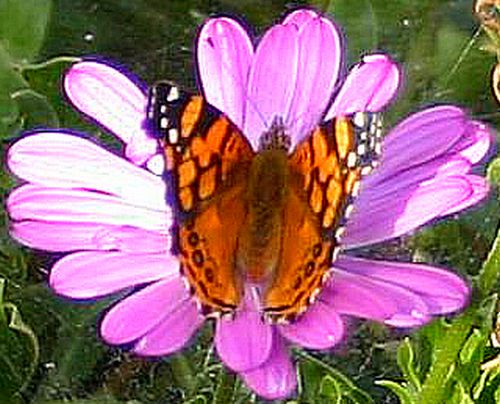
Yes, this is a butterfly on a daisy in our yard in December.

This from the Salvation Army Newsletter:
The Story Behind the Red Kettles…
The Salvation Army Captain in San Francisco had resolved in December of 1891 to provide a free Christmas dinner to the area’s poor. But how would he pay for the food?
Suddenly, his thoughts went back to his days as a sailor in Liverpool, England. On the Stage Landing he saw a large pot, called “Simpson’s pot†into which charitable donations were thrown by passers-by.
On the next morning, he secured permission from the authorities to place a similar pot at the Oakland ferry landing, at the foot of Market Street. In addition, a brass urn was placed on a stand in the waiting room for the same purpose. Thus, Captain Joseph McFee launched a tradition that has spread not only throughout the United States, but throughout the world.
By Christmas, 1895, the kettle was used in 30 Salvation Army Corps in various sections of the West Coast area. Shortly afterward, two young Salvation Army officers who had been instrumental in the original use of the kettle, William A. McIntyre and NJ Lewis, were transferred to the East. They took with them the idea of the Christmas kettle.
In 1898, the New York World hailed The Salvation Army kettles as “the newest and most novel device for collecting money.”
Everywhere, public contributions to the kettle enable The Salvation Army to bring the spirit of Christmas to those who would otherwise be forgotten – to the aged and lonely, the ill, the inmates of jails and other institutions, the poor and unfortunate. In the United States, The Salvation Army annually aids more than 5 million persons at Thanksgiving and Christmas.
Behind it all, though, is the same Salvation Army message, “Sharing is Caring.â€
These delicate blossoms emerge every winter from the Christmas Cactus.

Bill Clinton has no more business addressing the UN Climate Conference than he has for educating teenage girls about sex.
Montreal (CNSNews.com) – Former President Bill Clinton is expected to address the U.N. Climate Change Conference on Friday, the final day, after the Sierra Club reportedly raised the money to pay for Clinton’s trip.
Clinton’s visit is intended to help draw more media attention to the U.N. meeting and to pressure the U.S. delegation to make more concessions on climate issues, according to the Canadian Press.
Bush administration officials reportedly were “annoyed” that Clinton chose to come on the last day of the conference to try to influence the negotiations, according to the Associated Press.
Read Bill Clinton Heats Up UN Climate Conference — 12/09/2005 at CNS News.
Also read Flat Earth, Hurricanes and Global Warming for our perspectives on this issue.
This may be of particular interest to those of us living near seismically active areas. Interpretation of microseismic emission precursors may represent a possible breakthrough on earthquake prediction:
Prelude to an Earthquake?
A geophysicist from the U.S. Department of Energy’s Lawrence Berkeley National Laboratory (Berkeley Lab) has identified possible seismic precursors to two recent California earthquakes, including the 1989 Loma Prieta earthquake that wreaked havoc throughout the Bay Area.
After sifting through seismic data from the two quakes, Valeri Korneev found a spike in the number of micro-earthquakes followed by a period of relative calm in the crust surrounding the quakes’ epicenters — months before the quakes occurred. Although more work needs to be conducted to determine whether other large quakes are foreshadowed by a similar rise and subsequent decline in small-magnitude tremors, Korneev’s analysis suggests that these peaks may be indicative of the total set of geological stresses that affect the timing and location of large earthquakes. Understanding this total stress picture may eventually make it be possible to predict destructive earthquakes within a much shorter time frame than currently possible.
Photo: 1989 Quake Damage to Interstate 880 – S.F. Chronicle
Peaks in seismic activity in the crust surrounding a fault could help signal the arrival of large earthquakes,†says Korneev of Berkeley Lab’s Earth Sciences Division. “These peaks may be a good mid-term precursor and allow authorities to declare alerts several months before earthquakes.â€
Read the rest of the article at Science Blog: Prelude to an Earthquake?
Not much to say about this, other than I drove out of my way going home this evening to get this shot from Hermosa Beach.
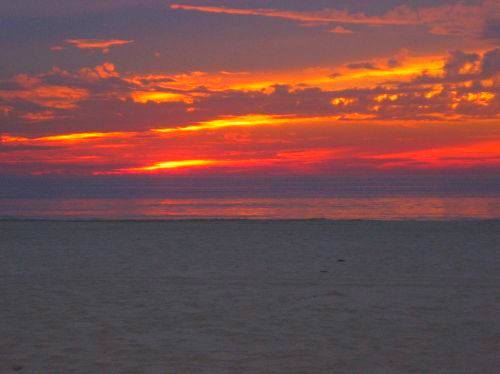
Update: What I wouldn’t do for art! My detour made me late for happy hour with Damsel . . . I think it was worth it.
There was a glitch at our ISP today; the power went off for five minutes and after the backup came on it took another 45 minutes to recover/restore. Apologies if you weren’t able to connect.
It also affected the Never Forget graphic which is seen on many sites. Sorry for any problems it may have caused you.