Nostalgia

Operation Overlord 81st Anniversary

Image credit: deviantart.com.

Operation Overlord: A Turning Point in World History

Operation Overlord was the codename for the Allied invasion of Nazi-occupied France during World War II. It took place on June 6, 1944, also known as D-Day, and marked a significant turning point in the war. The operation involved a massive airborne assault and amphibious landing on five beaches along a 50-mile stretch of the Normandy coast.

The invasion was carried out by a coalition of American, British, Canadian, and French forces, with the goal of liberating Western Europe from German occupation. The operation involved over 156,000 troops, 5,000 ships and landing craft, and extensive air support. The Allied forces faced fierce resistance from German troops, but ultimately secured a foothold on the continent. The successful execution of Operation Overlord paved the way for the eventual defeat of Nazi Germany and the end of World War II in Europe.

After all of the blood treasure lost during the “Crusade in Europe,” it is a damn shame that many of the “liberated” European countries have gone to the hard left and are again flirting with socialist policies that generally have doomed nations in the past. Combine that tendency with the influx of foreign (read Islamist) insurgents to further endanger the citizenry to “intifada.”

We pray daily for the Almighty to temper the growth of the invasion and to restore freedom and for those nations to eject the invaders.

On this anniversary of D-Day, we will be remembering the efforts of the western nations and our USA Armed Forces to liberate Europe from the evils then, and praying for those nations to regain the liberty that they were given by the sacrifice of so many who believed in restoring their freedom in 1944.

USS Brooklyn March 1943

Eighty-one years ago, during WWII, in Casablanca harbor, my father was stationed aboard the USS Brooklyn as an Electrician’s Mate, Second Class. Dad went on to become a Chief Warrant Officer in the US Navy.

USS Brooklyn CL-40 in Casablanca harbor – March 1943

The first of the nine Machine Gun Cruisers*, USS Brooklyn was commissioned in September 1937. With a primary armament of fifteen 6”/47 guns in five triple turrets, each 6”/47 gun had a maximum rate of fire of 8-10 shells a minute. Theoretically, a Brooklyn-Class cruiser could fire a total of 120-150 6” rounds a minute at a target.

USS Brooklyn survived WW2 and was put into reserve in 1946, in 1951 she was transferred to Chile, where she was renamed O’Higgins. Serving for 40 years in the Chilean Navy, she was sold for scrap in 1992, but foundered and sank while under tow to shipbreakers in India. One of her 6”/47 turrets is preserved at the Chilean Navy base at Talcahuano.

LIFE Magazine Archives – J R Eyerman Photographer

*Machine Gun Cruisers typically refer to naval vessels equipped with multiple machine guns for anti-aircraft and anti-small craft defense. The Brooklyn-class cruisers, for example, were armed with several M2 Browning machine guns alongside their main artillery, enhancing their combat capabilities during World War II.

I find the installation and use of the .50 BMG M2 Machine guns to be particularly interesting:

The .50 Browning Machine Gun (BMG) round is one of the most widely used service ammunition. Also known as the .50 Browning and the 12.7x99mm NATO, it is currently listed as military ammunition for the U.S. and at least 30 other countries. However, civilian shooters also enjoy .50 caliber shooting – using this rifle round for long-range hunting and shooting competitions. Developed in the early 1900s by John Moses Browning, the .50 BMG is a scaled-up version of the .30-06.; No stranger to military and law enforcement use, .50 BMG ammo has been fired from WWII fighter aircraft and is still used today on helicopters and ground vehicles.

Once the DOJ and the SCOTUS gets off their collective asses and removes the infringements on ALL firearms and accessories, we might want to own one of those. The ammo, however, is quite expensive and could burn through your weekly allowance in one quick hurry when you go down to the range to have some fun.

Canon Powershot
  A710-IS Retirement

After almost 18 years, I’m finally retiring my Canon Powershot A710-IS Camera. This venerable little photo workhorse has served me for all these years as a pocket-sized take-along camera as well as being available at my office desk for impromptu photo needs in the house.

The A710-IS is actually a very sophisticated little camera with features such as 6x optical zoom, image stabilization and a host of modes and other features. Frankly, it has survived other small cameras, which have come and gone, that I tried out in the past. One feature I liked is an optical viewfinder, which is largely unavailable among pocket-sized units these days.

The camera is being retired for a couple of reasons – 1) it had fallen into disuse since I carry my phone/camera most of the time and use it for those occasions where I may have used the little Canon. 2) I took it up on the hill where the birdfeeders are located and attempted to photograph a squirrel up there, but got an overexposed image.

I will miss the little camera which has already been in the Canon Museum of Retired Cameras and Accessories for a long time now. It’s now in the little box where electrical and other disposables repose until the next free dump day sponsored by the Town of Wickenburg.

2024 Cops Who Care
   Classic Car Run

Damsel and I attended the annual “Cops Who Care” Toyz for Totz Car Run and Show today. We were early, and the entire field had not yet shown up, but since we were both a little under the weather, we did not stick around too long. However, Between Damsel’s Camera and my Samsung phone, we managed a few good shots of some of the action.

First, who can remember 55¢ Big Boys and 30¢ shakes from Bob’s Chain in the 60s? Good times.

And how about this good lookin’ 1957 Ford Panel Truck?

And there were many other old classics, most notably this old red and yellow roadster …

… and a seldom seen REO roadster. Click on any image to enlarge.

Before leaving, we deposited a couple of unwrapped toys for the kids that benefit from the Car Run.

Beyond Infamy — 83 Years ago

December 7th is the date we post about when it comes around each year, because we choose not to forget “a date that will live in infamy” and because of the massive historical significance of the surprise attack on the US Fleet in Pearl Harbor. Not only that, but the effect that it has had on the lives of many of us that lived during that era and the memories we have of it. My memories are kind of limited, since I was actually born after 1941, so we can discuss those perhaps on the next December 7th — or the one after it.

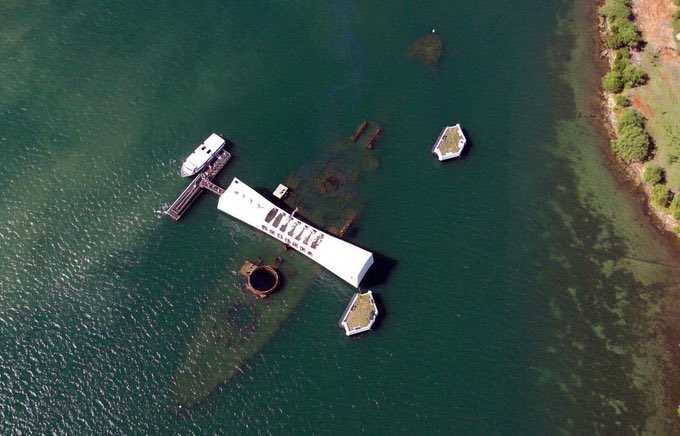
The image above (found somewhere on the internet), is another aerial view of the final resting place of the USS Arizona at Pearl Harbor. What I did not know until I did some research for today’s post, was that some of the assets of the Arizona went on to provide support in the ongoing war in the Pacific after the initial bombing.

From the National WWII Museum of New Orleans:

USS Arizona’s Last Salvo

Famously, the battleship USS Arizona (BB-39) was only in combat for minutes before a Japanese armor-piercing bomb struck the ship’s forward magazine, causing an explosion that devastated the “super-dreadnought” and killed 1,177 officers and crewmen. The hulk of the vessel, battered and burned, became a symbol of the December 7, 1941 attack on Pearl Harbor.

While other warships at Pearl Harbor were recovered and refitted, the Navy quickly abandoned the idea of reviving the Arizona in its entirety. But crews worked on the wreck for months, removing equipment, cutting away mangled metal, searching for bodies, and reclaiming weaponry.

The report goes on to describe the salvage and reassignment of some of Arizona’s armament for use by the Territory of Hawai’i and other US Naval vessels.

On this day, we pause to reflect on the lives lost, the resolve of the American people and to thank the Lord above for the eventual outcome of the conflict. We further pray that in these times of reckless global policies of the US that the incoming administration may stay any further escalation of war or other forms of terror on the American people.

Service Record Post Part 4
  Avionics Line and Shop


In the previous chapter of my Naval Aviation saga, I finally advanced to my billet of Avionics Technician at the Targets and Drones Avionics Shop. At last, I was working alongside my friend and original sponsor that got me assigned to the Targets Department, Emmett.

After transfer to the Avionics Shop, I was assigned as a line troubleshooter and repair technician. My job was to remove and re-install avionics radios and other equipment from the aircraft on the line. The technicians in the shop and the aircraft maintenance schedules kept me pretty busy with that assignment.

Eventually, since I had the coveted Navy Driver’s License, the Chief Petty Officer over the shop put me in charge of the two “Fox Vans” which were a part of the shop’s maintenance responsibility. The vans were Large (think Class A RV) and contained the electronics for remote control of the drone aircraft as well as a large diesel generator to power all the equipment.

I kept the vans fueled up, ran up the generators once a week and drove the vans with the pilots aboard when they were remotely launching and landing the QF9G drone aircraft from the airfield. For safety of the airfield and its personnel, these operations always had a pilot on board the drones just in case something went wrong with the remote systems. NOLO (No Live Operator) operations were restricted to the Auxiliary Field on San Nicholas Island, 60NM south of Point Mugu. “Saint Nick” is an unpopulated island save for the limited base personnel that stay there. The island had their own Fox Vans.

It was at this time that I became senior enough to upgrade from ATNAN to ATN3 or Airman Avionics Technician Navigation Striker to Airman Avionics Technician Third Class Petty Officer. I passed the exams and got the new stripes plus a “hash mark” on my sleeve, since I now had four years as a sailor. A Hash Mark is awarded for each four years of service, including Navy Reserve time. I enlisted in 1960 and it was now 1964.

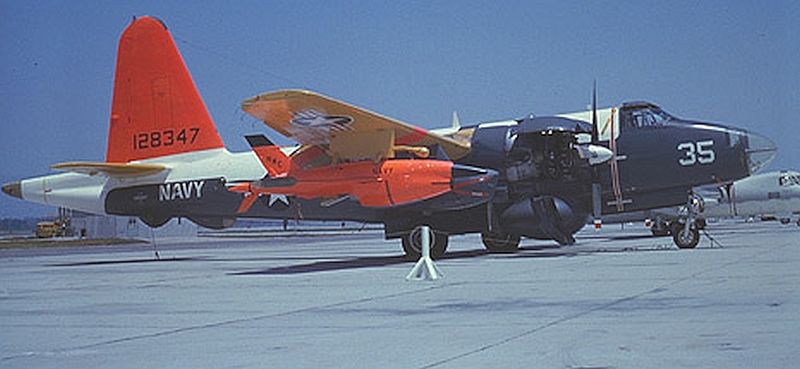
Concurrently with my Fox Van duties, I was also qualified to be an aircraft crew member, so I started earning “Flight Skins” as a crew member. “Skins” refers to hazardous duty pay which is in addition to the regular paygrade. Although I managed to serve as crew for several different aircraft on the base, I am particularly proud of my service as radioman on many missions aboard our drone launch aircraft, a Lockheed P2V Neptune converted from submarine detection and combat to launch the Ryan BQM-34A (Q2C) Firebee Drone, which was a pilotless drone also managed by our department.
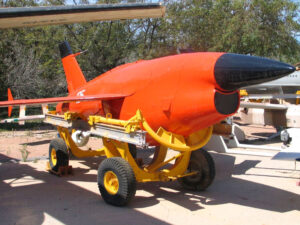
A typical Firebee launch mission would be to fly downrange (over the Pacific Missile Range) and at some designated point, fire up the drone’s jet engine, release the drone (under remote control from the PMR HQ) and bank the aircraft hard away from the Firebee as it proceeds further downrange to be shot at by the target mission aircraft.

Most of the time, however, the drones would survive and splash down somewhere in the area only to be recovered by an old classic H-34 Sikorsky Wright Cyclone Radial Engine Powered rescue Helicopter. I had the opportunity to fly in the left seat of one of these recovery missions. What a blast!

The image at the top of the article is our P2V with a Firebee Drone attached and ready to fly. Click on either image to enlarge.

So that tells some of the story of those days after the Vietnam conflict had begun, but not yet in full swing. I finished my obligation on active duty and mustered out into the civilian world and pursued a career in aerospace engineering in which I not only supported the conflict overseas, but also space programs and many other technological improvements to the state of the art in electronics and software.

Footnote: I mentioned that my Ham Radio pal, Emmett, was involved in getting me assigned to the Targets division, but we were both involved in the Radio Club at Point Mugu, K6CST. Although I only had a Technician Class License at the time, I was able, under the supervision of the Club’s Lead PO, a General Class Ham, to learn and operate the Club’ various stations including RTTY HF, VHF/UHF, SSB HF, CW HF and more. Local Hams in the Oxnard/Ventura/Camarillo area were also involved in the Radio Club. It was a good camaraderie with those old guys, many of whom are now gone to the Savior. I still miss them.

This concludes the story of that part of my life in the service of our Nation as a young buck willing to take the risks of being a part of the Nation’s defense. I hope you enjoyed the story. God Bless.

Service Record Post Part 3
  Naval Missile Center

In the second installment of my Navy experience, I alluded as to how I may have had a hand in getting my ultimate assignment to the Targets and Drones Department at the Naval Missile Center. Well, one of the Avionics Techs assigned to Targets was none other than a ham radio acquaintance from my earlier days involvement in the radio hobby in the western Los Angeles County area, Emmett, WA6COT (SK). Emmett found a way to influence the Master Chief Petty Officer, Chief Stringham, to select my name from the list of sailors becoming available in mid-1962. I was assigned to the Targets and Drones flight line as a result.

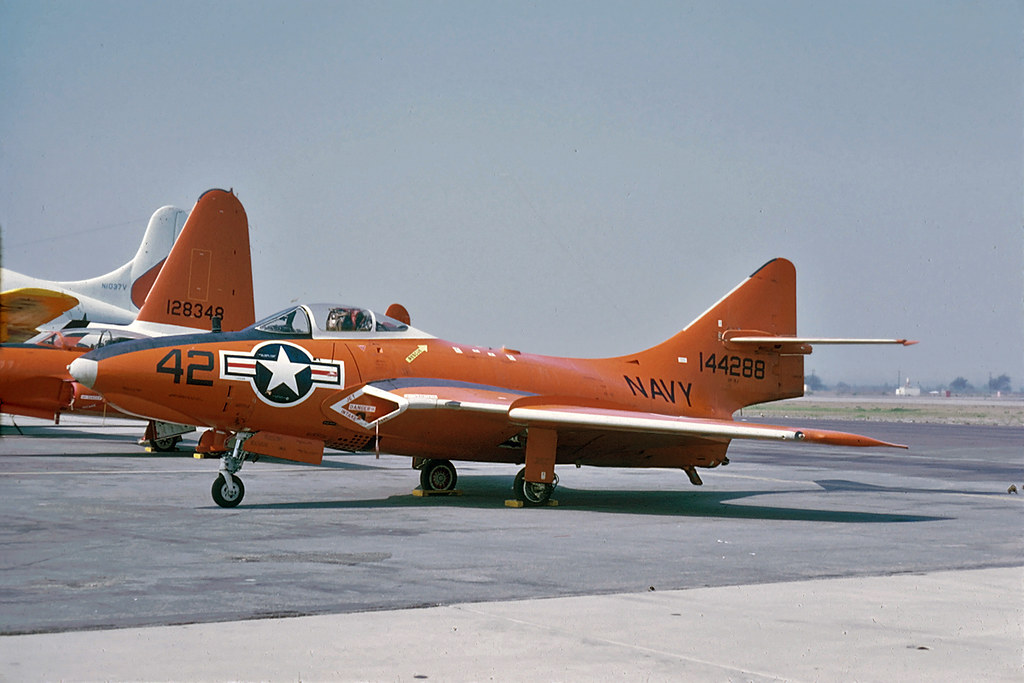
The flight line at the Targets Department had two categories of aircraft; looking from the line shack, on the left were “chase” aircraft equipped with remote control systems for the drones, and on the right were the drones themselves, several QF-9G Drone Aircraft. Better known as the Grumman Cougar, these planes were brightly colored with red-orange fluorescent paint, thereby identifying them as drones.

When I checked into the line shack for duty, the chief petty officer in charge assigned me to be a driver, since I was then 20 years old which was enough to qualify for a Navy drivers license. I became qualified to run the various tow tractors and utility vehicles on the line. I also qualified for several other vehicle types including fork lifts, NC-5 mobile power generator carts and what the Navy referred to as a “fox-van” which contained the remote control equipment used for piloting departures and arrivals of drone aircraft.

I spent several months on the Targets Aircraft line tending to the “fleet” of vehicles on the line which I had been put in charge of seeing to their fuel, maintenance and usage. There was an event that took place during my time on the line that was very significant in the history of the USA – the assassination of President John F. Kennedy. For several days prior to JFK’s interment, the base played dirges and other grim music over the 1-MC (public address system). We were sad to hear of the death of the Commander in Chief, but were glad when things got back to normal.

The last few weeks on the aircraft line, I was commissioned as a “plane captain” for one of the QF9G drones and became responsible for this particular airplane to keep it clean, maintained and ready for operation by a live pilot on the airfield. NOLO Operations (no live operator), were restricted to our auxiliary Naval Air Base on San Nicolas Island located 60 NM due south of Point Mugu.

The next (and final) chapter of my service record will account for the time spent as an avionics technician assigned to my actual training as an Aviation Technician Navigation Striker in the avionics shop. Stay Tuned.