USS Brooklyn March 1943

Eighty-one years ago, during WWII, in Casablanca harbor, my father was stationed aboard the USS Brooklyn as an Electrician’s Mate, Second Class. Dad went on to become a Chief Warrant Officer in the US Navy.

USS Brooklyn CL-40 in Casablanca harbor – March 1943

The first of the nine Machine Gun Cruisers*, USS Brooklyn was commissioned in September 1937. With a primary armament of fifteen 6”/47 guns in five triple turrets, each 6”/47 gun had a maximum rate of fire of 8-10 shells a minute. Theoretically, a Brooklyn-Class cruiser could fire a total of 120-150 6” rounds a minute at a target.

USS Brooklyn survived WW2 and was put into reserve in 1946, in 1951 she was transferred to Chile, where she was renamed O’Higgins. Serving for 40 years in the Chilean Navy, she was sold for scrap in 1992, but foundered and sank while under tow to shipbreakers in India. One of her 6”/47 turrets is preserved at the Chilean Navy base at Talcahuano.

LIFE Magazine Archives – J R Eyerman Photographer

*Machine Gun Cruisers typically refer to naval vessels equipped with multiple machine guns for anti-aircraft and anti-small craft defense. The Brooklyn-class cruisers, for example, were armed with several M2 Browning machine guns alongside their main artillery, enhancing their combat capabilities during World War II.

I find the installation and use of the .50 BMG M2 Machine guns to be particularly interesting:

The .50 Browning Machine Gun (BMG) round is one of the most widely used service ammunition. Also known as the .50 Browning and the 12.7x99mm NATO, it is currently listed as military ammunition for the U.S. and at least 30 other countries. However, civilian shooters also enjoy .50 caliber shooting – using this rifle round for long-range hunting and shooting competitions. Developed in the early 1900s by John Moses Browning, the .50 BMG is a scaled-up version of the .30-06.; No stranger to military and law enforcement use, .50 BMG ammo has been fired from WWII fighter aircraft and is still used today on helicopters and ground vehicles.

Once the DOJ and the SCOTUS gets off their collective asses and removes the infringements on ALL firearms and accessories, we might want to own one of those. The ammo, however, is quite expensive and could burn through your weekly allowance in one quick hurry when you go down to the range to have some fun.

Tate

Welcome to our *fifth* great grandchild, Tate. He was born on the 2nd of March in Sacramento, California, to our youngest granddaughter and her husband. Tate is the first child to be born to the couple.

Our other four great grandchildren ranging in age from five to ten years, are also in California, in and around the Santa Rosa area. Two boys belong to our eldest granddaughter living in Windsor and two girls belong to the middle of the three granddaughters living in Rohnert Park.

We have met and held the three older kids, but have yet to see the younger two in person. Perhaps in our upcoming travels we may finally get to see them all.

Both photos above were taken of Tate with his mom before coming home from the hospital. Click on either image to view enlarged.

Panoramic Images

Panoramic Image of Our House

Earlier this month, I retired my venerable Canon Powershot A710IS Camera and started using my newer Kodak PIXPRO FZ152 Camera. The older camera had roughly 18 years on it and after it got retired, I started using the newer camera. The newer camera, it turns out, had more features that I didn’t know about because I used it so seldom. Lo and behold, there is a “panoramic image” mode.

To make panoramic images using the FZ152, one must select the proper mode and shooting left to right (other direction optional) snap three or four images as you move the camera. There is a “ghost” image of the preceding image that helps the user to align the camera. When done, select the “SET” button and the camera begins to “stitch” the images into a single elongated image — a panoramic image.

I am still learning how to use the panoramic image mode, although some of the image results from following the procedure have been disappointing, with visible disconnects in the continuity of the image. I thought I was using the proper procedure and got the result seen below:

Discontinuity example

As you can see, the right half of the panned image jumps from a place in the middle of the house to repeating (in a distorted fashion) the same image segment going to the right. The image is not useful except to demonstrate the problem.

I guess I am spoiled by having had a really good Canon Utility in the past that would render panoramas from several images with very good results, even with marginally acceptable images. Unfortunately, that utility stopped being supported and did not work with later versions of Windows subsequent to about seven years ago or so.

I will keep trying to get panoramas with the Kodak Camera in the future, but I may opt for a Photoshop ($$$) utility to do the things I used to do with ease and for free with the Cannon App.

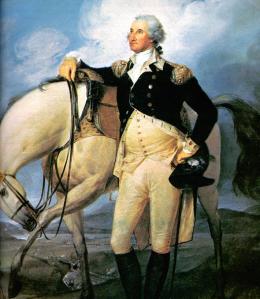
Washington’s Birthday

We still honor the Father of the Country, George Washington, on the Anniversary of his birth, February 22nd. The following is edited from our post of Washington’s Birthday back in 2010.


Today is the anniversary of the birth of George Washington, the first president of the United States, and the Commander-in-Chief of the Continental Army during the Revolutionary War.

From WikiPedia:

gw.jpgGeorge Washington (February 22, 1732 – December 14, 1799) served as the first President of the United States from 1789 to 1797 and as the commander of the Continental Army in the American Revolutionary War from 1775 to 1783. Because of his significant role in the revolution and in the formation of the United States, he is often referred to as “Father of His Country”.

The Continental Congress appointed Washington commander-in-chief of the American revolutionary forces in 1775. The following year, he forced the British out of Boston, lost New York City, and crossed the Delaware River in New Jersey, defeating the surprised enemy units later that year. Because of his strategy, Revolutionary forces captured the two main British combat armies at Saratoga and Yorktown. Negotiating with Congress, the colonial states, and French allies, he held together a tenuous army and a fragile nation amid the threats of disintegration and failure. Following the end of the war in 1783, King George III asked what Washington would do next and was told of rumors that he’d return to his farm; this prompted the king to state, “If he does that, he will be the greatest man in the world.” Washington did return to private life and retired to his plantation at Mount Vernon.

For those who still recognize this day in honor of our first president, have a very Happy Washington’s Birthday!

Spring Song

This 10 second video is of a Curve-Billed Thrasher singing what sounds like a mating call. It’s not the usual loud “weee-weet-tweet” that we hear during other times of the year. Could it be that we’re getting an early spring about four weeks ahead of schedule? The forecast for our part of Arizona calls for 80° temperatures by the weekend.

AS you can see from the video, holding the camera steady at 250mm zoom is difficult without a bi- or tripod. I made this video today with my Canon EOS Rebel SL3 and the EF 55-250mm lens. I am still experimenting with and getting used to making videos with the Canon camera.

Lincoln’s Birthday

Today, we celebrate the 216th anniversary of President Abraham Lincoln’s birth. He was only 56 at the time of his death at the hands of an assassin. His memory lingers, however, and despite having his birthday celebration clumped in with other, lesser presidents on President’s Day, many of us still honor him as one of the greatest presidents.

The Formative Years Lincoln Penny (pictured above) shows Lincoln’s familiar portrait on the “heads” side of the coin, and the young Lincoln sitting on a log reading on the “tails” side. The 2009 Formative Years Lincoln cent design represents Lincoln’s life, when he was a rail splitter, from 1816-1830 in Indiana. This is the second of four different reverse designs issued in 2009 for the Lincoln cent coin on the bicentennial of his birth. Now that minting of pennies is to be discontinued, the collectors’ value of these coins will doubtlessly climb.

Click on the penny image to enlarge.

Finches

This is a photo of one of the Nyjer Seed feeders in the back yard intended to attract Finches. You can see it was doing its job this morning when I snapped the photo.

On the left side of the feeder (stage right) is a House Finch, the male of the species. House Finches are commonly seen throughout the U.S. and Mexico, with some excursions north of the U.S. border.

The smaller Lesser Goldfinches are seen on the right and bottom of the feeder. This variety of Goldfinch ranges across much of the Southwest U.S. and Mexico. They seem to be permanent residents here in the Sonoran Deserts of Arizona.

Both species of finch like to snack on the Nyjer seeds. The oily content of the seeds seems to be nutritious for the birds. We buy Nyjer seeds for the Finches and a mixed seed variety for the other birds that hang out here. Nyjer is quite a bit more expensive than the other seed mixes, but we think it is worth the investment in order to keep the finches coming around.

Click on the image to enlarge in the viewer.