Environment

Solar “Conveyor Belt” Speeds Up

This is an interesting article on the SOHO website. The speeding of the internal plasma circulation is connected with the deepest solar minimum in a century.

solar conveyorOne of the outstanding questions facing solar physicists is the origin of the solar magnetic cycle: What drives the 11-year sunspot cycle? We have just passed an extended and deep minimum, unlike any in the past 100 years. The late onset of the new solar cycle (#24) and the unusually deep minimum between cycles 23 and 24 took all experts by surprise, which suggests that there is a fundamental lack in our understanding of the origin of the solar activity cycle.

Image: Artist’s concept of the Sun’s meridional circulation, a large scale flow that transports solar plasma from the equator to the poles and back like a giant conveyor belt. Credit: Science@NASA

The Sun’s meridional circulation is a massive flow pattern within the Sun that transports hot plasma near the surface from the solar equator to the poles and back to the equator in the deeper layers of the convection zone, similar to a “conveyor belt”. The flow is rather slow, with typical speeds of 10-15 m/s (20 to 30 mph). The structure and strength of this meridional flow is believed to play a key role in determining the strength of the Sun’s polar magnetic field, which in turn determines the strength of the sunspot cycles. One class of dynamo models predicts that a stronger meridional flow produces weaker polar fields, whereas another class of models predicts stronger polar fields (and a shorter sunspot cycle) for the same flow. [more]

NASA Measures a 31 Inch Landshift

The 7.2 Baja earthquake of April 4, 2010 and numerous aftershocks have displaced the land around Calexico, CA, about 31 inches. From NASA:

NASA Radar Images Show How Mexico Quake Deformed Earth

PASADENA, Calif. — NASA has released the first-ever airborne radar images of the deformation in Earth’s surface caused by a major earthquake — the magnitude 7.2 temblor that rocked Mexico’s state of Baja California and parts of the American Southwest on April 4.

The data reveal that in the area studied, the quake moved the Calexico, Calif., region in a downward and southerly direction up to 80 centimeters (31 inches). The maps can be seen at: http://www.nasa.gov/topics/earth/features/UAVSARimage20100623.html .

A science team at NASA’s Jet Propulsion Laboratory, Pasadena, Calif., used the JPL-developed Uninhabited Aerial Vehicle Synthetic Aperture Radar (UAVSAR) to measure surface deformation from the quake. The radar flies at an altitude of 12.5 kilometers (41,000 feet) on a Gulfstream-III aircraft from NASA’s Dryden Flight Research Center, Edwards, Calif.

The team used a technique that detects minute changes in the distance between the aircraft and the ground over repeated, GPS-guided flights. The team combined data from flights on Oct. 21, 2009, and April 13, 2010. The resulting maps are called interferograms.

interferometry

Overview of the UAVSAR interferogram of the magnitude 7.2 Baja California earthquake of April 4, 2010, overlaid atop a Google Earth image of the region. Major fault systems are shown by red lines, while recent aftershocks are denoted by yellow, orange and red dots. Image credit: NASA/JPL/USGS/Google

Click on the image to enlarge.

(More)

Desert Colors

desert-colors.jpg

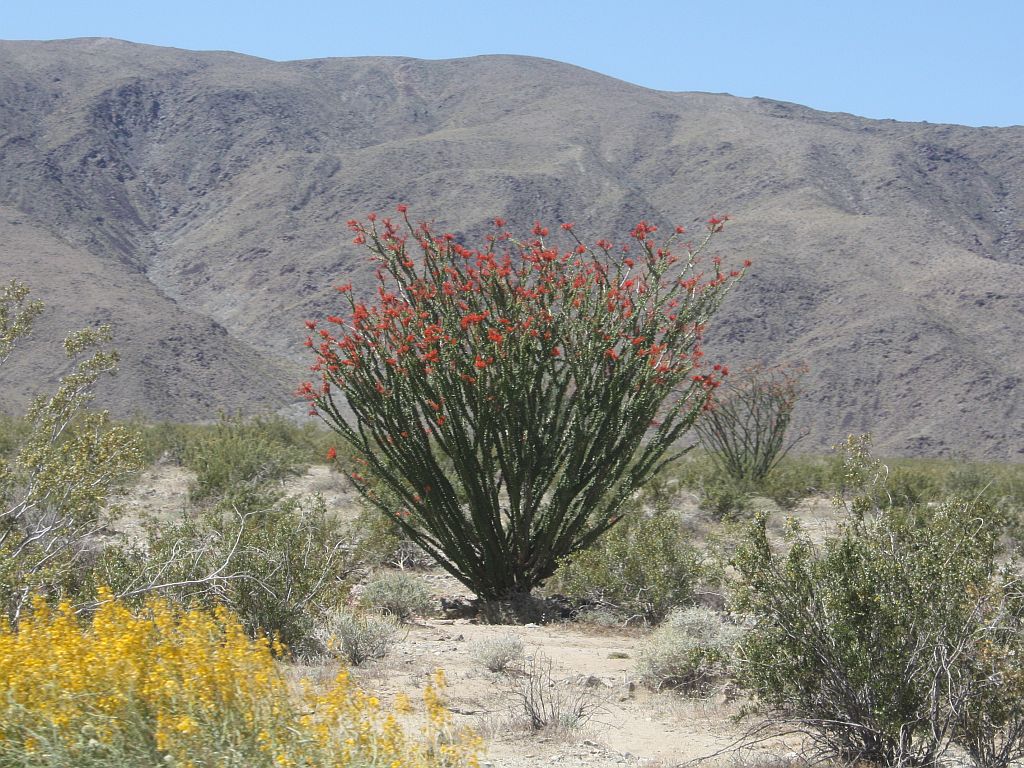
Crossing the desert in the springtime is a very colorful experience. The ocotillo and wildflowers in this photo offer a small sample of the variety of desert colors. Click on the image to enlarge.

Salton Sea from Keys View

We visited the Joshua Tree National Park today. As always when we come here, we drove to Keys View to see the spectacular panorama overlooking the Coachella Valley and Salton Sea. This photo (slightly enhanced to reduce the haze) shows the Salton Sea just above the tops of the mountain ridge in the foreground. Click on the image to enlarge.

salton.jpg

Anthropogenic Warming – It’s True!

It’s true, but not on a global scale . . .

Increases in local temperature averages are due, in large part, to URBANIZATION. For those of us who bother to seek out actual scientific studies, we can clearly see that Urban Heat Islands are the cause of localized increases in temperature. Consider this study from the Center for the Study of Carbon Dioxide and Global Change:

The Urban Heat Island of Mexicali, Mexico

Background

Mexicali City borders the United States at the northern end of Mexico’s Baja California. It is an urban settlement that had its beginnings in the first decade of the 20th century. At that point in time it had an area of approximately 4 km2; but by 1980 it covered an area of a little over 40 km2, and by 2005 it covered something in excess of 140 km2.

What was done

Working with daily records of maximum and minimum temperature from six weather stations “in Mexicali City and its surroundings” covering the period 1950-2000, and with “a climatic network of rural and urban weather stations in Mexicali and its valley and the Imperial Valley, California” over the “contemporary period (2000-2005),” the authors characterized the spatial and temporal development of the city’s urban heat island over the latter half of the 20th century and the first five years of the 21st century.

What was learned

Garcia Cueto et al. state that Mexicali City “changed from being a cold island (1960-1980) to a heat island with a maximum intensity of 2.3°C in the year 2000, when it was compared with rural weather stations of Imperial, California,” noting that “the replacement of irrigated agricultural land by urban landscapes, anthropogenic activity and population growth, appear to be the major factors responsible for the observed changes.” And from the “more updated information (2000-2005),” they found that “the greatest intensity of the urban heat island was in winter with a value of 5.7°C, and the lowest intensity in autumn with 5.0°C.”

What it means

The results of this study clearly demonstrate that population growth and the clustering of people in cities can lead to localized warming (in areas where temperatures are routinely measured) that is both more rapid and much greater (by as much as an order of magnitude, in fact) than what climate alarmists typically attempt to characterize as the “unprecedented” warming of the 20th century. And that population-growth-induced warming — spread across the world — has likely contributed, in large part, to what they wrongly construe to be CO2-induced global warming.

Simply said, CO2 is NOT a dangerous gas.