Environment

Peanuts Thrive in CO2 Rich Atmosphere

You might ask “what does increased levels of CO2 have to do with peanuts?” Well, the climate experts that blog at World Climate Report have a baseball-related explanation:

Baseball’s Back – With More Peanuts Than Ever

peanutFor many citizens in the USA, this has been a winter for the ages. From no end of storms in the Southwest to record-breaking snow in the Northeast, this has been one long winter. But in Arizona and Florida, the boys of summer are dusting off their bats and balls and spring training is now underway. Fans are flocking back to the ballparks, and our consumption of peanuts is on the rise. American will eat more than 600 million pounds of peanuts this year at ballparks around the country (and elsewhere), we will eat over 700 million pounds of peanut butter, and we will spend over four billion dollars on our peanut habit.

What’s the climate change rub? Rising atmospheric carbon dioxide levels are enhancing peanut productivity and protecting the crop from the harmful impacts of atmospheric pollutants such as ozone. Which means more peanuts to go around. So next time you raise your hand and call out “Hey Beerman, how about a cold one and jumbo bag of peanuts!” remember that elevated atmospheric CO2 is helping to keep your bag full. [more]
C’mon Global Warming

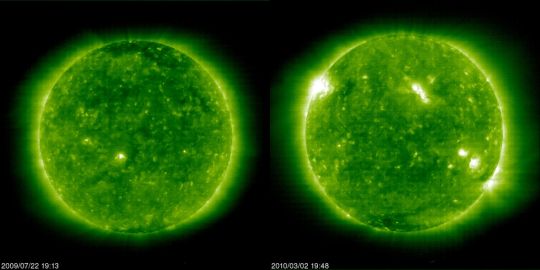
SOHO Extreme ultraviolet Imaging Telescope (EIT) solar images last summer and today:

then-now.jpg

Solar activity is starting to increase again after what has been a relatively long quiet spell associated with the minimum part of the solar cycle. February was the first month in quite some time where there were sunspots every day of the month. In the image above from last July (left), the lone bright area below the equator near the center was not associated with a sunspot, but was in an area of magnetic activity.

Remember that the sun is a star, like all stars, whose business is to fuse lighter elements into heavier ones; our sun fuses hydrogen into helium. This process results in chaotic magnetic behavior of the solar plasma which fluctuates in intensity over an eleven year cycle. We wrote “Ultimate Global Warming – SPF 2 Million Won’t Be Enough” to describe the process.

Evidently, we’re on the upswing after what some scientists (real ones, not climate liars) say was a very extended inactive period, which some feared would put the sun into many years of minimal activity. It is likely that such an extended period, the Maunder Minimum, was the cause of the “Little Ice Age” during the 1600s and 1700s. We wrote “Correlating Sunspots to Global Climate” which illustrates the phenomenon using animations and graphics.

Personally, after the winter we have been having in North America this season, I will be glad to see the sunspots bring us back to our subtropical weather patterns. Old folks like warmer weather, y’know. C’mon global warming! 🙂

Diaz Lake – A Panoramic View

Diaz Lake is located in the Owens Valley, California, It has the distinction of having recently been formed as the result of a large earthquake. Click on the panoramic thumbnail for the full-sized version.

diaz-lake-pan.jpg

From Wikipedia:

Diaz Lake is located just south of Lone Pine, California, United States in Owens Valley. The lake was formed by the 1872 Lone Pine earthquake when 18 mi (29 km) of the Owens Valley dropped approximately 20 feet (6 m) and a new spring opened, causing water to fill the lowland.

The lake was named for the Diaz family who established a ranch here when brother Rafael and Eleuterio Diaz emigrated from Chile in the 1860’s. They owned and operated a successful cattle ranch until the land was sold to the city of Los Angeles.

Year-round fishing is available, and the “Diaz Lake Fish Derby” is held the first Saturday in March.

Snow Capped San Gabriel Mountains

snow

In this El Niño year, the snow levels dropped to below 5000 feet in the San Gabriels, normally not seen with snow on the southern slopes. Damsel took this image (cropped to make a panorama) after the rain passed the other day. Lingering clouds can be seen topping some of the peaks. Click on the image to see the full-sized panoramic image – don’t forget to use the scroller to see the whole image.

Sunspots Are Returning

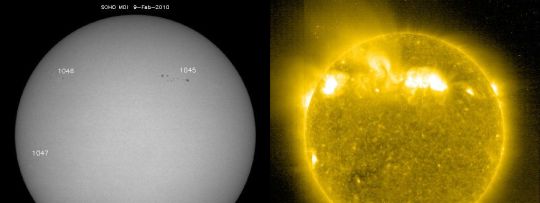
solar disc

It looks like the solar activity is starting to increase. This is the first day in a while where there are three sunspots visible on the Earth-facing side of the sun. These images are from the SOHO spacecraft. The left panel is the visible light snapshot and the right panel is energy being emitted in a narrow band of ultraviolet. You can’t see UV, but it’s common knowledge that it is a major cause of skin damage.

Just how solar activity affects the climate isn’t well understood, but there is correlation between sunspot numbers and the climate.

I don’t know about you, but I am sure there are a lot of Americans rooting for warmer weather tonight. That includes us, even though we’re California weather wimps according to Breda.

After a Gentle Rain

While most of the east is enjoying the biggest blizzards in 90 years (so much for that global warming crap), we had a gentle rain last night which this Christmas cactus seemed to enjoy. Click on Damsel’s image to enlarge.

gentle-rain.jpg