Environment

Wind Farm Wake Turbulence Inefficiency

wind-farm.jpgPlanet Gore posted an item today about wind turbine wake (‘propwash’) causing turbines downwind to have reduced output because of the turbulent air generated by upwind turbines.

Image: Wind Turbines In Banning Pass. One of the largest wind turbine farms in the world is here near Palm Springs, CA. Photo courtesy Damsel. Click to enlarge.

I have always been skeptical about the reliability, efficiency and cost-per-generated-kilowatt of wind turbines. We recently were on a road trip and saw two different convoys of trucks carrying the estimated fifty foot long blades either to a new installation or to maintenance. I couldn’t believe the way the immense turbine blades dwarfed the big-rig tractors hauling them.

From Popular Science.

Downstream wind turbines may lose 20 percent or even 30 percent of their power compared to their fellows in front, according to a study on wake effects at Horns Rev that MacKay highlights on his blog. The paper also emphasizes that different wind directions make it practically impossible to gauge an overall “steady state” for large wind farms, unless researchers can sample wind speeds and directions at multiple points throughout the array.

This shows that wind energy may represent a highly visible form of alternative energy, but certainly not one without its quirks and controversies. Still, better technology can squeeze more juice out of each gust, and cooperative energy-sharing efforts can help offset the fickle nature of wind power.

Big Waves at the Point

Damsel and I drove to Point Vicente on the Southwest side of the Palos Verdes Peninsula to check out the waves after our Pacific storms last week. I caught this short video of the breakers crashing onto the rocks at the point.

After we relocate, we won’t miss the taxes and politics in California, but we will miss the seashore. But – where we’re going has its unique beauties too.

Global Warming Strikes Europe, Northeast America

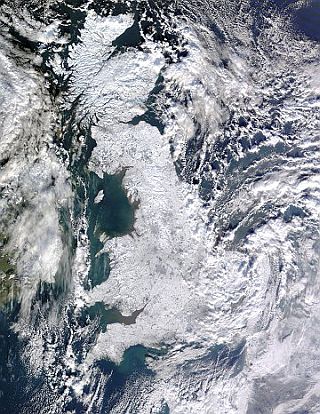
A satellite image shows a snow-covered Britain; record snowfall and cold weather wreaks havoc with the European Continent, Northeastern U.S. and Canada.

Via SpaceWeather.com:

uk-snow.jpgISLAND SNOW

Last week when NASA’s Terra satellite orbited over Europe, it saw something very unusual. The normally temperate British Isles were completely covered by snow. From an altitude of 420 miles, Terra’s MODIS (Moderate-resolution Imaging Spectroradiometer) camera snapped the picture to the right.

It’s not only Britain. Heavy snowfall and record-low temperatures have spread across Europe, closing schools, paralyzing airports, and downing power lines. Much of North America and parts of Asia are experiencing the same brutal cold.

The cause of the phenomenon could be the Arctic Oscillation (AO). The AO is a seesawing strengthening and weakening of semi-permanent areas of low and high atmospheric pressure in the Arctic and the mid-latitudes. One consequence of the oscillation’s negative phase is cold, snowy weather in Eurasia and North America during the winter months. The extreme negative dip of the Arctic Oscillation Index in December 2009 was the lowest monthly value observed for the past six decades. [more]

Gore-Effect Game of the Week

gore-game.jpg

The Buffalo Bills defeated the Indiana Colts in Gorechard Park, NY, by a score of 30 to 7. While the outcome of the game had no effect whatsoever on the post-season playoffs, it did punctuate the fact that it still gets cold and blizzards still happen.

Oh, I forgot . . . Global Warming sometimes makes it colder.

Uhhh – right.

First Day of Winter

winter.jpg

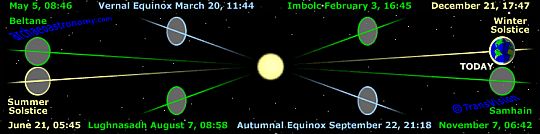
Today marks the first day of winter in the northern hemisphere. It’s the shortest day of the year for the Los Angeles area; the solar disk will be above the horizon for only 9 hours and 54 minutes today at our latitude.

The diagram above illustrates the orbit of the Earth around the Sun and highlights the passage of our planet through eight significant portals recognized by cultures for many millennia. Those are the two equinoxes, the four cross quarter days and the two solstices. Today, we pass through the winter solstice for the northern hemisphere.

For more information about the science and lore of these several special days, check out the website Archaeoastronomy.com and have a look around.

A History of Skepticism

Over three and a half years ago, the cat was already out of the bag that the University of East Anglia falsified their data. According to Bob Carter of Queensland, Australia, who wrote an article in March of 2006. We posted it then and will repeat it now that the alarmists have been outed . . .


Global Warming takes a Break
More and more evidence surfaces about the true nature of global warming. Real scientists looking at the hard evidence of the phenomenon, realize that claims of man-made greenhouse gasses causing warming are false.

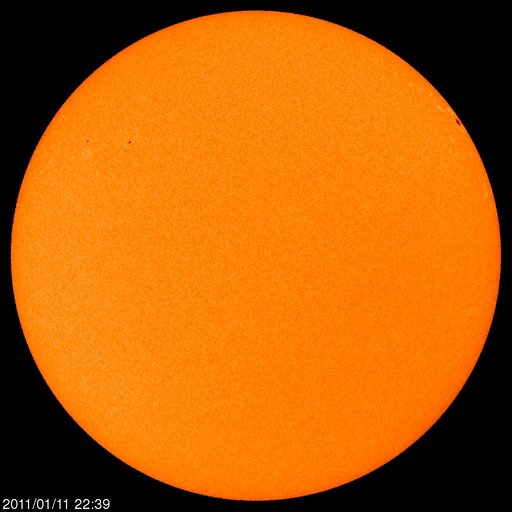
Right: Current SOHO Sunspot Image.

Professor Bob Carter, a geologist at James Cook University, Queensland, who is engaged in paleoclimate research, wrote this excellent article addressing the “Man-made global warming” myth:

There IS a problem with global warming… it stopped in 1998

For many years now, human-caused climate change has been viewed as a large and urgent problem. In truth, however, the biggest part of the problem is neither environmental nor scientific, but a self-created political fiasco. Consider the simple fact, drawn from the official temperature records of the Climate Research Unit at the University of East Anglia, that for the years 1998-2005 global average temperature did not increase (there was actually a slight decrease, though not at a rate that differs significantly from zero).

Yes, you did read that right. And also, yes, this eight-year period of temperature stasis did coincide with society’s continued power station and SUV-inspired pumping of yet more carbon dioxide into the atmosphere.

[read more]