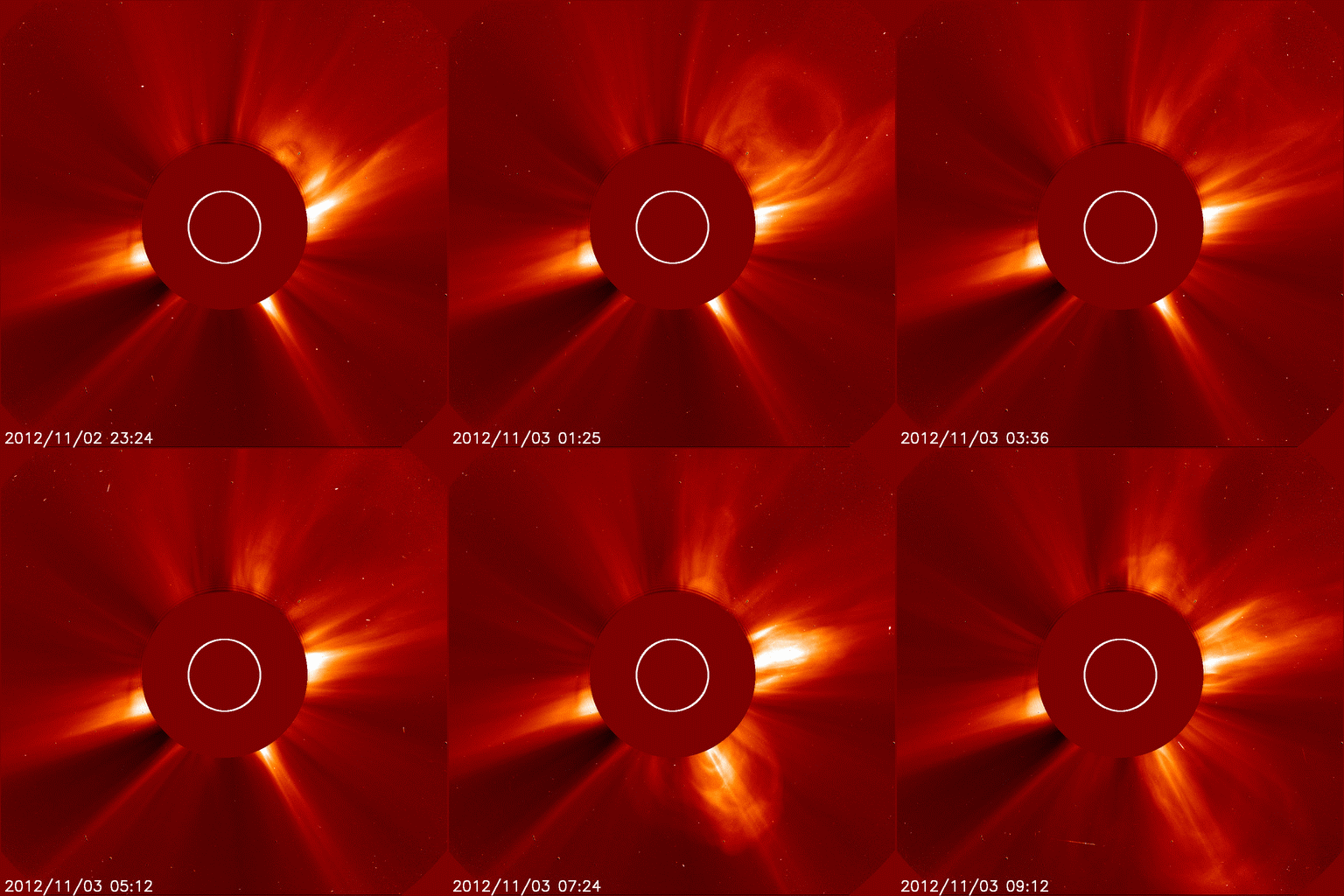
This is a reminder for those who believe that puny anthropogenic emissions have sh*t to do with climate and the environment. Witness the influence of our star – SOL.

This is a reminder for those who believe that puny anthropogenic emissions have sh*t to do with climate and the environment. Witness the influence of our star – SOL.

Whenever I notice a large sunspot on the Space Weather dot com main page, I go over to the SOHO sunspot page and read about it. On SOHO, I saw that sunspot 1543 is prominent in the northern hemisphere of the solar globe today.
I grabbed the Canon SX-40 and my economy solar filter and went out in the courtyard and took the image above. I am using the same camera setup that I used for the May 20th annular eclipse and the June 5th transit of Venus.
The “little” sunspot is about three times the diameter of the Earth. Click on the image to enlarge.

I was tooling across the web on Friday at my usual web stops when I ran across this behemoth telescope on APOD. It’s the High Energy Stereo System (HESS) used not for looking into space, but to analyze the light emitted by cosmic rays striking the Earth’s atmosphere.
When I first saw the picture of this 32×24 meter cherenkov telescope I immediately thought of the giant contraption in the film “Contact” where Jody Foster takes a trip to the Vega star system. Click on the image to enlarge.

New sunspot 1520 has rotated into view and is producing C class solar flares according to SpaceWeather.com. They also expect M class and possibly X class flares as the sunspot rotates toward the mid-solar southern latitudes.
I took this image this morning from Wickenburg, Arizona using my Canon SX40 and a Rainbow Symphony solar filter. I annotated the sunspot numbers with my Irfanview graphic editor. Click on the image to enlarge.
Update: 07/11/2012 The group is now closer to facing Earthward.
 I made my daily stop at spaceweather.com where they profiled a giant sunspot (AR1504) region that might be capable of producing solar flares. I grabbed the camera and the solar filter and proceeded out to the courtyard to take this photo of the sun. Each spot visible on the solar surface is two or more Earth diameters in width.
Image: Sunspot region AR 1504. Click image to enlarge.
The article talks about a ‘beta-gamma-delta’ magnetic field that harbors energy for strong solar flares. Since the huge sunspot complex is directly facing Earth, there may be atmospheric fireworks resulting in auroras and possible interference or disruption of power grids.
We know that the current solar cycle is quite a bit less intense than the last one, but we might wonder if some of these regions might also contribute to our planet’s climate as they have done in the past.

This is a visual summary of the transit as seen from our Arizona home. Starting at the upper left is the first we were able to detect the silhouette of Venus as it just entered into the solar disc. Although we didn’t observe any disciplined schedule of taking images, we went outside every once in a while and snapped several images.
This is a collage of a dozen images from the first noticeable shadow until after the mid-transit image. Ecliptic north lies at about the 2:30 position in the individual images. Notice how atmospheric attenuation darkens the solar disc in the last three or four images taken as the sun approached the horizon.
Click on the image to enlarge.
 This image taken at about 18:24 Arizona time, is the approximate mid point in the transit of Venus. I adjusted the image such that ecliptic north is up. Venus moved from left to right across the northern hemisphere of the solar disc.
Image: Venus at Mid-Transit. Camera: Canon SX-40, Rainbow Symphony Solar Filter, Shutter Speed: 1/2000′, Aperture: F 5.0, Film Speed: ISO 3200
We will not be able to watch or photograph much more today since the terrain rises to the west and apparent sunset is about forty minutes before actual. Regardless, we wouldn’t see Venus exit the disc since that will occur well after sundown here in the 48 contiguous states. We feel lucky that we got to see the midpoint of the transit.
We also feel lucky to have witnessed two solar events in just a little over three weeks, the first semi-rare event being the annular eclipse and this extremely rare Venus transit. The next transit of Venus will be 105 years hence in the year 2117.
