Astronomy

Annular Animation

Using photographs that Damsel took during the eclipse, I threw together a little animation of the main part of the event. To start the animation, click the image below; it will run until maximum annularity. Click again to continue to almost the end of annularity. Click once more to to rewind. Pardon the slight jitter; it was difficult to align each frame perfectly.

I cannot tell you how amazingly spectacular it was to see in person. Damsel and I are already starting to plan for the total eclipse that will occur on August 21, 2017. We are looking at being near Casper, WY, but that could change between now and five years from now.

June 5, 2012 Solar Transit of Venus

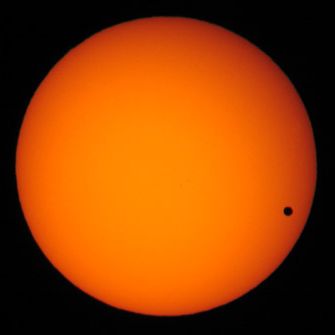
Sebastian posted a bleg yesterday asking about observing the 2012 transit of Venus across the solar disk.Since I have been preparing for the annular eclipse, I posted a comment there pointing to my recent experiences with solar photography. His post got me to look up some information about the transit since we wanted to observe it here, too.

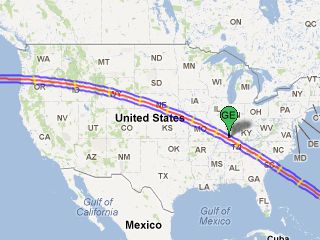
I found the NASA map of global visibility (Image courtesy of NASA) Going to the link helps you to decode the map elements (I,II,III,IV). Click on the map to enlarge.

transit-map.jpg

There is a listing of transit contact events for US cities (and another for international). The closest city listed to our location is Phoenix, AZ. The first event is when the disc of Venus first touches the solar disc occurs at 15:05:55 (Arizona Time); the sun will be 54° above the horizon. The second event is when the other edge of Venus crosses the edge of the sun and occurs at 15:23:32; the sun will be at 50° of elevation. The last transit contact listed is greatest transit which, I assume, is when Venus is halfway across its path over the sun; that occurs at 19:25:24 when the sun is at 13° of elevation.

Nobody in the 48 contiguous states can witness the entire transit because it will not be over until after sundown. It will be entirely visible in Alaska and Hawaii, however.

So, I guess we will keep the eclipse shades and solar filters handy for another three weeks or so. We wouldn’t want to miss this transit since the next one will not be until December of 2117.

Another (BIG) Sunspot

spot-1476-1.jpg

I’m still rehearsing for the eclipse next week. Yesterday, very large sunspot 1476 was strutting its stuff across the solar plasma (still is today, I believe). I stepped out to the courtyard and captured this solar disk image using the techniques for previous solar imaging. If you look closely, you can see sunspot group 1477 above and to the left – look for a pair of slightly dark spots at about latitude 45. Click on the image for full resolution.

Solar Photography Practice

spot1472.jpgThe 2012 annular solar eclipse is just over two weeks away. We are still scheduled to witness this magnificent event from Page, Arizona, almost exactly on the centerline of the annular eclipse path. The eclipse will occur about an hour before sunset, so the sun will be low in the western sky at the peak of annularity.

I took a minute this afternoon to check the SOHO website for active sunspots and found that large spot 1472 is currently showing midway between the center and the limb of the sun. I went outside with the SX-40 and the solar adapter to take some practice shots. For the image at the right, I used the filter (of course) 1/1600′ shutter speed and F8.0 aperture with a film speed of 3200. Sunspot 1472 shows up at about 7 o’clock on the solar disk in the image.

I wanted to make sure that my earlier experiments would work when we are in Page on May 20th. I think that using the filter, a very fast film speed, a fast shutter speed and a normal aperture will enable me to capture the lunar/solar images just fine. Now, if the weather will cooperate, we have it made. 😉 Click on the solar image to enlarge.

Preparing to Photograph the Eclipse

filter.jpgI ordered some solar filters for all of our cameras so we can try to get images of the annular solar eclipse in May. The filters aren’t very substantial since they are made with cardboard tubing and have polymer filters, but they are cost-effective (~$10 each) and they work.

The filters come with an adhesive felt liner that you install to allow a snug fit when you slip the filter over the objective lens of the camera. Once installed, the filter doesn’t interfere with the auto-focus mechanisms nor with any other camera function.

Image: Solar filter slipped over my Canon SX-40 with inset of solar photo – click to enlarge

After some experimentation, I found that trying to use the cameras in auto modes (other than auto-focus) does not give good results; camera motion would blur most images. I tried using a tripod, but getting the image centered in the camera was taking too long. The eclipse would be over before getting all the proper adjustments.

I finally settled on using the camera in manual mode where you can independently set the film speed, aperture and shutter speed. I settled on ISO 3200 film speed, F5.6 for the aperture and 1/1250 second shutter speed. Holding the camera in my hands, the image was good enough to resolve sunspot 1445 currently transiting the solar surface. I uploaded a large image of the sun to the image viewer. Click on the link to view.

Vernal Equinox 2012

first-cardinal.jpgToday is the first day of spring. Right on cue, we saw this cardinal perched on the power pole across the road on Sunday. He was whistling the cardinal mating call which is considerably more musical than the bird’s normal metallic “chip” sound. We assume this handsome fellow is looking for a mate.

Image: Male cardinal perched calling for a mate. Click on the image to enlarge.

We’re hoping that this cardinal and his mate settle nearby. We had two or more cardinal couples frequenting the area last spring and summer.