Asian Aerosols and US Climate Change

circle.jpgI learned through World Climate Report that a group at the National Center for Atmospheric Research, Boulder, Colorado, wrote a paper outlining “Potential Impacts of Asian carbon aerosols on future US warming.”

The paper postulates that Asian emissions have a greater effect on climate change in the US than US emissions do. It would seem that the EPA’s efforts to regulate carbon in the country would be rendered moot by the NCAR report.

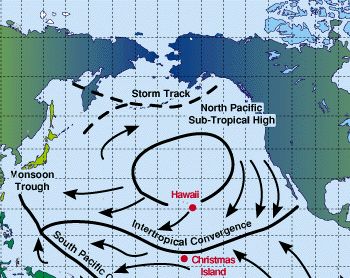
Image: atmospheric circulation in the north Pacific Ocean

The climate along the Pacific coast of the US is affected by air and ocean current circulation way more than Asian carbon. That’s why temperatures along the coasts of western states remain relatively stable – cooler in summer and warmer in winter than most places in the contiguous US.

Now, after doing all the numbers in terms of atmospheric volume versus greenhouse gasses, the actual impact of Asian, as well as US emissions, do very little to affect the climate. Urban Heat Islands and solar activity have far more effect on the environment.

It seems to us that the efforts by the paper’s authors, even though it short-circuits the measures taken in the US by the EPA, is just another attempt at “proving” Anthropogenic Global Warming is reality. We’re still saying that AGW is bullsh*t.

Golden Ball Cactus

golden-ball.jpg

When I bought this Golden Ball Cactus (Notocactus leninghausii) at the garden shop the other day, the flower buds were all closed. Just a little while after I got it home and on the patio, the flowers opened. Click on the image to enlarge.

Venus Transit Progress

transit-progress.jpg

This is a visual summary of the transit as seen from our Arizona home. Starting at the upper left is the first we were able to detect the silhouette of Venus as it just entered into the solar disc. Although we didn’t observe any disciplined schedule of taking images, we went outside every once in a while and snapped several images.

This is a collage of a dozen images from the first noticeable shadow until after the mid-transit image. Ecliptic north lies at about the 2:30 position in the individual images. Notice how atmospheric attenuation darkens the solar disc in the last three or four images taken as the sun approached the horizon.

Click on the image to enlarge.

Venus at Mid-Transit

mid-transit.jpgThis image taken at about 18:24 Arizona time, is the approximate mid point in the transit of Venus. I adjusted the image such that ecliptic north is up. Venus moved from left to right across the northern hemisphere of the solar disc.

Image: Venus at Mid-Transit. Camera: Canon SX-40, Rainbow Symphony Solar Filter, Shutter Speed: 1/2000′, Aperture: F 5.0, Film Speed: ISO 3200

We will not be able to watch or photograph much more today since the terrain rises to the west and apparent sunset is about forty minutes before actual. Regardless, we wouldn’t see Venus exit the disc since that will occur well after sundown here in the 48 contiguous states. We feel lucky that we got to see the midpoint of the transit.

We also feel lucky to have witnessed two solar events in just a little over three weeks, the first semi-rare event being the annular eclipse and this extremely rare Venus transit. The next transit of Venus will be 105 years hence in the year 2117.

Venus Transit of the Sun Tomorrow – June 5, 2012

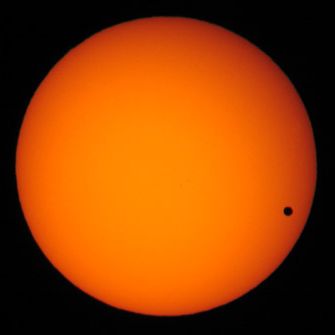
transitTomorrow is the rare solar transit of planet Venus. Even though we’re going to be running errands tomorrow afternoon, we’re taking our cameras, solar filters and eclipse shades in an attempt to witness and record the phenomenon. The event starts at a little after three our time and will still be in progress at sundown. We will be home when Venus reaches the halfway point across the solar disc.

We’re hoping to get imagery similar to the image at the right. We will be using the same cameras and techniques used for the May 20 annular eclipse.

Here’s some information I posted last month:

There is a listing of transit contact events for US cities (and another for international). The closest city listed to our location is Phoenix, AZ. The first event is when the disc of Venus first touches the solar disc occurs at 15:05:55 (Arizona Time); the sun will be 54° above the horizon. The second event is when the other edge of Venus crosses the edge of the sun and occurs at 15:23:32; the sun will be at 50° of elevation. The last transit contact listed is greatest transit which, I assume, is when Venus is halfway across its path over the sun; that occurs at 18:25:24 when the sun is at 13° of elevation.

There is supposed to be a live webcast covering the event. Remember – if you miss this transit, the next one will not be until the year 2117.

Goldfinch Feeders

goldfinch.jpg

I hung out the goldfinch feeders last week in hopes of attracting goldfinches. At first, there were lots of house finches (with the red heads), but, finally, over the last couple of days, the goldfinches have arrived. this is three of them on one of the two finch feeders on the hill above the RV Drive. Click on the image to enlarge.

Bishops Cap Flowers – A New Record

bishops-cap-8.jpg

We bought this Bishops cap barrel cactus over ten years ago in the Phoenix area. It lived with us at the California house for most of that time and had flowers most every summer. Since living here in Arizona, it has had many flowers – more and more often – than in the California patio. Today, eight flowers were open simultaneously – a record for this cactus. Click on the image to enlarge.