Vendela Roses

Vendela Roses

Our regular shopping schedule has been perturbated by the holidays. Today, we shopped for the weekend a day later than usual.

I bought a dozen of these pretty cream-colored “Vendela” roses at the flower concession in the supermarket today. I put them in a vase where I already had some white Asian lilies. I expect that they will look very nice together as the roses and lilies begin to open up.

The Vendela is a very popular rose according to FiftyFlowers.com:

Vendela Ivory Rose is our #1 selling cream rose. Its very large head opens into a cup-shaped bloom with well defined, slightly curled edges. Vendela is greatly admired for the hint of pink found on the petal edges. This champagne ivory rose would add a special touch to a wedding bouquet, table centerpiece or flower arrangement.

Merry Christmas

Xander First Christmas

Our Granddaughter posted this charming photo of our first great grandson on social media for us to see. It is Alexander David’s first Christmas and we are proud to send this festive image of him along to you as our wish for a joyful Merry Christmas to all.

Winter Solstice

winter-solstice.jpg

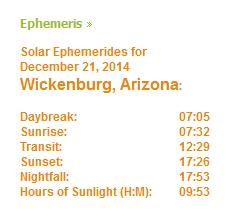
ephemeris.jpgHappy First Day of Winter! Although the seasonal temperatures are going to continue to be cool or cold, the good news is that the days from this point forward (in the northern hemisphere) will be getting longer until the June Summer Solstice.

I got a screenshot from Archaeoastronomy dot com showing the position of the Earth in our orbit today. In ninety days when we arrive at the vernal equinox, the weather should be warm and the flowers on the cacti will be opening.

I also put a screenshot from the ephemeris on our family blog to the right, showing the less than ten hours of daylight that we get here on this day. As I mentioned above, the days will now be getting longer. The times shown in the graphic are Arizona local.

Powered Flight – 111th Anniversary

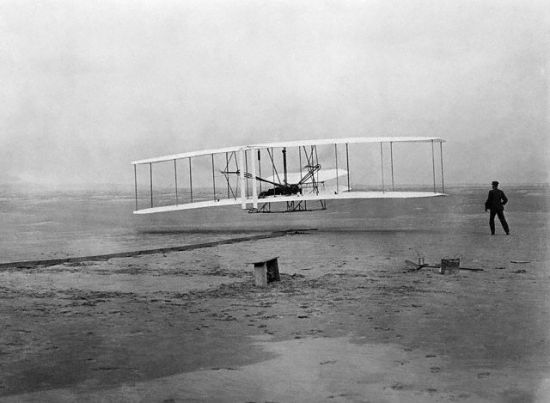
A hundred and eleven years ago today, Orville and Wilbur Wright made their first flights from Kill Devil Hill, close to Kitty Hawk, North Carolina. Their history-making effort sparked the greatest period of technology in the United States and abroad.

I took my first flying lesson on December 16th, 1961, just a day short of their 58th anniversary. By then, the sound barrier had been broken, satellites were in orbit, the Russian, Yuri Gagarin had already orbited the Earth, and John Glenn would be in orbit within a couple of months. It was a great time to get into a career in aviation or aerospace.

First Flight

What makes Wilbur and Orville Wright’s achievement so significant is not only that it was the first time in history that a manned, powered aircraft completed a fully-controlled, sustained flight, but it proved to naysayers around the world that heavier-than-air flight was practical. After the Wrights proved their critics wrong, the field of aeronautical engineering was born. Governments, universities, and inventors soon began dedicating vast resources to understanding the science of flight and methods of building improved flying machines. In essence, every event and discovery in aviation either led up to or followed from the flight of the Wright Flyer, and it changed the way we live forever.

Image and text courtesy of AeroSpaceWeb.org.

Note: This article originally appeared here on December 17, 2007, and has been modified for the 111th anniversary of powered flight.

Infrared Portrait

Infrared Portrait

While going through some stuff we brought from the old house, I ran across an old Polaroid photo of myself as seen through a Forward Looking Infrared Receiver (FLIR). The FLIR was part of the optical suite of instruments destined to be the night vision system on the Abrams M1 Army Tank. At that time, I was a Member of the Technical Staff at Hughes Aircraft Company in charge of the design of display symbology for the system.

The imaging quality of the FLIR is not as bad as the photo makes it look. Bear in mind that the photo is over forty years old and is one of those old Polaroids that required a coating of “fixer” to keep the image from fading. The coating made the image look blotchy.

That is my infrared signature as I posed, arms folded, in front of the FLIR for the photo. The image is “white hot” which means that the warmer temperatures are brighter. You can see the lenses on my glasses are a little darker than my face because they are somewhat opaque to FLIR detectors. The three horizontal lines are due to three dead channels in the IR detector array. The targeting reticule (my design) in the lower right is one of several symbols displayed in the image and is computer controlled to position itself at a point in the image where a fired round from the big gun would hit.

The Abrams tank saw action in Operation Desert Storm. The targeting FLIR easily found and knocked out several of Saddam Hussein’s Russian tanks of the so-called “Republican Guard” long before they saw our forces approaching in Kuwait. I take pride to know that between the Abrams and Hellfire Missiles, both systems of which I had designed in part, some of the Iraqis were forced to retreat back across the border and out of Kuwait.

Ninety Million “Never Forget” Tribute Hits

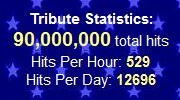
ninetymillion.jpgThis morning, the hit counter for the Never Forget Tribute rolled past ninety million. The hit counter displays an approximation of the number of times that the Tribute has been accessed since August of 2005, the date when it was made available to other websites. Knowing the exact count is virtually impossible, since we only began tracking it after it had been deployed for a couple of years. We used an extrapolation algorithm to establish the approximate count back then, and have incorporated a real-time hit counter since.

The Hits per hour and Hits per day readouts are also approximations. One thing for sure, though, is that the HPD and HPH have diminished from their peak values from about 2009; at that time there were more than 1000 hits per hour. I suppose that a lot of bloggers who previously displayed the Tribute have dropped out of the game. I also suspect that the paradigm shift towards social media had an effect of reducing hits to blogging sites.

At the current rate of hit accumulation, the counter would pass the One Hundred Million mark sometime in the spring of 2017. That is optimistic, however, given the trend toward fewer hits per day.

We thank those sites that continue to display the Never Forget Tribute. Given the current continued Islamic terrorist movements in the World, none of us will ever be able to forget.

UPDATE: (12/09/2014) I revised the hits per hour and hits per day algorithm to estimate the current rates. With the fall-off since the last benchmark of 75 Million hits, the new estimates are closer to reality and seem to be less than half of those reported prior (compare the graphic above to the sidebar counter). The algorithm I use is faulty in that it averages over the longer term rather than doing a running average. I will think about ways to implement a better algorithm if I have the inclination. 😉