The Town of Wickenburg posted on their social media page about all the spring wildflowers that are popping up after the recent rainfall. On our weekly trip to the supermarket today, we could see lots of flowers along the roadway as we drove. There were desert marigolds, orange mallow and lots of poppies. I got out of the truck just up the road from our house and took this photo of a poppy. Very pretty! Click on the image to enlarge.
After the Rain
I climbed up on the hill out back to replace the bird seed bell and block that would usually be up there; since the rain mostly abated today, I was able to go up and do the replacement. After I finished, the first customer impatiently waited on a cholla cactus about 20 feet away from where I was. I took this photo of the curve billed thrasher using the Canon SL1 and 300mm telephoto lens.
A little later, I went out front where Damsel has a few cacti growing in the landscape rock garden. It would seem that we’re going to have a lot of pink and purple flowers soon. Left to right in the lower panel above: beavertail cactus flower bud, several hedgehog flower buds and scores more beavertail buds on one very prolific plant. I took these photos also with the same camera, but with a shorter focal length for close-ups. Click on any image to enlarge.
Where’s Waldo?
If you look very carefully, you may see a bird in Damsel’s plum tree.
Seriously, Damsel and I have a running joke of saying “Where’s Waldo?” whenever we see a male cardinal outside; the bright crimson color of these birds makes them easy to spot even in non-sunny conditions like this morning. I was on the courtyard patio with the intention of shooting some close-up photos of plum blossoms with raindrops, when this cardinal briefly lighted in the tree.
I got the photo of the bird OK but I’m still working on competing with Damsel when it comes to crisp close-ups (none of my raindrop/flower pictures were acceptable). Click on the image to enlarge.
More Signs of Spring – Plum Flowers
This is one cluster of a couple of new flower clusters opening on the flowering plum tree that we recently had replaced. The old tree was destroyed by the monsoons last summer when its trunk snapped in a microburst.
The new tree, at our request, is a more substantial one than the little sapling that it replaced. The little trunk was two or three inches in diameter and the new tree is more like six or maybe seven inches. In addition to the new little flowers, purple leaves on the tree are appearing.
There will be some rain coming to town this weekend to nourish all the spring flowers that will be coming soon. I can’t wait for spring flowers everywhere. Click on the image to enlarge.
Daffodils
I just love it when these show up before spring really gets here. Yesterday, while shopping for a few things, I saw that the flower concession stand featured cut daffodils. I picked up several bunches and this morning they were all mostly open.
Last year, as I recall, the flowers lasted for several days, perhaps up to a week, before they would begin to wilt. I’m hoping these will do as well. Click on the image to enlarge.
Seeing Spots
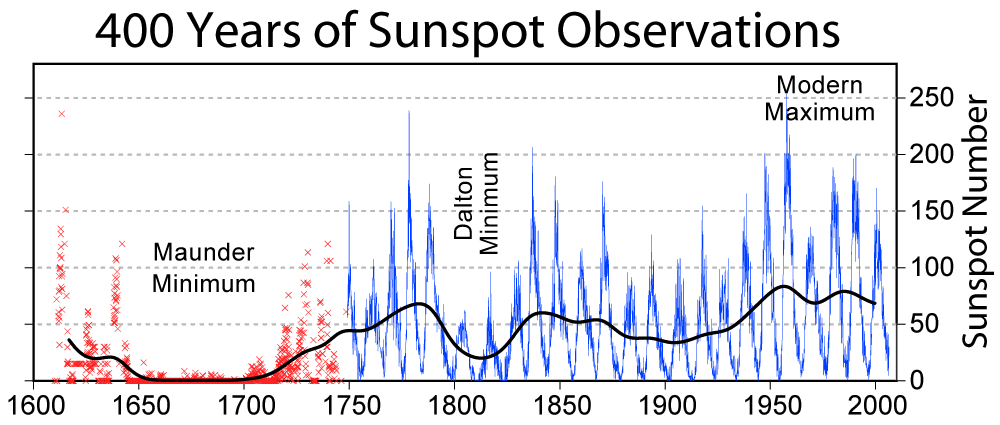
Over eight years ago, we posted a chart similar to the above in a write-up about Correlating Sunspots to Global Climate. The conclusions from that post still hold true today given the lack of ocean levels rising and icecaps melting that the Greenbats would have had you believe. At this point in time, we’re way past the supposed deadline of doom that the Greenbats, UN loonies and Algorians foresaw back then.
I was reading the March 2015 issue of QST Magazine, the publication of the American Radio Relay League (ARRL), when I saw the graphic above. The associated discussion with the sunspot graphic spoke about predicting sunspots for the next solar cycles. The author mentioned that the current cycle may lead to another period of minimum activity as the sun has previously exhibited.
Ham radio operators have known for a century that radio propagation is greatly affected by sunspot activity. The more spots, the merrier for long-distance communication on certain frequencies. Solar flux causes the atmosphere to ionize, thus refracting radio waves over the horizon and even around the entire planet.
If, as the writer of the QST article fears, another sunspot minimum is in the works, then ham operators that depend on ionospheric propagation for their hobby will be out of luck. The rest of the world, in that event, should prepare for the bitter cold that a new minimum will likely bring.
Click on the image to enlarge.

Desert Marigold
We were out along the side of the driveway this afternoon, trimming up some of the unwanted shrubbery and a cats paw tree. I always bring my camera so I can get a before and after photo of our work, which I did, but those will be for another time.
What attracted my attention was our first wild Desert Marigold of the spring has opened up the hill a few steps from where we were working. I walked up and took the above photo of the new flower. Even though it’s only the middle of February, we have seen this and other desert wildflowers in bloom.
Here’s an excerpt and a link to the Wikipedia article on this flower:
Baileya (the desert marigolds) is a genus of plants in the aster family Asteraceae. All are native to the southwestern United States and to Mexico.
They are typically annual, though B. multiradiata may be perennial. The leaves, which may range from being entire to deeply lobed, mostly occur in a basal cluster. From this arises several flower stems, up to 18 inches (50 cm) in height, usually carrying a single yellow radiate flower each, although B. pauciradiata may have 2-3 flowers on a stem.
Desert marigolds typically have their main bloom in the spring, extending through July. Summer thunderstorms may enable a second bloom in October and even into November.


