Firearms

Waiting — Again

Thanks to the State of California, we’re on the 10-day wait for a new Remington 870 Express shotgun. All but a handful of states have no waiting period for shotgun purchases, and many of those do not require registration for shotguns either. Not good old moonbatty California, though.

remington-870-security1.gif

Image: The Remington 870 Security Shotgun waiting in the vault for us.

Not only do we Californians have to jump through all the aggravating hoops, but then have to go to extraordinary steps to even keep guns in our home. The Attorney General’s description of “acceptable” gun safes looks like a specification for an airlock on the International Space Station — this many tumblers, that many bolts, this minimum thickness and so on. Safes that meet the specifications are easily out of the price range of many folks who deserve home protection.

Another point — if a sudden home invasion were to occur, how quickly can you get your safe open and have the weapon loaded and ready to use? What if the safe is on another floor — upstairs and you’re downstairs or vice-versa.

Three Strikes Out

We put up a silhouette target at the range today. We personified it a bit by sticking on some adhesive target patches we brought along. We then each discharged five shotgun rounds, taking photos before, after I shot five 20 gauge rounds and again after Cap’n Bob shot five 12 gauge rounds. The target was at about 25 yards from where we stood. Earlier, we peppered a couple of pistol targets with rounds from Cap’n Bob’s .357 Magnum and my 9 millimeter (both S&W). The shotguns we use are Remington 870 Express, 20 and 12 gauge sizes.

We had a lot of fun at the range today.

123.jpg

No Castles for California

castle.jpgUPDATE: As of February 2007, castle doctrine lives in California. From the California Department of Justice:

No license or permit shall be required to possess keep, or carry a handgun openly or concealed in one’s home or place of business, including temporary residences and campsites.

You now can defend yourself using a firearm in your own home, at work or while encamped; there will be NO charges brought for using a weapon, as long as it’s registered. However, you better have a good lawyer because the perp’s family will likely sue you.

For historical purposes, the original article appears below.


“A man’s home is his castle,” is a metaphor often used to describe the way people feel about their domiciles. Whether you are the owner or are renting, you should be able to feel safe, comfortable and secure in your own space. You should also expect to assume the responsibilities to keep it that way. For example, you should be prepared to deal with any number of breaches to comfort and security — if the roof leaks or something breaks, you should be prepared for that — or — if there is an intrusion into your space by forced entry, you should be prepared to defend your property as well as your life.

In California, we can have hammers, drills, saws and wrenches to maintain our comfort by fixing most problems around the house. All you have to do is go the the home improvement center and purchase what you need. In California, it’s a completely different story when it comes to protecting your home with a pistol or shotgun. Our anti-gun legislature and left-leaning elected officials will not allow the honest law-abiding homeowner to go to the firearms dealer and get a weapon to maintain the security of the castle unless he or she endures a myriad of abusive procedures, delays, rules and restrictions. Moreover, even if we go through all the painful process to get a firearm, we aren’t protected from frivolous litigation if we use it to protect our home – which is NOT a castle in California.

Sadly, the left-coast demographic here will probably not vote the anti-gun politicians out of office. Because of that, the likelihood of a “Castle Doctrine” in California is virtually nil.

Fortunately, for many other states, Castle Doctrine progress is being made.

Continue reading…

Yet Another Reason to GET OUT of the UN

Let me start out by quoting a famous American:

“If you beat your sword into a plowshare, you will probably end up plowing for someone who kept their sword.” — Samuel F.B. Morse

The UNODC, the United Nations Office on Drugs and Crime, is urging Colombians to turn their guns into guitars. No, really, that’s what they’re saying! Not only that, but they say if all nations (including the US) gets rid of guns then the world will be safer.

Right – safer for the people who keep their guns, that is.

NRA Executive Vice President Wayne LaPierre takes this notion to task in his article GUNS, GUITARS & GOOFBALLS:

Continue reading…

Making the Grade

Each year the anti-second-amendment folks at the Brady Campaign issue “grades” to each state in the union. This year, thirty-two states received a “D” or an “F” grade measuring their state’s gun laws. The Brady Campaign assigns this grade based on a state’s “Anti-Gun Violence Laws.”

Actually, that is a misnomer; they really should be called “anti-legitimate gun ownership laws.”

California gets an A- grade while nearby Arizona, Nevada, Utah, Colorado, New Mexico and Idaho all receive “failing” grades. The truth is that these other states know what California’s legislators seem not to know; anti-gun laws do not decrease a state’s crime rate. I suggest inverting the grades to get the real value from the Brady Campaign’s assessment; states like California and Massachusetts which get an A are really getting an F when it comes to protecting their citizens from crime.

Continue reading…

Christmas Eve Sunday

On our way to the shooting range, I paused to snap this palm tree in front of our house silhouetted against a cloud-filtered sun. A very nice Southern California morning for shooting both pictures and guns!

The Essence of Democracy

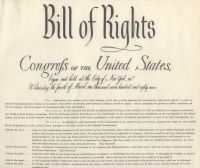
Friday, December 15, 2006 marks the 215th anniversary of the ratification of the Bill of Rights, the very essence of our democracy.

The National Archives Experience Website says that during the debates on the adoption of the Constitution, its opponents repeatedly charged that the Constitution as drafted would open the way to tyranny by the central government. Fresh in their minds was the memory of the British violation of civil rights before and during the Revolution. They demanded a “bill of rights” that would spell out the immunities of individual citizens. Several state conventions in their formal ratification of the Constitution asked for such amendments; others ratified the Constitution with the understanding that the amendments would be offered.

On September 25, 1789, the First Congress of the United States therefore proposed to the state legislatures 12 amendments to the Constitution that met arguments most frequently advanced against it. The first two proposed amendments, which concerned the number of constituents for each Representative and the compensation of Congressmen, were not ratified. Articles 3 to 12, however, ratified by three-fourths of the state legislatures, constitute the first ten amendments of the Constitution, known as the Bill of Rights.

Continue reading…