Astronomy

Winter Solstice

Today is Solstice, the shortest day in the Northern Hemisphere – according to the solar ephemeris for our location, the length of our day will be approximately nine hours and fifty-four minutes.

Solar Ephemerides for
Sunday, December 21, 2008
Torrance, California:

Twilight Begins:

05:55

Sunrise:

06:54

Transit:

11:51

Sunset:

16:48

Twilight Ends:

17:47

Total Daylight (H:M):

09:54
The table at the left shows the various events associated with the motion of the Earth at our longitude and latitude. Twilight is the time when first light from the sun begins to illuminate the atmospheric particles or when last light ceases illumination. Sunrise and sunset are the times when the limb (edge) of the sun peeks above or disappears below the horizon. Transit is when the sun midpoint crosses the meridian, or longitude of our location.

Ephemeris Table courtesy vernabob.com.

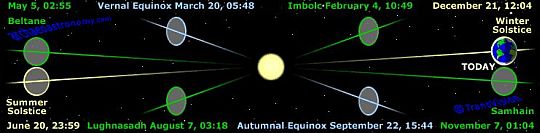
The graphic below is taken from a very interesting website, Archaeoastronomy.com. On their website, you can learn about Equinoxes, Solstices and Cross Quarters which are moments shared planet-wide, defined by the earth’s tilt and the sun’s position on The Ecliptic along 45° arcs.

This neat graphic is put into motion on Archaeoastronomy.com.
Solstice

Solar Minimum

The Sun is at solar minimum these days. That is, the eleven year solar cycle is passing through the period of lowest activity. Yet there is this spectacular activity revealed by the STEREO (Ahead) solar probe in this video from the SOHO website.

A close-up of the Sun from the STEREO (Ahead) spacecraft showing a pair of active regions (that appear as brighter regions) with some interesting activity over a two-day period (April 5-6, 2008). Two surges of material burst out from the region to the left, and the second surge appears to break away from its magnetic bindings.

Not long after, particles from one area along the Sun’s edge rise up and, following unseen magnetic field lines, connect with another area before material above each area spirals alone. None of these events caused any solar storming.

It never ceases to amaze me that our stellar companion is downplayed by the left in its contribution to global climate.

Solar Sparkler

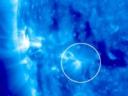
sparkler.jpgNASA’s SOHO website has a weekly feature that highlights selected solar events. This week’s SOHO Pick of the Week is about a video taken by one of the STEREO Spacecraft pair. STEREO consists of two space-based observatories – one ahead of Earth in its orbit, the other trailing behind. The video reveals a recent “shower of sparks” event on the sun’s surface. The circled region in the inset is where to look when playing the 36-second video embedded below:
Continue reading…

A Real Shooting Star

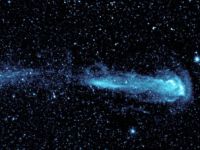
mira-tail.jpgCal Tech Astronomers using the GALEX telescope, made a very interesting and unprecedented discovery of a massive tail being left in the trail of a well-known star, Mira. The faint tail, seen in ultraviolet light, spans more than 13 light years in the wake of Mira. The discovery of this phenomenon includes a ‘bow-shock’ ahead of the star, analogous to a vessel underway on the sea.

Mira, a late-sequence red-giant star, is shedding it’s outer layers as it hurtles through the universe at amazingly high speeds (relative to our Sun). As scientists study this interesting discovery, they are likely to learn more about the ultimate destiny of our own star, which, as we know, will be similar to Mira in about five billion years.

From Science@NASA:

August 15, 2007: Astronomers using a NASA space telescope, the Galaxy Evolution Explorer, have spotted an amazingly long comet-like tail behind a star streaking through space. The star, named Mira after the Latin word for “wonderful,” has been a favorite of astronomers for about 400 years, yet this is the first time the tail has been seen.

Galaxy Evolution Explorer–“GALEX” for short–scanned the popular star during its ongoing survey of the entire sky in ultraviolet light. Astronomers then noticed what looked like a comet with a gargantuan tail. In fact, material blowing off Mira is forming a wake 13 light-years long, or about 20,000 times the average distance of Pluto from the sun. Nothing like this has ever been seen before around a star.

NASA and JPL/Caltech prepared a half-minute animation which is an artist’s conception of Mira generating her tail. Be sure and watch this neat little video.

Continue reading…

Solar Spicules

Huge spikes of plasma fly out of the Sun’s surface all the time, according to scientists studying observations made by SOHO and STEREO spacecraft. This week’s SOHO Pick of the Week discusses these spikes in scientific terms, although there is still considerable question as to their nature and effects, especially about how they affect the planets — ours in particular.

I’m thankful for the ongoing study of the Sun. The more we learn about it, the more we will be able to refute the hysterical Greenbat nonsense about man-made global warming .

Breaking News! James Hansen’s Fake Temperature Algorithms

From SOHO Pick of the Week:

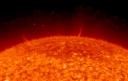
spiculesA close up view of the top of the Sun as seen in profile shows thousands of little spurts, like small blow torches, shooting out all over the Sun. The movie shows just an average day’s worth of this kind of activity as seen from the STEREO spacecraft (Ahead) in extreme ultraviolet light (August 3, 2007). These spurts are called spicules. With STEREO’s 2048×2048 image resolution and an image every 10 minutes, we can zoom in on features like this with no distortion. Spicules are plasma jets that shoot through the Sun’s atmosphere or corona at about 90,000 kilometers per hour. Discovered in 1877 by Angelo Secchi, they remain largely unexplained, in part because observations are difficult for objects with a brief life (about 5 minutes) and relatively small size (diameters of just 300 miles / 500 kilometers). They are caused by shock waves formed when sound waves at the solar surface leak into the solar atmosphere. More than 100,000 spicules occur at any given time on our star’s surface.

Watch the video below for a dynamic look at Solar Spicules.

Continue reading…

Large Exoplanet Discovered by Lowell Astronomers

tres-4.jpgFor several years, Damsel and I have been contributing members of Lowell Observatory on Mars Hill near Flagstaff, Arizona. We occasionally visit them and always enjoy the museum and tours.

Recently, Lowell Astronomers made a discovery of a very large, but low-density planet, orbiting a distant star. The planet should be smaller and more compact, according to physics, but it is a nebulous, oversized lightweight ball.

Image above courtesy Lowell Observatory: Artist conception of TrES-4 and it’s host star. Click on the thumbnail image to view the high-resolution artwork.

From Lowell Observatory:

FOR IMMEDIATE RELEASE

August 6, 2007

Largest Transiting Extrasolar Planet Found Around A Distant Star

Flagstaff, Ariz.– An international team of astronomers with the Trans-atlantic Exoplanet Survey announce today the discovery of TrES-4, a new extrasolar planet in the constellation of Hercules. The new planet was identified by astronomers looking for transiting planets – that is, planets that pass in front of their home star – using a network of small automated telescopes in Arizona, California, and the Canary Islands. TrES-4 was discovered less than half a degree (about the size of the full Moon) from the team’s third planet, TrES-3.

“TrES-4 is the largest known exoplanet,” said Georgi Mandushev, Lowell Observatory astronomer and the lead author of the paper announcing the discovery. “It is about 70 percent bigger than Jupiter, the Solar System’s largest planet, but less massive, making it a planet of extremely low density. Its mean density is only about 0.2 grams per cubic centimeter, or about the density of balsa wood! And because of the planet’s relatively weak pull on its upper atmosphere, some of the atmosphere probably escapes in a comet-like tail.”

Continue reading…

The Great 1991 Solar Eclipse – 16 Years Ago Today

Less than 1500 km from home, and I didn’t go! I kicked myself mentally for days after that, knowing that I had missed one of the more spectacular astronomical events in my lifetime. I did watch the partial eclipse visible from my location near LAX with an improvised helioscope made from an old set of binoculars and a cardboard box. It was OK, but when I heard the reports coming in from friends who were in Cabo San Lucas at the tip of Baja, California, I kicked myself again.

From Fred Espenak (Mr. Eclipse):

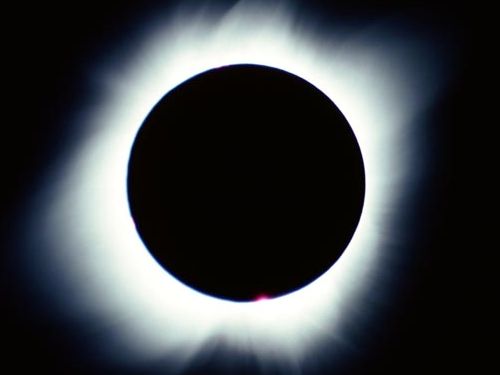
19910711.jpgThe Experience of Totality is one never to be forgotten. In the last seconds as totality begins, the daytime sky is quickly replaced by an eerie twilight as the Moon’s shadow sweeps across the landscape at speeds in excess of 1,200 mph. The bright Sun is suddenly extinguished and in its place stands the pitch black disk of the Moon surrounded by the gossamer, ethereal solar corona. All too quickly, totality ends and you realize you must see another one!

The next opportunity for totality in North America will be in August of 2017, following a path from Oregon to South Carolina: Continue reading…