Astronomy

Fathers Day Flare

The new solar cycle antes up a massive CME for Fathers day. From SpaceWeather.com . . .

FATHER’S DAY BLAST: Consider it a Father’s Day gift … from the sun. This morning around 1 a.m. UT, magnetic fields on the sun’s eastern limb became unstable and erupted, producing one of the most spectacular explosions of the year. NASA’s Solar Dynamics Observatory recorded the action:

The explosion did not cause a solar flare (a flash of electromagnetic radiation) but it did hurl a massive cloud of magnetized plasma into space. Because of the blast site’s location on the eastern limb, the cloud will not hit Earth. There won’t be any geomagnetic storms or auroras.

STEREO Spacecraft Approaching Diametric Opposition

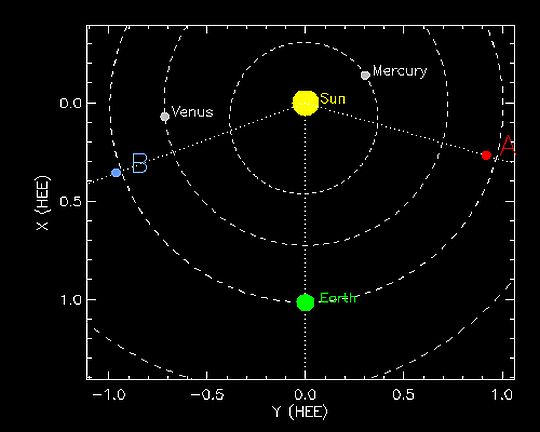
Why would that be significant? Well, it would allow for a full 4PI (360×360°) view of the sun. The animated movie of the sun on STEREO’s Website currently has a gap in the coverage of the sun. The spacecraft are in a heliocentric orbit drifting away from the Earth, one leading and one lagging. This diagram shows the current position of spacecraft A (ahead) and B (behind). The scale is in astronomical units, the average distance between the earth and sun.

Sun-monitoring instrumentation on spacecraft like SOHO and STEREO have gone a long way in discovering what makes the sun behave in mysterious ways. Also, the data coming back (when not intentionally distorted by the IPCC, the CRU or NASA’s James Hansen) can be used to chart the relationship between solar activity and global climate.

stereo.jpg

First Light for the Solar Dynamics Observatory

These images are just astounding . . .

prom.jpgApril 21, 2010: Warning, the images you are about to see could take your breath away.

At a press conference today in Washington DC, researchers unveiled “First Light” images from NASA’s Solar Dynamics Observatory, a space telescope designed to study the sun.

“SDO is working beautifully,” reports project scientist Dean Pesnell of the Goddard Space Flight Center. “This is even better than we could have dreamed.”

Launched on February 11th from Cape Canaveral, the observatory has spent the past two months moving into a geosynchronous orbit and activating its instruments. As soon as SDO’s telescope doors opened, the spacecraft began beaming back scenes so beautiful and puzzlingly complex that even seasoned observers were stunned.

Be sure to click on the image above to view full-size and then go to the SDO Website.

Sungrazing Comet

Or should it be SUN-IMPACTOR COMET? I saw this yesterday on SpaceWeather.com:

sungrazerSUNGRAZING COMET: Today, the sun had a comet for breakfast. The icy visitor from the outer solar system appeared with no warning on April 9th and plunged into the sun during the early hours of April 10th. One comet went in, none came out. The Solar and Heliospheric Observatory (SOHO) had a good view of the encounter.

The comet was probably a member of the Kreutz sungrazer family. Named after a 19th century German astronomer who studied them in detail, Kreutz sungrazers are fragments from the breakup of a giant comet at least 2000 years ago. Several of these fragments pass by the sun and disintegrate every day. Most are too small to see but occasionally a big fragment like today’s attracts attention.

This has been an active year for big, bright sungrazers. There was one on Jan. 4th, one on March 12th, and now one today. Normally we see no more than 3 or 4 bright ones in a whole year; now we’re seeing them almost once a month. It could be a statistical fluctuation or, maybe, a swarm of Kreutz fragments is nearing perihelion (closest approach to the sun). Stay tuned for doomed comets!

Click on the thumbnail image for full-size movie.

Sunspots Are Returning

solar disc

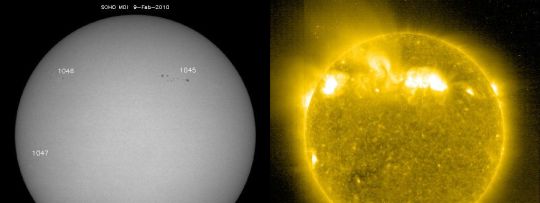
It looks like the solar activity is starting to increase. This is the first day in a while where there are three sunspots visible on the Earth-facing side of the sun. These images are from the SOHO spacecraft. The left panel is the visible light snapshot and the right panel is energy being emitted in a narrow band of ultraviolet. You can’t see UV, but it’s common knowledge that it is a major cause of skin damage.

Just how solar activity affects the climate isn’t well understood, but there is correlation between sunspot numbers and the climate.

I don’t know about you, but I am sure there are a lot of Americans rooting for warmer weather tonight. That includes us, even though we’re California weather wimps according to Breda.

Blue Moon on New Year’s Eve

blue-moon.gifTomorrow night, when the full moon rises over North America, it will be a “blue moon,” the first such occurrence to fall on December 31st since 1990.

The modern definition for “blue moon” is the second full moon to occur within a calendar month and tomorrow’s full moon will indeed be the second to occur in the month of December, 2009.

Cartoon Image courtesy of NASA.

But wait – there’s more to the blue moon phenomenon . . .

From NASA

Most months have only one full Moon. The 29.5-day cadence of the lunar cycle matches up almost perfectly with the 28- to 31-day length of calendar months. Indeed, the word “month” comes from “Moon.” Occasionally, however, the one-to-one correspondence breaks down when two full Moons squeeze into a single month. Dec. 2009 is such a month. The first full Moon appeared on Dec. 2nd; the second, a “Blue Moon,” will come on Dec. 31st.

This definition of Blue Moon is relatively new.

. . .

The modern definition sprang up in the 1940s. In those days, the Farmer’s Almanac of Maine offered a definition of Blue Moon so convoluted that even professional astronomers struggled to understand it. It involved factors such as the ecclesiastical dates of Easter and Lent, and the timing of seasons according to the dynamical mean sun. Aiming to explain blue moons to the layman, Sky & Telescope published an article in 1946 entitled “Once in a Blue Moon.” The author James Hugh Pruett cited the 1937 Maine almanac and opined that the “second [full moon] in a month, so I interpret it, is called Blue Moon.”

That was not correct, but at least it could be understood. And thus the modern Blue Moon was born.

. . .

The modern astronomical Blue Moon occurs in some month every 2.5 years, on average. A Blue Moon falling precisely on Dec. 31st, however, is much more unusual. The last time it happened was in 1990, and the next time won’t be until 2028.