Astronomy

Not So Long Ago in a Galaxy Not So Far Away

What if someone told you that planet Earth originated in another Galaxy and that the Milky Way caught us up in a gravitational sweep? What if they told you that the climate cycles on planet Earth were largely due to this galactic collision? Sound crazy? Maybe not . . .

Hat tip to my colleague, Rick, who sent this to me.

From ViewZone.com:

galaxy-collideUsing volumes of data from the Two-Micron All Sky Survey (2MASS), a major project to survey the sky in infrared light led by the University of Massachusetts, the astronomers are answering questions that have baffled scientists for decades and proving that our own Milky Way is consuming one of its neighbors in a dramatic display of ongoing galactic cannibalism. The study published in the Astrophysical Journal, is the first to map the full extent of the Sagittarius galaxy and show in visually vivid detail how its debris wraps around and passes through our Milky Way. Sagittarius is 10,000 times smaller in mass than the Milky Way, so it is getting stretched out, torn apart and gobbled up by the bigger Milky Way.

Image (David Law/University of Virginia): A new infra red digital survey of the entire sky was made in 2003. Teams from the universities of Virginia and Massachusetts used a supercomputer to sort through half a billion stars to create a — NEW STAR MAP showing our Solar System (yellow dot) to be at the exact nexus crossroads where two galaxies are actually joining.

. . .

It has been postulated that this is the real reason for both global warming since higher energy levels of the Milky Way are almost certain to cause our Sun to burn hotter and emit higher energies. Indeed, temperatures have been seen to rise on virtually all the planets in our system. This seems quite apart from any local phenomenon like greenhouse gases etc.

Watch the animation and read about other effects being observed in our solar system:

Continue reading…

Just What Is A Blue Moon?

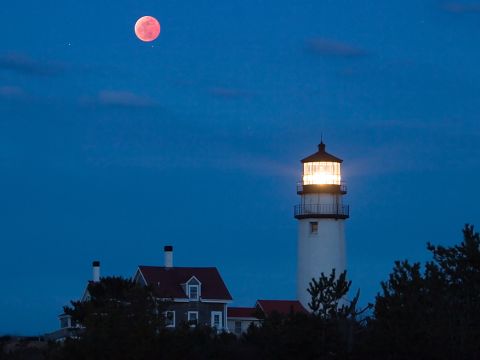
blue-moon.gifTomorrow night, when the full moon rises over North America, it is believed that this will be a “blue moon.” The modern definition for “blue moon” is the second full moon to occur within a calendar month and tomorrow’s full moon will indeed be the second to occur in the month of May, 2007.
Cartoon Image courtesy of NASA.

But hold on – Sky and Telescope magazine retracted it’s 1946 second-in-a-month definition in favor of stating that the “blue moon” is actually based on the four seasons and is the fourth full moon to occur within a season (Winter, Spring, Summer and Autumn). Using this definition, a “blue moon” may or may not occur within a calendar month.

It gets even more confusing.

Continue reading…

SOHO — So Spectacular

This video is from a collection of SOHO images taken over the operational lifetime of the spacecraft (a little more than eleven years). In it you can see some of the more spectacular solar activity that occurred over that period.

“The Sun is anything but a stable, yellow ball in the sky.” That quote is the opening line of commentary in a recently-produced NASA video about the STEREO project — another spaceborne observation system that captures solar images in three dimensions.

I look forward to seeing a three-dimensional equivalent of this video from STEREO in the not-to-distant future.

Video courtesy NASA and SOHO

First STEREO Images

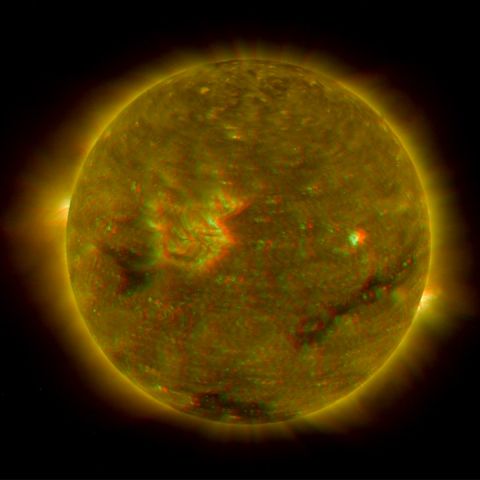
The STEREO spacecraft has furnished its first 3D images. The images are taken from STEREO’s X-ray cameras; one taken from the “Ahead” spacecraft and one taken from the “Behind” spacecraft and then combined to produce the 3D effect.

To view these anaglyphic images in 3D you will need red-blue glasses, which you can get free from Rainbow Symphony.

stereo 3d

I also repackaged a lower-bandwidth video of the rotation of the solar disk leading up to the view of the Sun seen above. I even put some music to it to add some cinematic pizazz. Eat your heart out, Al Gore:

Continue reading…

Sideways Sunspot

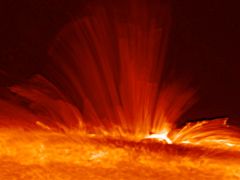
sideways-sunspotToday’s Astronomy Picture of the Day features this remarkable image of a sunspot on the limb of the Sun as seen from the Japanese solar-observing spacecraft, Hinode. Like a fountain of fire, solar plasma is ejected from the sunspot, most of which cascades back onto the surface. Some of the ejecta particles will continue speeding off into space, ultimately falling onto whatever is in the path. Better understanding of how the Sun ejects particles into space may result in more accurate predictions of solar storms that affect satellites, astronauts, and even power grids on Earth.

Image Credit & Copyright: Hinode, JAXA, NASA

Between the venerable SOHO spacecraft and the newly-launched Hinode and STEREO probes, scientists are sure to discover much more about our stellar companion. We are entering into an age of enlightenment (so to speak) about the nature of the Sun’s influence on the environment and climate on planet Earth. This is unfortunate for those who would like to divert attention from science in favor of over-representing anthropogenic (man-made) effects and predictions of imminent global disaster.

Continue reading…

SOHO Captures First Complete Solar Cycle


2007 SOHO EIT IMAGE

1997 SOHO EIT IMAGE

SOHO moves around the Sun in step with the Earth, by slowly orbiting around the First Lagrangian Point (L1), where the combined gravity of the Earth and Sun keep SOHO in an orbit locked to the Earth-Sun line. The L1 point is approximately 1.5 million kilometers away from Earth (about four times the distance of the Moon), in the direction of the Sun. From that vantage point, SOHO’s Extreme ultraviolet Imaging Telescope (EIT) has enjoyed an uninterrupted view of our daylight star for the last eleven-plus years. All previous solar observatories have orbited the Earth, from where their observations were periodically interrupted as our planet `eclipsed’ the Sun.

SOHO’s Pick of the Week featured this remarkable milestone:

Continue reading…