Astronomy

STEREO

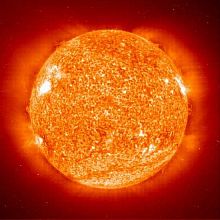
sun-explode.jpg“The Sun is anything but a stable yellow ball in the sky” — That’s how the narration begins in the NASA video presentation about the STEREO mission. The video itself is well done, with informative commentary and the usual outstanding NASA animated graphics. I highly recommend that you follow the link above and watch the four-minute video.

NASA’s twin STEREO spacecraft completed a series of complex maneuvers Sunday to position the spacecraft in their mission orbits. The spacecraft will be in position to produce the first 3-D images of the sun by April.

As physicists learn more about the Sun and it’s less than subtle behavior, we can expect to be able to “connect the sunspots” and identify the extent to which the Sun influences Earth’s environment and climate.
Comet McNaught Transits SOHO

This is simply extraordinary . . . We’re in awe.

Brightest Comet in Over Forty Years

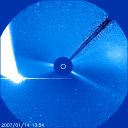
Comet McNaught (C/2006 P1) has not only become the brightest comet SOHO has ever seen, but even the brightest comet observed in over forty years! The comet swung by the sun on Jan 12th – 15th, and is now emerging into the skies of the southern hemisphere. During its close encounter with our mother star, comet McNaught became a naked-eye object in broad daylight. It was discovered on August 7th, 2006 by the hugely successful comet discoverer Rob McNaught (Siding Spring Survey). At time of discovery, the comet was a very faint object, but the predicted perihelion distance (closest distance to the sun) of just 0.17 AU indicated already that the object had the potential to become very bright.

As you are probably aware, the LASCO instrument on-board SOHO has the ability to watch comets as they get extremely close to the Sun. Fortunately for us, comet McNaught has passed right through the LASCO C3 field of view! We do not know exactly the peak brightness of the comet yet, but it is definitely brighter than -3 mag! It is thus much brighter than comet NEAT or comet 96P/Machholz. In other words, comet McNaught is by far the brightest and most spectacular comet SOHO has ever seen!

Comet McNaught Visible in Broad Daylight

mcnaught-soho.jpgThis may be a once in a lifetime celestial event for Earthlings to witness. A sun-grazing comet, McNaught, is visible to the naked eye in broad daylight! If you have clear skies, you should step outside today and try to observe the comet.
SOHO also “sees” the comet, but it’s so bright in the sky it badly blooms the image.

Image: SOHO LASCO C3 view of McNaught.

Read more about how to observe this spectacle from SpaceWeather.com:

Continue reading…

Solar Cycle 24 = Lots of Spots

NASA Scientists studying the relationship between the Sun’s magnetic activity and the peak number of sunspots, have discovered a six-year relationship between the two phenomena. If the trend continues as it has since 1868, we should experience a count of about 160 sunspots during the next solar cycle peak, due in 2011. Previous correlations between climate and sunspot count may also indicate a warmer climate during this cycle.
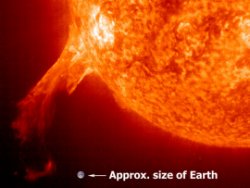
Right: An erupting solar prominence photographed by the Solar and Heliospheric Observatory (SOHO).

Continue reading…

Crescent Moon

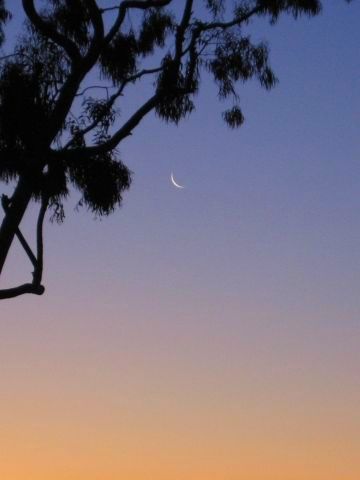
On a very cold (for us) and clear December morning, the moon showing a thin crescent rises above the eastern horizon.
Earlier, I was able to see Saturn about 10° to the left of “la bella Luna” but the morning twilight obscured the normally dazzling planet as dawn drew closer.

Not seen in this view are the crisp outlines of the San Gabriel and Santiago peaks jutting up from the horizon.

This was a very nice morning for vistas, both terrestrial and celestial.

I took this shot with my little Canon PowerShot 3.2 Mega Pixel camera. Not as high resolution as Damsel’s Digital Rebel, but does a fair job. I used a little tripod to steady the camera for a longer exposure in the reduced light.

Solar Tsunami

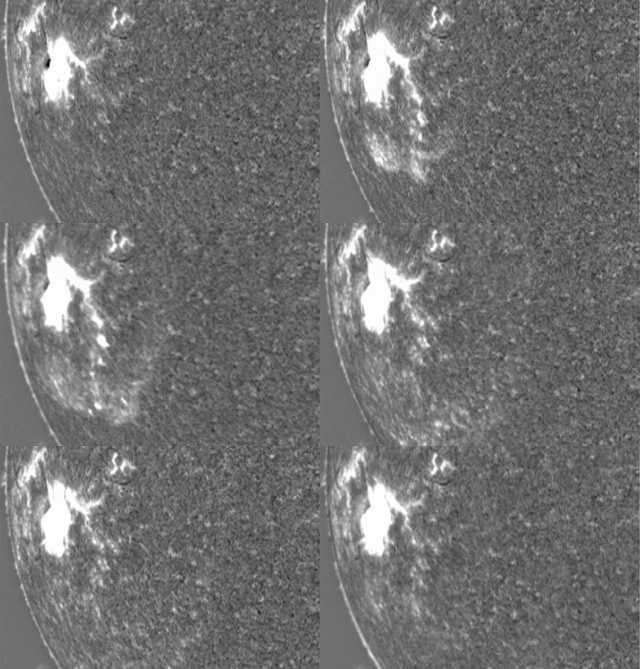
This may be more evidence that the Sun is entering one of it’s most active solar maximums in modern times. The solar flare from December 6, 2006 was so intense that it caused a virtual tsunami of solar plasma to ripple away from sunspot 930.
The interesting thing about this event is that it occurred far enough ahead of the maximum to allow it to be studied in detail without having to deal with the chaos associated with the maximum. Hang on and enjoy the ride. I have a feeling we’re in for an interesting display of climate and electromagnetic effects from our Sun.

Image courtesy SpaceWeather.com

Continue reading…

A Christmas Card from the Sun

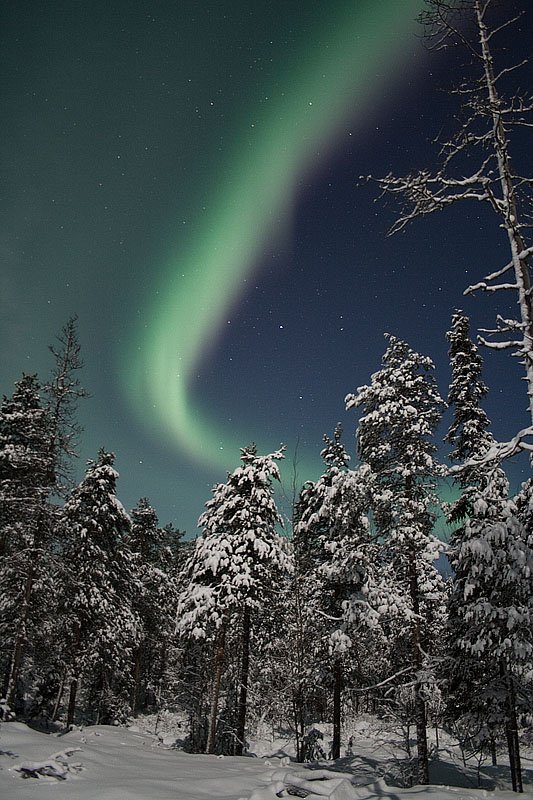
A new very active sunspot sent a coronal mass ejection Earthward which interacts with our magnetosphere to produce bright auroras.

In Finland, a photographer captured the aurora’s glow over snow-tufted conifers to produce this wonderful picture that looks like it was staged to become the front of a Christmas card. (Click on the image to see a larger version.)

From SpaceWeather.com:

AURORA WATCH: Sky watchers, be alert for auroras. A coronal mass ejection (CME) is expected to brush past Earth tonight, sparking a mild geomagnetic storm. The display will probably favor high latitudes–e.g., Scandinavia, Canada and Alaska–but it could descend as well to northern-tier US states such as Michigan, Minnesota and Wisconsin. (continued below)

The source of the CME is sunspot 930, which has been exploding regularly since it first appeared on Dec. 5th. The “angry sunspot” is slowly turning to face Earth. As it does, it might send more CMEs our way, and they would hit head-on rather than merely brushing past. By next week, Northern Lights could reach deep into the United States. Stay tuned. (And keep your fingers crossed.)

Picture: Auroras over Finland on Dec. 8th. Credit: Vesa Särkelä

Visit the December 2006 Aurora Gallery for more beautiful pictures.