Astronomy

Major Solar Flare

A major solar flare associated with a new, giant sunspot, indicates increasing solar activity as our Sun approaches its 11-year peak (maximum is forecast to occur in 2011). If the sunspot count is particularly high this cycle, we can expect increasing global temperatures as the predominant climatological change generator (the Sun) heats up the planet.

From SpaceWeather.com:

Earth-orbiting satellites detected a major X9-class solar flare this morning at 1035 UT (5:35 a.m. EST). The source: big, new sunspot 929, which is emerging over the Sun’s eastern limb. GOES-13 captured this X-ray image of the blast:

Because of the sunspot’s location near the limb, the flare was not Earth-directed. Future eruptions could be, however, because the Sun’s spin is turning the spot toward Earth. Sunspot 929 will be visible for the next two weeks as it glides across the solar disk.

Al Gore and his band of Greenbats ought to get a clue about actual climate science. How dare they compare anthropogenic climate effects to those of this giant stellar monster? HOW DARE THEY?
The Great Orion Nebula

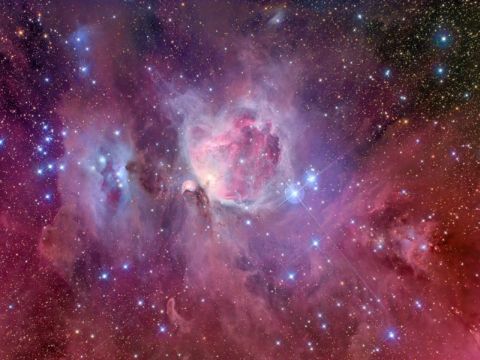
APOD has a nice astrophoto of the Great Orion Nebula today.

I highly recommend watching the The San Diego Supercomputer Center’s great video Volume Visualization of the Orion Nebula to get an amazing perspective on this immense phenomenon.

The Great Nebula in Orion, an immense, nearby starbirth region, is probably the most famous of all astronomical nebulas. Here, glowing gas surrounds hot young stars at the edge of an immense interstellar molecular cloud only 1500 light-years away. In the above deep image, faint wisps and sheets of dust and gas are particularly evident. The Great Nebula in Orion can be found with the unaided eye just below and to the left of the easily identifiable belt of three stars in the popular constellation Orion. In addition to housing a bright open cluster of stars known as the Trapezium, the Orion Nebula contains many stellar nurseries. These nurseries contain hydrogen gas, hot young stars, proplyds, and stellar jets spewing material at high speeds. Also known as M42, the Orion Nebula spans about 40 light years and is located in the same spiral arm of our Galaxy as the Sun.

Image, story courtesy APOD and NASA.

2006 Leonids Meteor Shower

Late Wednesday night, as Damsel and I were walking the dogs, the skies were exceptionally clear for the urban Los Angeles area. We were looking towards the “Seven Sisters” near the zenith when we saw a shooting star. It was probably an early Leonid meteor. This weekend will be a good time to look skyward, especially in the wee hours before dawn when the radiant (located in the constellation Leo) will be above the horizon and your part of the Earth will be plowing head-on into the dust trail left by comet 55P/Tempel-Tuttle.
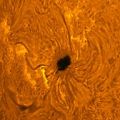
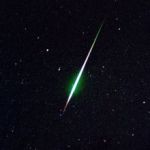
Image: A Leonid “green fireball” meteor. (Courtesy NASA)

According to experts, you just might be able to see up to a hundred meteors per hour — that’s better than one a minute!

Continue reading…

The Solar Neighborhood Today

There’s a lot of interesting things to see in the sky today – the bad news is they’re all happening in the direction of the Sun and impossible to see without special equipment. The good news, however, is that there are ways to see these events without looking directly at the Sun, which is ill-advised and likely dangerous to your vision.

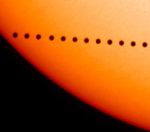
Image: Sunspot 923 as seen through a SolarMax filter

Sunspot 923 is almost in the center of the Sun today, and can be seen using eclipse shades or making a pinhole camera. Over the weekend Damsel and I saw it when I used a pair of binoculars to image the solar disk on the floor.

Continue reading…

Mercury to Transit the Sun Today

UPDATE 2: A Segment of a heliograph taken in Hawaii shows a tiny dot near the center. The dark spot on the left is a sunspot that is rotating towards Earth.

UPDATE: Astronomy Picture of the Day shows just how unspectacular the transit will appear.

Don’t get your hopes up for a spectacular view of this event. Even with eclipse glasses, mercury’s image will appear to be so very tiny compared to the solar disk.

Left: A prior Mercury transit as observed by SOHO

If you have a pair of binoculars available, you might try and project the sun’s image onto a flat, shaded surface. Point the objective lens (the end you don’t look through) toward the sun and try to focus the solar disk onto the flat surface. DO NOT LOOK AT THE SUN THROUGH THE BINOCULARS!

If you plan to try and observe the event, for God’s sake, do not look at the sun without the proper solar filters — instant damage can be done to your eyes.

From NASA:

NASA – 2006 Transit of Mercury

On Wednesday, Nov 8th, the planet Mercury will pass directly in front the Sun. The transit begins at 2:12 pm EST (11:12 am PST) and lasts for almost five hours. Good views can be had from the Americas, Hawaii, Australia and all along the Pacific Rim.

[Read more]

Samhain

Today is the autumnal cross-quarter day. Like equinox and solstice, a cross-quarter day identifies a place in the Earth’s orbit. Cross-quarters occur at the midpoint between solstice and equinox.

Image: Diagram of solstices, equinoxes and cross-quarter events. (Courtesy Archaeoastronomy.com — Click for an animated version)

Ancient Celtics celebrated cross-quarter days as significant events in their calendar. Samhain marked the end of the harvest and the end of summer. Samhain is the word for November in the Irish language. The same word was used for a month in the Celtic calendar, in particular the first three nights of this month, with the festival marking the end of the summer season and the end of the harvest. A modernized version of this festival continues today in some of the traditions of the Catholic All Saints’ Day, the secular Halloween, and in folk practices of Samhain itself in the Celtic Nations and the Irish and Scottish diasporas.

Archeoastronomy.com is an interesting site to visit. Go there and read about the ancient peoples celebration of celestial events. Also visit Old News and read about the possibility that ancient Native Americans may have been influenced by the Celtic calendar! Fascinating stuff.

Death of a Comet


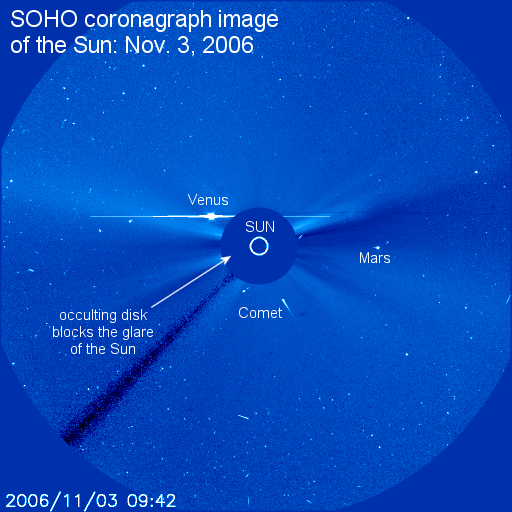
Did you ever see a comet plunge into the sun? Not likely unless you have seen images from the Solar and Heliospheric Observatory (SOHO). Watch as the comet strikes the heliosphere and causes a solar explosion.

Image: Courtesy NASA and SOHO

Spaceweather.com says:

Yesterday, the Solar and Heliospheric Observatory (SOHO) caught a comet plunging toward the sun. It went in–but not out again. The sungrazing comet disintegrated like an ice cube in an oven.

In the animation, the white circle represents the outline of the sun. The dark circle is a shield in the optics to block the solar image so background activity and objects may be seen. Above and to the left is the planet Venus which just passed above and in front of the Sun. In a wider field of view image, the planet Mars can also be seen along with labels explaining the image.