This is simply extraordinary . . . We’re in awe.
Brightest Comet in Over Forty Years
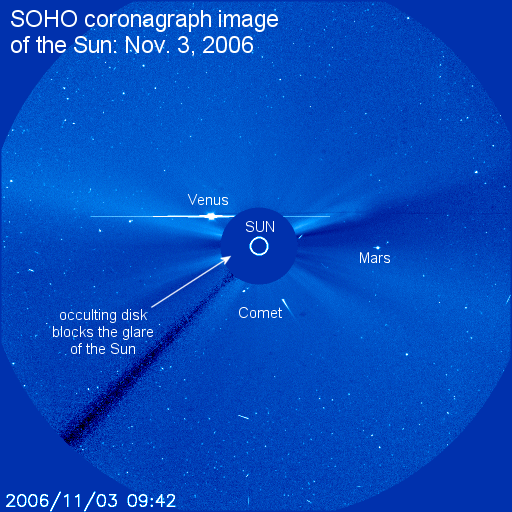
Comet McNaught (C/2006 P1) has not only become the brightest comet SOHO has ever seen, but even the brightest comet observed in over forty years! The comet swung by the sun on Jan 12th – 15th, and is now emerging into the skies of the southern hemisphere. During its close encounter with our mother star, comet McNaught became a naked-eye object in broad daylight. It was discovered on August 7th, 2006 by the hugely successful comet discoverer Rob McNaught (Siding Spring Survey). At time of discovery, the comet was a very faint object, but the predicted perihelion distance (closest distance to the sun) of just 0.17 AU indicated already that the object had the potential to become very bright.
As you are probably aware, the LASCO instrument on-board SOHO has the ability to watch comets as they get extremely close to the Sun. Fortunately for us, comet McNaught has passed right through the LASCO C3 field of view! We do not know exactly the peak brightness of the comet yet, but it is definitely brighter than -3 mag! It is thus much brighter than comet NEAT or comet 96P/Machholz. In other words, comet McNaught is by far the brightest and most spectacular comet SOHO has ever seen!
 I worry when a large, politically left-leaning enterprise like
  Google and NASA Ames will focus on making the most useful of NASA’s information available on the Internet. Real-time weather visualization and forecasting, high-resolution 3-D maps of the moon and Mars, real-time tracking of the International Space Station and the space shuttle will be explored in the future.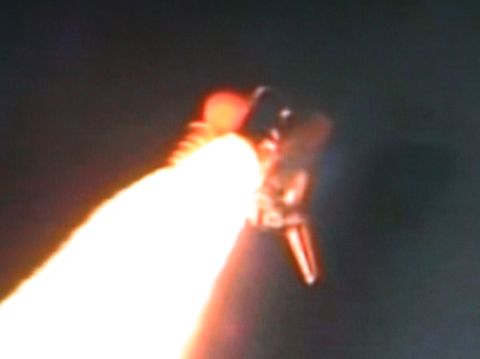
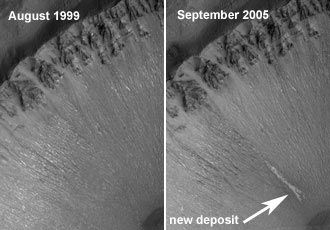 Image right: A new gully deposit in a crater in the Centauri Montes Region. Image credit: NASA/JPL/Malin Space Science Systems
  ECLSS in Iraq — Since April 2006, an Earth-bound application of a portion of the ECLSS water recovery system is being trucked from one rural village to another in northern Iraq to filter particulates and contaminants out of dirty groundwater or well water to provide residents with clean drinking water. That portable system—about half the size of a refrigerator including all its pumps and computer controls—purifies water at a good clip of 4 gallons a minute, for a cost of only about two cents a gallon.
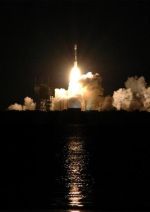 The twin spacecraft mission STEREO blasted off from Cape Canaveral in a nighttime launch last night. STEREO, which stands for Solar TErrestrial RElations Observatory, is a two-spacecraft mission to observe solar activity from two vantage points in orbit around the sun. the spacecraft, identified as A (ahead) and B (behind), will head for the Moon to get a gravitational “slingshot” into orbit. B will be flung into orbit behind the Earth while A will return to the Moon for another boost into orbit ahead of Earth. This separation in space provides a unique view of the Sun from orbits with a similar distance from the Sun as the Earth, while imaging from points away from our planet. The spacecraft will assume their stations near