
Aerospace

Solar Spicules

Huge spikes of plasma fly out of the Sun’s surface all the time, according to scientists studying observations made by SOHO and STEREO spacecraft. This week’s SOHO Pick of the Week discusses these spikes in scientific terms, although there is still considerable question as to their nature and effects, especially about how they affect the planets — ours in particular.

I’m thankful for the ongoing study of the Sun. The more we learn about it, the more we will be able to refute the hysterical Greenbat nonsense about man-made global warming .

Breaking News! James Hansen’s Fake Temperature Algorithms

From SOHO Pick of the Week:

spiculesA close up view of the top of the Sun as seen in profile shows thousands of little spurts, like small blow torches, shooting out all over the Sun. The movie shows just an average day’s worth of this kind of activity as seen from the STEREO spacecraft (Ahead) in extreme ultraviolet light (August 3, 2007). These spurts are called spicules. With STEREO’s 2048×2048 image resolution and an image every 10 minutes, we can zoom in on features like this with no distortion. Spicules are plasma jets that shoot through the Sun’s atmosphere or corona at about 90,000 kilometers per hour. Discovered in 1877 by Angelo Secchi, they remain largely unexplained, in part because observations are difficult for objects with a brief life (about 5 minutes) and relatively small size (diameters of just 300 miles / 500 kilometers). They are caused by shock waves formed when sound waves at the solar surface leak into the solar atmosphere. More than 100,000 spicules occur at any given time on our star’s surface.

Watch the video below for a dynamic look at Solar Spicules.

Continue reading…

The Flight of the Phoenix

phoenix-lander.jpgYesterday’s launch of the asteroid-bound Dawn Mission was postponed until September due to bad weather and potential interference with the scheduled launch of the Mars Phoenix Lander on August 8th.NASA has scheduled a news conference for later today to discuss aspects of the postponement and the Phoenix program. Prior to the Phoenix presentations, media will have the opportunity to learn in more detail about the rescheduled Dawn launch.

Image left: Artist’s concept of Phoenix on the surface of Mars. Image credit: NASA/JPL.

The Phoenix Lander is the first in a series of landers in NASA’s Mars Scout Program. The “Phoenix” name is taken as the lander is a reincarnation of previous landers or failed missions. Phoenix will land in the icy Northern Plains of Mars and become a fixed-location probe designed to explore the geological history of that region of the planet.

Read more about the Phoenix Lander Program and watch the really cool NASA animated video of the arrival of Phoenix on Mars: Continue reading…

SOHO — So Spectacular

This video is from a collection of SOHO images taken over the operational lifetime of the spacecraft (a little more than eleven years). In it you can see some of the more spectacular solar activity that occurred over that period.

“The Sun is anything but a stable, yellow ball in the sky.” That quote is the opening line of commentary in a recently-produced NASA video about the STEREO project — another spaceborne observation system that captures solar images in three dimensions.

I look forward to seeing a three-dimensional equivalent of this video from STEREO in the not-to-distant future.

Video courtesy NASA and SOHO

The Right Stuff – Wally Schirra, 1923 – 2007

Wally Schirra, space pioneer and astronaut, passed away today at his California home.

From WikiPedia:

wally-schirra.jpgOn April 2, 1959, Schirra was chosen as one of the original seven American astronauts. He entered Project Mercury and was assigned the specialty area involving life support systems.
On October 3, 1962, Schirra became the fifth American in space, piloting the Mercury 8 (Sigma 7) on a six-orbit mission lasting 9 hours, 13 minutes, and 11 seconds. The capsule attained a velocity of 17,557 miles per hour and an altitude of 175 statute miles, and landed within four miles of the main Pacific Ocean recovery ship.

On December 15, 1965, Schirra flew into space a second time in Gemini 6A with Tom Stafford, rendezvousing with astronauts Frank Borman and James Lovell, Jr. in Gemini 7. This was the first rendezvous of two manned spacecraft in earth orbit. The two vehicles, however, were not capable of actually docking. Gemini 6 landed in the Atlantic Ocean the next day, while Gemini 7 continued on to a record-setting 14-day mission.

On October 11, 1968, Schirra became the first man to fly in space three times on his final flight as commander of Apollo 7, the first manned flight in the Apollo program after a fatal fire during tests of Apollo 1. The three-man crew, including Donn Eisele and Walter Cunningham, spent eleven days in earth orbit, performed rendezvous exercises with the upper stage of the Saturn 1-B launch vehicle that rocketed them into space and provided the first television pictures from inside a U.S. manned spacecraft for which he received an Emmy.

Condolences to the Family and Friends of Space Pioneer Wally Schirra.

Image: Wally Schirra – courtesy NASA.

Lunar Transit of the Sun

Although there will be an eclipse of the Moon later today, there was a solar eclipse, of sorts, last week — from the vantage point of one of the recently-launched STEREO spacecraft, that is. Astronomy Picture of the Day featured this video of a lunar transit of the Sun taken by the cameras on board STEREO B, one of two STEREO spacecraft en route to their observation stations. The angular subtense of the Moon in this video is about a quarter of the size as would be seen from Earth.

Video courtesy NASA & APOD.

Assymetrical Solar Polar Mystery

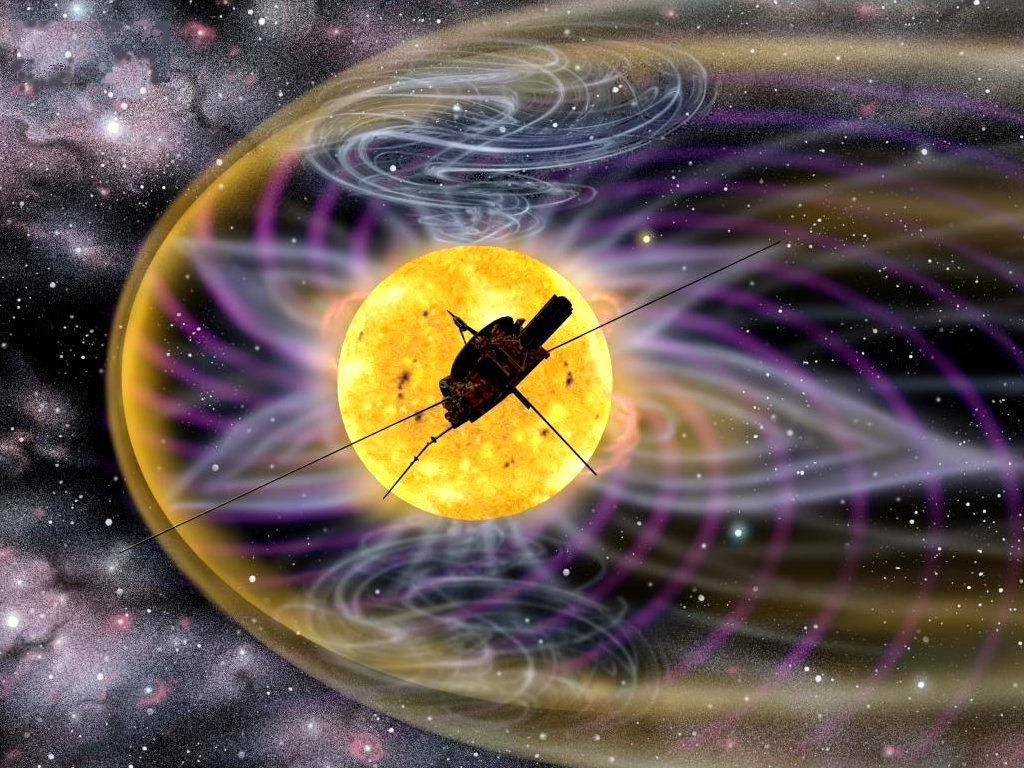
solar magnetic fieldTo see is to know — that’s an old science and engineering principle that has been around for most of the history of human technological progress. If you hypothesize you can develop a theory about a topic. If you have a theory, it isn’t much good unless you test it. Testing, it seems, isn’t always easy nor is it infallible. And once in a while, when testing your theories, you come up with a real head-scratcher. Like why is the Sun’s south pole cooler than it’s north pole? Why does that hold true regardless of the solar magnetic field’s north-south orientation?

Image: Ulysses and the Solar Magnetic Field (click image for full-size view) ESA Solar Image Gallery

I know, I know! It must be industrial pollution on planet Earth and greenhouse gasses . . . well, maybe Al Gore can explain it better.

Continue reading…

SOHO Captures First Complete Solar Cycle


2007 SOHO EIT IMAGE

1997 SOHO EIT IMAGE

SOHO moves around the Sun in step with the Earth, by slowly orbiting around the First Lagrangian Point (L1), where the combined gravity of the Earth and Sun keep SOHO in an orbit locked to the Earth-Sun line. The L1 point is approximately 1.5 million kilometers away from Earth (about four times the distance of the Moon), in the direction of the Sun. From that vantage point, SOHO’s Extreme ultraviolet Imaging Telescope (EIT) has enjoyed an uninterrupted view of our daylight star for the last eleven-plus years. All previous solar observatories have orbited the Earth, from where their observations were periodically interrupted as our planet `eclipsed’ the Sun.

SOHO’s Pick of the Week featured this remarkable milestone:

Continue reading…