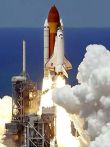
 UPDATE: All Systems were GO and Discovery blasted off this afternoon! Godspeed to the Astronauts.
Image: Discovery clears the pad on liftoff — FoxNews.com
Discovery is on the pad and poised for a Fourth of July launch. NASA gives it a sixty-percent chance of launching.
NASA – Space Shuttle
Discovery’s a “Go” for Independence Day
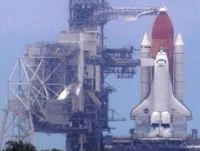 After analysis of available data, the Mission Management Team has given a “go” for Tuesday’s launch of Space Shuttle Discovery to the International Space Station.
During a routine inspection Sunday night after the draining of the external fuel tank, a crack was discovered in the foam near a bracket that holds the liquid oxygen feedline in place. It is believed that the rain experienced during Sunday’s launch attempt caused water to run down the feedline and form ice near the top of the strut next to the feedline bracket. As the tank warmed and expanded, the ice that formed most likely pinched the foam on the top of the strut, causing a crack and eventual loss of the small piece of foam. The Mission Management Team met Monday at 6:30 p.m. EDT to discuss the results of the information before making a final decision regarding Tuesday’s launch attempt.
Extensive analysis showed that the area around the crack is intact and there is no concern for heating as there is adequate foam in place on the strut. Additional borescope inspection of the tank revealed that the bracket has no cracks.
Currently, there is a 60 percent chance of favorable launch weather for Tuesday and a 40 percent chance of favorable weather for Wednesday according to Air Force First Lt. Kaleb Nordgren of the 45th Weather Squadron. If the weather cooperates this will be the first Independence Day launch of a space shuttle!
A Fourth of July Discovery Launch would nicely compliment STS-4 Columbia‘s Fourth of July, 1982 landing at Edwards AFB in California.
SpaceLine.org — July 4, 1982 – 9:09:31 a.m. PDT at Runway 22, Edwards Air Force Base, California. Rollout distance was 9,878 feet. Rollout time was 73 seconds. Mission duration was 7 days, 1 hour, 9 minutes, 31 seconds. Landing occurred during the 113th orbit.
This was the first landing on the 15,000-foot concrete runway at Edwards.
I was lucky enough to have been on Rogers Dry Lake on July 4th, 1982 and witnessed the arrival of STS-4 at Edwards and also to observe NASA’s 747 piggy-back departure with another of the Space Shuttle Fleet in tow that same Day – spectacular! President Reagan was there that day, although I didn’t get close enough to see him.

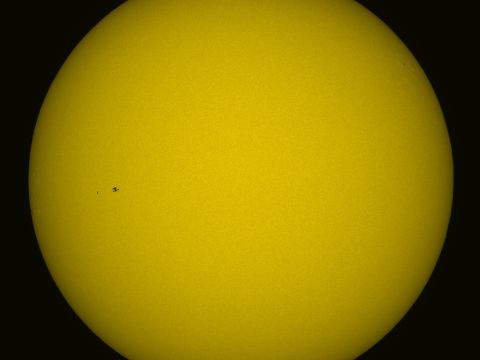
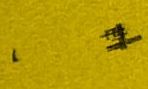 Though it’s 93 million miles away, the Sun still hurts your eyes when you look at it. But bright sunlight (along with accurate planning and proper equipment!) resulted in this sharp silhouette of spaceship and space station. The amazing telescopic view, recorded on September 17, captures shuttle orbiter Atlantis and the International Space Station in orbit over planet Earth. At a range of 550 kilometers from the observing site near Mamers, Normandy, France, Atlantis (left) has just undocked and moved about 200 meters away from the space station.
  The Mission Control Center in Houston informed the STS-115 crew about 10:45 a.m. EDT that Wednesday’s landing attempts have been waved off due to an unfavorable weather forecast, coupled with the possibility of additional inspections of Space Shuttle Atlantis.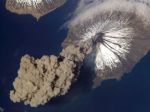
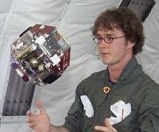 Six years ago, MIT engineering Professor David Miller showed the movie Star Wars to his students on their first day of class. There’s a scene Miller is particularly fond of, the one where Luke Skywalker spars with a floating battle droid. Miller stood up and pointed: “I want you to build me some of those.”