I can’t add much to this photo except to say “Where else but California?” Click on the image for a closer look.


I can’t add much to this photo except to say “Where else but California?” Click on the image for a closer look.
Damsel and I enjoy pro football – especially since we acquired our big screen HDTV. Tonight we’re watching the Hall of Fame Game with Tennessee and Buffalo.
Screenshot – click to enlarge:

Even in the doldrums of an extended solar minimum, our nearest star continues to be dynamic in it’s (mostly) unseen behavior. This week’s SOHO Pick of the Week illustrates some of this unseen activity in this animation.
A few areas of this rather unremarkable solar image taken in extreme ultraviolet (UV) light on August 4, 2009, provide good starting points for explicating some of the unseen features of the Sun. For one thing, the darker polar coronal holes at the Sun’s poles (top and bottom) are the source of open magnetic field lines (red) that head way out into space. They are also the source regions of the fast solar wind, which is characterized by a relatively steady speed of approximately 800 km/s.
A more variable slow solar wind (gray) flows from all other areas of the Sun, carrying particles out into space. The solar wind defines the breadth of our solar system, the heliosphere. The image also shows a dark coronal hole at lower latitudes, just about facing towards Earth. The high speed solar wind particles (white) blowing from there will likely reach Earth in a few days and may spark some auroral activity. Lastly, magnetic loops (yellow) above the one sizeable active region arc out and connect back to an area of opposite polarity. Hot particles in these loops make them visible in UV light.
Safe to say, there is more than meets the eye when studying the Sun.
Nobody knows for sure, but the lack of sunspot activity could continue and make the next solar cycle one of the longest minimums in modern times. Shall we call it the Gore Minimum?
 Patina is defined as a fine coating of oxide on the surface of a metal. The term ‘patina’ is most often used in discussions about collectible artifacts from the past. In many cases, removing the patina from a collectible is a big no-no.
We once watched an episode of the popular “Antiques Road Show,” where a woman brought a nice, shiny Tiffany lamp to be appraised. She polished it up the brass and copper surfaces to a new-looking gleaming lamp. Unfortunately, without the patina, the lamp was worth a small fraction of the antique value.
Patina is not as revered on classic vehicles though. Damsel and I were on our recent vacation when we spotted this old ford truck from the 1950’s. As she was taking this picture she said “I think I need a tetanus shot from just looking at that P.O.S.
Click on the image to enlarge.
 Damsel took this picture of one of my favorite plants. It’s called Stapelia Gigantea and is a cactus-like succulent native to the African continent. I like it, but not because it has pretty flowers, not because of lavish green stalks and certainly not because it smells good.
Every summer, the plant produces several pods that grow like great pointed balloons and then explode into five-pointed, hairy flowers that produce an aroma of rotting flesh. While flowers are in bloom, the flies flock to it and consequently keep out of the patio area. I like that about it – it’s sorta like a fly trap.
That’s Damsel’s hand lifting the drooping starfish up to be photographed. The plant can be seen at the left. Click on the image to enlarge.
Here’s more information about this exotic stinker that I lifted from UBC Botanical Garden:
As with many plants, Stapelia gigantea has a suite of common names. These include carrion flower, giant toad flower, Zulu giant, starfish flower and (in Australia) dead horse plant. Most of these are fairly descriptive – it does smell like carrion, it comes from Africa, it’s big, it resembles a starfish and it attracts flies like a dead horse. I haven’t been able to deduce the reason for toad flower, though (perhaps also because of the flies?).
You have probably guessed that this odd plant is pollinated by the blow-flies it attracts.
I should sneak in that Stapelia gigantea is considered an invasive plant in Hawaii and a weed in Australia.
 Patriot Day – September 11th – commemorating the victims of the terrorist attacks on America in 2001 is coming soon. We must Never Forget.
If you have a blog, please consider signing up to honor a victim of the attacks. D. C. Roe, the original 2996 organizer, has renewed the call for patriots to sign up to honor the victims on September 11th. Go to the Project 2996 Sign-up Page and select your honoree.
Project 2996 started on the fifth anniversary of the attacks in 2006. Each year since that time we have honored Mark Scott Zeplin, a victim of the attacks on the World Trade Center in New York. We signed up for that honor again this year.
We also are going to insert a link in the Never Forget Tribute to the Project 2996 Sign-Up Page. The tribute is seen on hundreds of websites world-wide and this will help to spread the word.
Found on Kini’s Hawaiian Website:
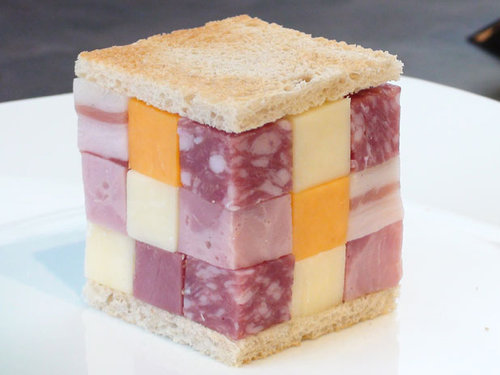
We got a good laugh at this when we saw it. I guess the idea is to get all the cheddar, provolone, jack cheese, etc., in alignment in order to eat it. Right?
If, for some reason, you have no idea what a Rubik’s Cube is, visit Wikipedia, where the following description may be found:
The Rubik’s Cube is a 3-D mechanical puzzle invented in 1974 by Hungarian sculptor and professor of architecture Ernõ Rubik. Originally called the “Magic Cube”, the puzzle was licensed by Rubik to be sold by Ideal Toys in 1980 and won the German Game of the Year special award for Best Puzzle that year. As of January 2009, 350 million cubes have sold worldwide making it the world’s top-selling puzzle game. It is widely considered to be the world’s best-selling toy.
In a classic Rubik’s Cube, each of the six faces is covered by 9 stickers, among six solid colours (traditionally white, red, blue, orange, green, and yellow). A pivot mechanism enables each face to turn independently, thus mixing up the colours. For the puzzle to be solved, each face must be a solid colour. Similar puzzles have now been produced with various numbers of stickers, not all of them by Rubik. The original 3×3×3 version celebrated its twenty-fifth anniversary in 2005.