In my job, making our products rad-hard is essential; use of TMR (triple-modular redundancy) and SECDED (single error correction/double error detection) are common practices in spacecraft systems design.
Perhaps science can develop a similar technology for the moonbat tinfoil-hat and koolaid crowd who are continuously bombarded by “radiation’ from the hard-left.
Excerpt from NASA – Computer Brains in Space:
When your computer behaves erratically, mauls your data, or just “crashes” completely, it can be frustrating. But for an astronaut trusting a computer to run navigation and life-support systems, computer glitches could be fatal.
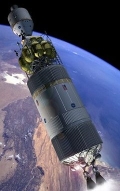 Unfortunately, the radiation that pervades space can trigger such glitches. When high-speed particles, such as cosmic rays, collide with the microscopic circuitry of computer chips, they can cause chips to make errors. If those errors send the spacecraft flying off in the wrong direction or disrupt the life-support system, it could be bad news.
Right: The humans inside this spacecraft aren’t the only ones who need protection from space radiation; their computers do, too.
To ensure safety, most space missions use radiation hardened computer chips. “Rad-hard” chips are unlike ordinary chips in many ways. For example, they contain extra transistors that take more energy to switch on and off. Cosmic rays can’t trigger them so easily. Rad-hard chips continue to do accurate calculations when ordinary chips might “glitch.”

 The W32/Sdbot-ADD worm infecting some users of AOL Instant Messenger is more dangerous than previously thought, according to Facetime Security Labs, the researchers who discovered the worm in October.