The Big House of Wupatki National Monument

big-house.jpg

This is the Wukoki ruins in Wupatki National Monument. Wukoki is a modern Hopi word meaning “big house.” I took this image today as we went through Sunset Crater and Wupatki on our way from Flagstaff to Page, AZ. The ruins in the area are very well preserved and to my delight were accessible along a short foot path. Unlike Casa Grande (also meaning “big House”) near Coolidge, AZ, I could walk directly into this big house that was built over 900 years ago. Click on the image to enlarge.

Eclipse Excursion – Day One

black-barts.jpg

Today’s the first leg of our excursion to Page, AZ to witness the May 20, 2012 annular eclipse of the Sun. We had a good trip that took us from our Wickenburg home, through the Saguaro forests along AZ SR 74 to I-17, thence north to Flagstaff, where we set up camp for the night among the tall conifer trees. Tomorrow, we head towards the ultimate destination with a few scenic stops along the way. Click on the image to enlarge.

Echinopsis – Easter Lily Cactus Flower

easter-lily-cactus.jpg

On our way out to walk the dogs this morning, I noticed that the echinopsis “Easter Lily” cactus flower was open. I grabbed the camera and got a picture while I could. By late morning, the flower had wilted. There are several more flower buds on the cactus, so I will be alert to get pictures of them as they open.

According to Wikipedia, echinopsis species are native to South America (Argentina, Chile, Bolivia, Peru, Brazil, Ecuador, Paraguay and Uruguay). They grow only in situations where the soil is sandy or gravelly, or on the sides of hills in the crevices of rocks. Apparently, they are OK in Arizona too, Click on the image to enlarge.

June 5, 2012 Solar Transit of Venus

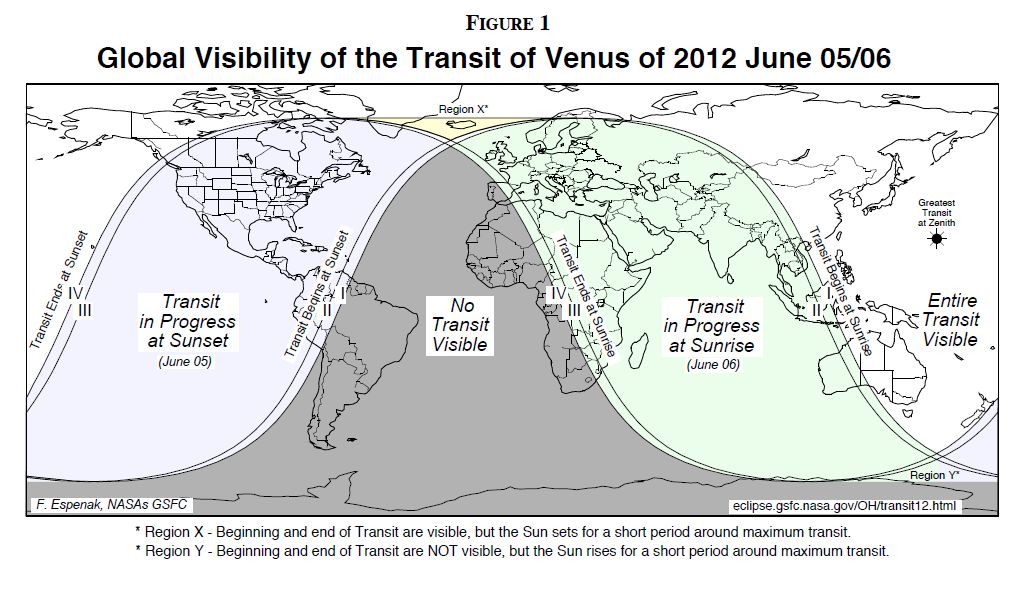
Sebastian posted a bleg yesterday asking about observing the 2012 transit of Venus across the solar disk.Since I have been preparing for the annular eclipse, I posted a comment there pointing to my recent experiences with solar photography. His post got me to look up some information about the transit since we wanted to observe it here, too.

I found the NASA map of global visibility (Image courtesy of NASA) Going to the link helps you to decode the map elements (I,II,III,IV). Click on the map to enlarge.
transit-map.jpg

There is a listing of transit contact events for US cities (and another for international). The closest city listed to our location is Phoenix, AZ. The first event is when the disc of Venus first touches the solar disc occurs at 15:05:55 (Arizona Time); the sun will be 54° above the horizon. The second event is when the other edge of Venus crosses the edge of the sun and occurs at 15:23:32; the sun will be at 50° of elevation. The last transit contact listed is greatest transit which, I assume, is when Venus is halfway across its path over the sun; that occurs at 19:25:24 when the sun is at 13° of elevation.

Nobody in the 48 contiguous states can witness the entire transit because it will not be over until after sundown. It will be entirely visible in Alaska and Hawaii, however.

So, I guess we will keep the eclipse shades and solar filters handy for another three weeks or so. We wouldn’t want to miss this transit since the next one will not be until December of 2117.

Pink Cholla

pink-cholla.jpg

This is a pink flower on a cholla cactus here in town. Now, we have dozens of cholla on and around our lot and none of them produce pink flowers – always orange or yellow. I’d like to get a cutting of this and plant it in a pot until it’s big enough to transplant to a place in the yard. But, this one (the only one in town?) is on a private lot. Click on the image to enlarge.