Wildflowers in Bloom

Arizona Poppy Desert Marigold Orange Mallow

Thanks to an El Niño shortened winter, spring wildflowers are already popping up everywhere in the desert. Last week, during our visit to the West Valley (Bob had a doctor appointment), we noticed a lot of wildflowers along the roadside and in the median on US 60 between Wickenburg and the outer loop (Loop 303) of the Phoenix Metro Area, which is where the desert ends and the urbs begin.

We took the dogs for a walk today after dinner and I remembered to bring my camera since we see wildflowers along our walk. All three of these photos above were taken within a quarter mile of our house and are completely uncultivated desert wildflowers.

From left to right above, we have an Arizona Poppy, a Desert Marigold and an Orange Mallow. I used my usual Canon Rebel T3 to capture all three images. Click on any of the images to enlarge.

Creek Bed Bank Line Reinforcement

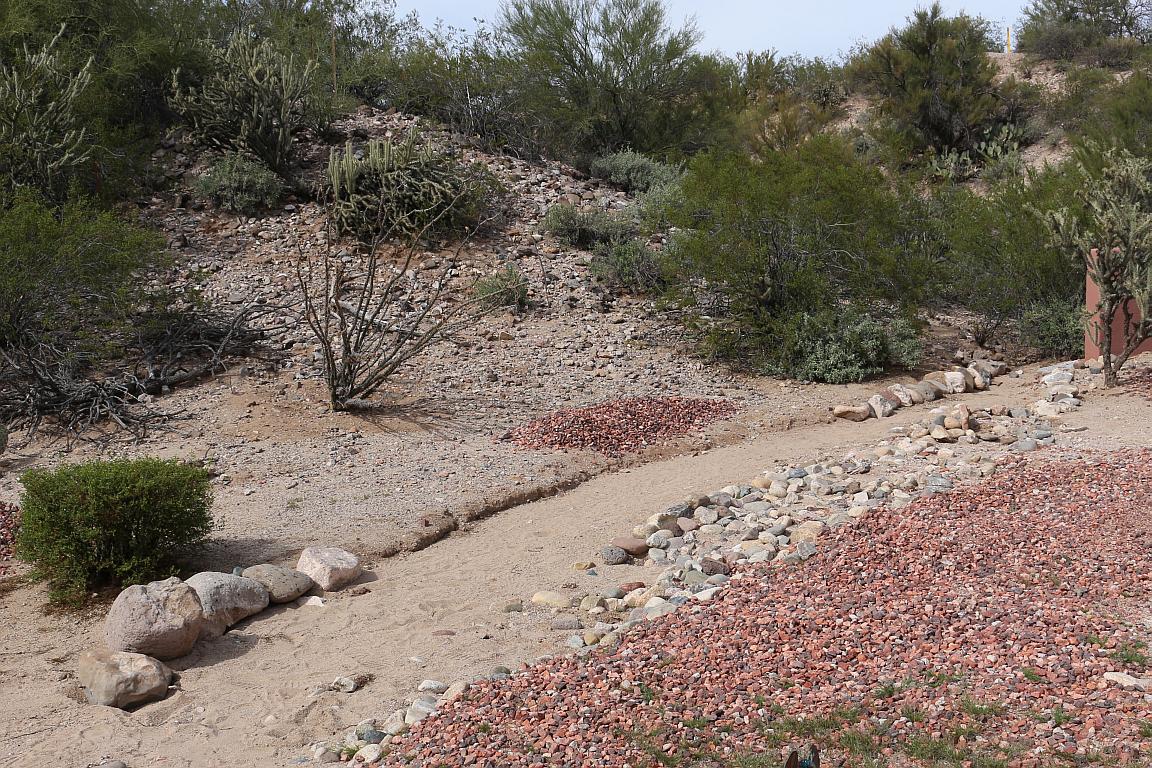
Creek Bed

This is one of the projects that Damsel and I have undertaken to modify her rock and cactus garden on the west side of the property. This is to account for the effects of having built a retention wall adjacent to the RV drive that now diverts runoff from the hills to the north. After we built the wall last year, water now flows to the west of the property rather than across the RV drive as it has in the past.

In the image above, the west end of the wall can be seen at the right edge. We have started lining the edge of the little creek that formed last summer when we had a great monsoon rainfall last summer. The idea is to line the banks with rocks to confine the flow to within the creek bed near where the water comes out from behind the wall.

Further down the creek, the banks are less defined. We decided to use some very large boulders (seen at the left of the photo) to keep the flow going down the natural creek wash that was there before, rather than spilling toward the west where there are some decorations and the trash bins are over there too.

As you can see in the photo, we have partially completed the bank lining up near the end of the wall. Next, we will continue to bring more of the rocks and complete the lining from where the rocks end upstream to the boulders that are on the left. After that, we will dig down to where the original landscapers put the creek rocks five years ago.

We hope that we can complete this project a little at a time (rocks are heavy!) over the spring before the next monsoon season. Click on the image to enlarge.
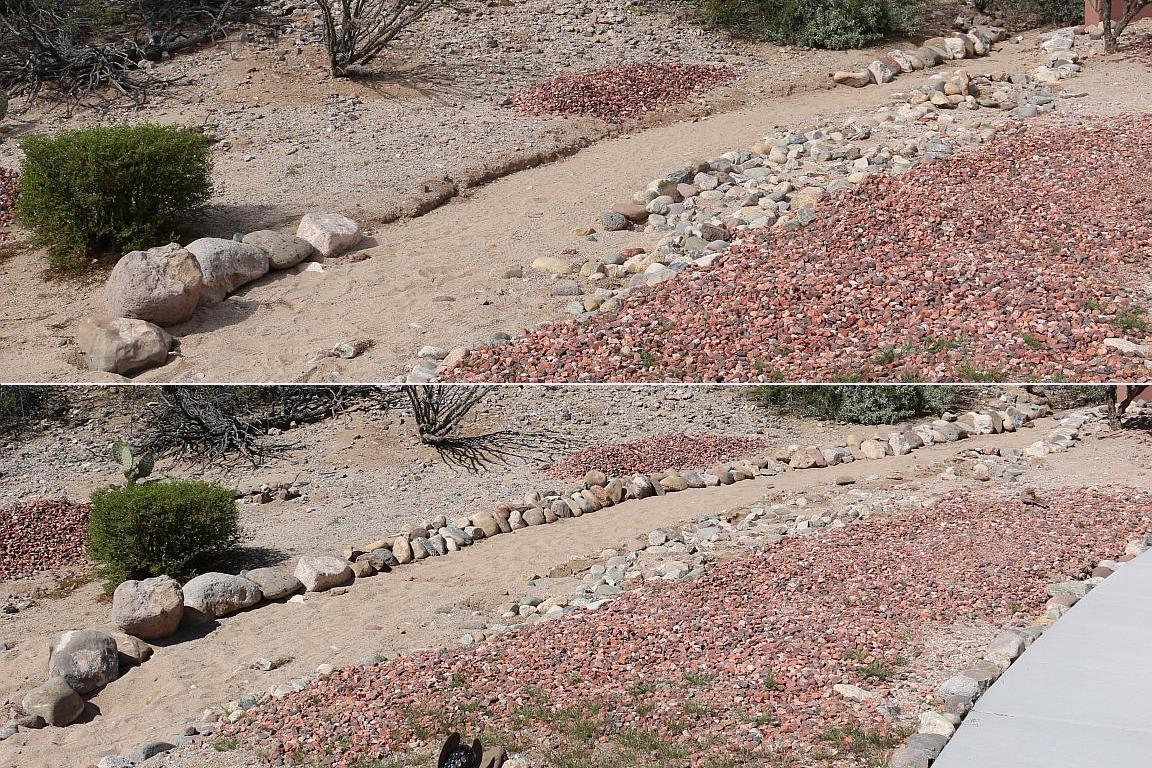
Bed ProgressUPDATE: March 04, 2016 – Damsel and I spent an hour or so finishing the west bank of our little runoff creek today. We gathered small boulders and round rocks from other areas on the property and continued to line the far side of the creek with reinforcements for the runoff that we expect this coming monsoon season.

The top panel is the work we completed when we posted the picture above; the bottom panel is the work we completed this afternoon. Click on the image to enlarge.

Leap Day 2016


This day is when the “loose change” of four “quarters” collected during the previous four years is resolved into a “dollar,” or a complete day. 2016 and every other leap year has 366 days and today, February, 29, 2016 is the 60th day of the year which would occur on March 1st in non-leap years.

Before the Gregorian Calendar, Romans and other civilizations had to ad-lib synchronization of their primitive calendars to accommodate the actual sidereal motion of the Earth around the sun by adding and subtracting days and even months.

From Wikipedia:

The calendar of the Roman king Numa Pompilius had only 355 days (even though it was not a lunar calendar) which meant that it would quickly become unsynchronized with the solar year. An earlier Roman solution to this problem was to lengthen the calendar periodically by adding extra days to February, the last month of the year.

February consisted of two parts, each with an odd number of days. The first part ended with the Terminalia on the 23rd, which was considered the end of the religious year, and the five remaining days formed the second part.

To keep the calendar year roughly aligned with the solar year, a leap month, called Mensis Intercalaris (“intercalary month”), was added from time to time between these two parts of February. The (usual) second part of February was incorporated in the intercalary month as its last five days, with no change either in their dates or the festivals observed on them. This followed naturally, because the days after the Ides (13th) of February (in an ordinary year) or the Ides of Intercalaris (in an intercalary year) both counted down to the Kalends of March (i.e. they were known as “the nth day before the Kalends of March”). The Nones (5th) and Ides of Intercalaris occupied their normal positions.

Before the Gregorian Calendar, which is in use currently, the Julian Calendar also added leap days to compensate for the actual solar circuit. When Pope Gregory XIII, introduced the new calendar in October 1582, many of the Julian Calendar errors were corrected at the expense of rearranging some important historical events to different dates than were originally established, mostly out of the Church’s desire to celebrate Easter near the time of the Vernal Equinox.

Happy Leap Day!

Rodeo Season

Bowman Rodeo Grounds

On our way up to the Wickenburg Sportsmen’s Club shooting range today, we passed the Everett Bowman Rodeo Grounds where a bunch of cowboys and cowgirls were warming up for one of the upcoming rodeo events here in town. During the winter months (and to a lesser extent the rest of the year), we see a lot of horse trailers on the roads and in the downtown and outlying arena parking areas.

We like the fact that the rodeo brings a lot of welcome commerce to our little town, even if it means more traffic on the road and more competition while grocery shopping. Both of us, although we aren’t rodeo participant types, enjoy seeing good horses and riders. We have been known to go to rodeos in the past and may do so again.

Gerbera Daisies and Tulips

Gerbera Daisies and Tulips

The flower shop in the supermarket had cut Gerbera Daisies and some nice tulips today. I bought a bunch of each and fashioned this centerpiece for the dining table this afternoon. Click on the image to enlarge.

The flowers made our light lunch of healthy greens, tomatoes, cubed avocado and shredded chicken breast taste all the better. We enjoyed a lovely spring-like day here in the desert once more.

Ultralight

Ultralight

Around the first week in December, I posted an image of an ultralight aircraft overhead at our little desert casita. Today, I had just finished delivering a package to the local UPS pickup point, when a pickup truck pulled in the parking lot with this contraption strapped in the bed.

Looking at the image I posted before, I can not positively say whether this is the same aircraft. This one has blue paint around the propeller shroud while the other one (seen in the inset) seems to have silver or white paint in that area.

I think that it is interesting that the pickup has a silhouette of a parafoil aircraft stenciled on the side, possibly indicating that there is a commercial enterprise associated with the two guys in the truck and the aircraft. Perhaps they are here for the rodeos that take place almost every weekend and on some weekdays.

Lizard Sunning on a Rock

Lizard Sunning on a Rock

I noticed this lizard sunning itself on one of the river rocks below the courtyard out front this morning. I went and got my Canon SL1 and the 300mm lens to get this picture. The little guy obliged me and sat tight while I went in to get the camera. This is another view of the same lizard.

Despite consulting a desert wildlife book and looking on the Lizards of Arizona webpage, I am unable to identify the common or taxonomic name of this variety. We see lizards all the time, now that the weather is warmer.

Maybe readers like Crotalus or Glenn B, being desert and reptile aficionados, can shed some of their wisdom on this one. Right now, I call it “Gray Lizard with two-tone brown pattern on its back.”

UPDATE: Thanks to Glenn B, the little critter has been almost positively identified as an ornate tree lizard. See Glenn’s comment below . . .