Rocket Science

In Memory of the STS-107 Crew and Columbia

lightnessIn 1981 I saw a spaceship land on Earth – twice. I went to Rogers Dry Lake by Edwards AFB in the desert and witnessed the arrival of the Columbia. I went April 14th for the first landing and again on the 4th of July for the second mission.

In 1992, I went to Titusville, Florida and watched as Columbia ascended atop a fiery plume and a trail of white smoke. The ground shook with the rumble and crack of the boosters.

Five years ago today, I awoke with a start – something – I don’t know what – made me turn on the little LCD TV I keep in the nightstand. I was horrified to see images of the destruction of Columbia.

I have a fond place in my heart for the Astronauts of STS-107 and the Columbia – and I will never forget February 1, 2003.

Image from NASA Image of the Day, taken from aboard STS-107. Click on it for 1024×768 in the viewer.
U.S. Enters Space Age – 50 Years Ago Today

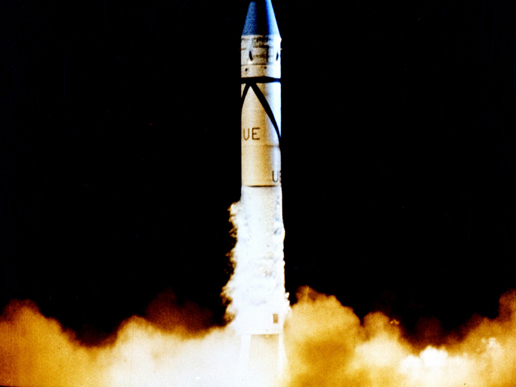
I was in my freshman year in high school and remember the elation I felt after months of failed Project Vanguard flights in the wake of the Russian Sputnik launches.

launch

Image credit NASA

Entering the Space Age

Through the combined efforts of JPL and the Army Ballistic Missile Ballistic Agency, Explorer 1 launched from Cape Canaveral, Fla., on Jan. 31, 1958. There was a nail-biting wait before tracking stations confirmed that Explorer 1 had gone successfully into orbit around Earth. With the launch of Explorer 1, the United States officially entered the space age.

The Delicate Colors of Mercury

MESSENGER, a spacecraft probe sent to explore the innermost planet, imaged the planet in multiple spectra last week. NASA/JHU image technologists re-assembled the image into colors detectable by the human eye. The result is this beautiful rendering of the delicate colors of Mercury. Click the image to enlarge.

By the way, Mars Rover OPPORTUNITY has been on the surface of the red planet for four Earth years as of today. Rover SPIRIT passed the four-year milestone January 3, three weeks ago. Congratulations to the Rover Team.

Here’s the MESSENGER article about this image.

mercury in colorMercury – in Color!

One week ago, the MESSENGER spacecraft transmitted to Earth the first high-resolution image of Mercury by a spacecraft in over 30 years, since the three Mercury flybys of Mariner 10 in 1974 and 1975. MESSENGER’s Wide Angle Camera (WAC), part of the Mercury Dual Imaging System (MDIS), is equipped with 11 narrow-band color filters, in contrast to the two visible-light filters and one ultraviolet filter that were on Mariner 10’s vidicon camera. By combining images taken through different filters in the visible and infrared, the MESSENGER data allow Mercury to be seen in a variety of high-resolution color views not previously possible. MESSENGER’s eyes can see far beyond the color range of the human eye, and the colors seen in the accompanying image are somewhat different from what a human would see.

The color image was generated by combining three separate images taken through WAC filters sensitive to light in different wavelengths; filters that transmit light with wavelengths of 1000, 700, and 430 nanometers (infrared, far red, and violet, respectively) were placed in the red, green, and blue channels, respectively, to create this image. The human eye is sensitive across only the wavelength range 400 to 700 nanometers. Creating a false-color image in this way accentuates color differences on Mercury’s surface that cannot be seen in the single-filter, black-and-white image released last week.

Continue reading…

Space Odyssey

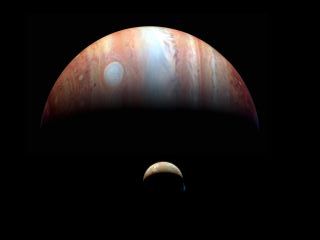
SPACE ODYSSEYAbout two years ago, I posted an article about the launch of the New Horizons interplanetary probe bound for Pluto. As part of the complex trajectory of the spacecraft, it passes close to planets that give it a gravitational ‘boost.’ When it passed by Jupiter last February, it captured images of the giant planet and its moons. This montage of the Jovian planet and its moon Io is reminiscent of scenes in the 1968 sci-fi classic ‘2001: A Space Odyssey.’

Please go to Astronomy Picture of the Day to see this incredible image close up.

Here’s the APOD story about this image:

As the New Horizons spacecraft sweeps through the Solar System, it is taking breathtaking images of the planets. In February of last year, New Horizons passed Jupiter and the ever-active Jovian moon Io. In this montage, Jupiter was captured in three bands of infrared light making the Great Red Spot look white. Complex hurricane-like ovals, swirls, and planet-ringing bands are visible in Jupiter’s complex atmosphere. Io is digitally superposed in natural color. Fortuitously, a plume was emanating from Io’s volcano Tvashtar. Frost and sulfuric lava cover the volcanic moon, while red-glowing lava is visible beneath the blue sunlight-scattering plume. The robotic New Horizons spacecraft is on track to arrive at Pluto in 2015.

Extreme Solar Images

NASA’s SOHO Extreme ultraviolet Imaging Telescope (EIT) scientific instrument has captured a complete solar cycle in the ultraviolet (extremely short wavelength light waves) spectrum. This remarkable collage demonstrates the extent to which the Sun changes over its cycle. Solar cycles have been documented for several hundred years, but never with so much detailed information as over this past cycle.

solar cycle

Every eleven years, our Sun goes through a solar cycle. A complete solar cycle has now been imaged by the sun-orbiting SOHO spacecraft, celebrating the 12th anniversary of its launch yesterday. A solar cycle is caused by the changing magnetic field of the Sun, and varies from solar maximum, when sunspot, coronal mass ejection, and flare phenomena are most frequent, to solar minimum, when such activity is relatively infrequent. Solar minimums occurred in 1996 and 2007, while the last solar maximum occurred in 2001 Pictured above is a SOHO image of the Sun in extreme ultraviolet light for each year of the last solar cycle, with images picked to illustrate the relative activity of the Sun.

Image, story courtesy SOHO – EIT Consortium, ESA, NASA & Astronomy Picture of the Day.

Please read our previous post about what the Sun is and what it does. Also read about how Solar activity can be correlated with global climate fluctuations. Then please refer to our Global Warming Resources page.

Educate yourselves – don’t trust good-intentioned but misinformed sources, and be wary of political opportunists whose goal is not to save mankind, but to cripple free enterprise and democracy.

Solar Sparkler

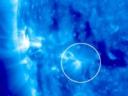
sparkler.jpgNASA’s SOHO website has a weekly feature that highlights selected solar events. This week’s SOHO Pick of the Week is about a video taken by one of the STEREO Spacecraft pair. STEREO consists of two space-based observatories – one ahead of Earth in its orbit, the other trailing behind. The video reveals a recent “shower of sparks” event on the sun’s surface. The circled region in the inset is where to look when playing the 36-second video embedded below:
Continue reading…

A Real Shooting Star

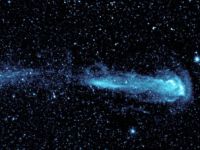
mira-tail.jpgCal Tech Astronomers using the GALEX telescope, made a very interesting and unprecedented discovery of a massive tail being left in the trail of a well-known star, Mira. The faint tail, seen in ultraviolet light, spans more than 13 light years in the wake of Mira. The discovery of this phenomenon includes a ‘bow-shock’ ahead of the star, analogous to a vessel underway on the sea.

Mira, a late-sequence red-giant star, is shedding it’s outer layers as it hurtles through the universe at amazingly high speeds (relative to our Sun). As scientists study this interesting discovery, they are likely to learn more about the ultimate destiny of our own star, which, as we know, will be similar to Mira in about five billion years.

From Science@NASA:

August 15, 2007: Astronomers using a NASA space telescope, the Galaxy Evolution Explorer, have spotted an amazingly long comet-like tail behind a star streaking through space. The star, named Mira after the Latin word for “wonderful,” has been a favorite of astronomers for about 400 years, yet this is the first time the tail has been seen.

Galaxy Evolution Explorer–“GALEX” for short–scanned the popular star during its ongoing survey of the entire sky in ultraviolet light. Astronomers then noticed what looked like a comet with a gargantuan tail. In fact, material blowing off Mira is forming a wake 13 light-years long, or about 20,000 times the average distance of Pluto from the sun. Nothing like this has ever been seen before around a star.

NASA and JPL/Caltech prepared a half-minute animation which is an artist’s conception of Mira generating her tail. Be sure and watch this neat little video.

Continue reading…