Rocket Science

The Flight of the Phoenix

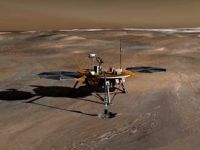
phoenix-lander.jpgYesterday’s launch of the asteroid-bound Dawn Mission was postponed until September due to bad weather and potential interference with the scheduled launch of the Mars Phoenix Lander on August 8th.NASA has scheduled a news conference for later today to discuss aspects of the postponement and the Phoenix program. Prior to the Phoenix presentations, media will have the opportunity to learn in more detail about the rescheduled Dawn launch.

Image left: Artist’s concept of Phoenix on the surface of Mars. Image credit: NASA/JPL.

The Phoenix Lander is the first in a series of landers in NASA’s Mars Scout Program. The “Phoenix” name is taken as the lander is a reincarnation of previous landers or failed missions. Phoenix will land in the icy Northern Plains of Mars and become a fixed-location probe designed to explore the geological history of that region of the planet.

Read more about the Phoenix Lander Program and watch the really cool NASA animated video of the arrival of Phoenix on Mars: Continue reading…
SOHO — So Spectacular

This video is from a collection of SOHO images taken over the operational lifetime of the spacecraft (a little more than eleven years). In it you can see some of the more spectacular solar activity that occurred over that period.

“The Sun is anything but a stable, yellow ball in the sky.” That quote is the opening line of commentary in a recently-produced NASA video about the STEREO project — another spaceborne observation system that captures solar images in three dimensions.

I look forward to seeing a three-dimensional equivalent of this video from STEREO in the not-to-distant future.

Video courtesy NASA and SOHO

First STEREO Images

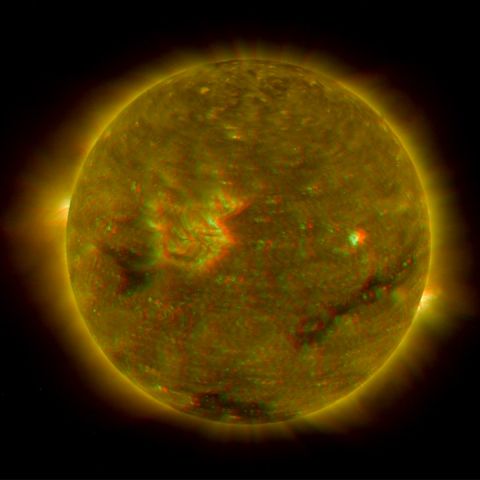
The STEREO spacecraft has furnished its first 3D images. The images are taken from STEREO’s X-ray cameras; one taken from the “Ahead” spacecraft and one taken from the “Behind” spacecraft and then combined to produce the 3D effect.

To view these anaglyphic images in 3D you will need red-blue glasses, which you can get free from Rainbow Symphony.

stereo 3d

I also repackaged a lower-bandwidth video of the rotation of the solar disk leading up to the view of the Sun seen above. I even put some music to it to add some cinematic pizazz. Eat your heart out, Al Gore:

Continue reading…

Lunar Transit of the Sun

Although there will be an eclipse of the Moon later today, there was a solar eclipse, of sorts, last week — from the vantage point of one of the recently-launched STEREO spacecraft, that is. Astronomy Picture of the Day featured this video of a lunar transit of the Sun taken by the cameras on board STEREO B, one of two STEREO spacecraft en route to their observation stations. The angular subtense of the Moon in this video is about a quarter of the size as would be seen from Earth.

Video courtesy NASA & APOD.

Assymetrical Solar Polar Mystery

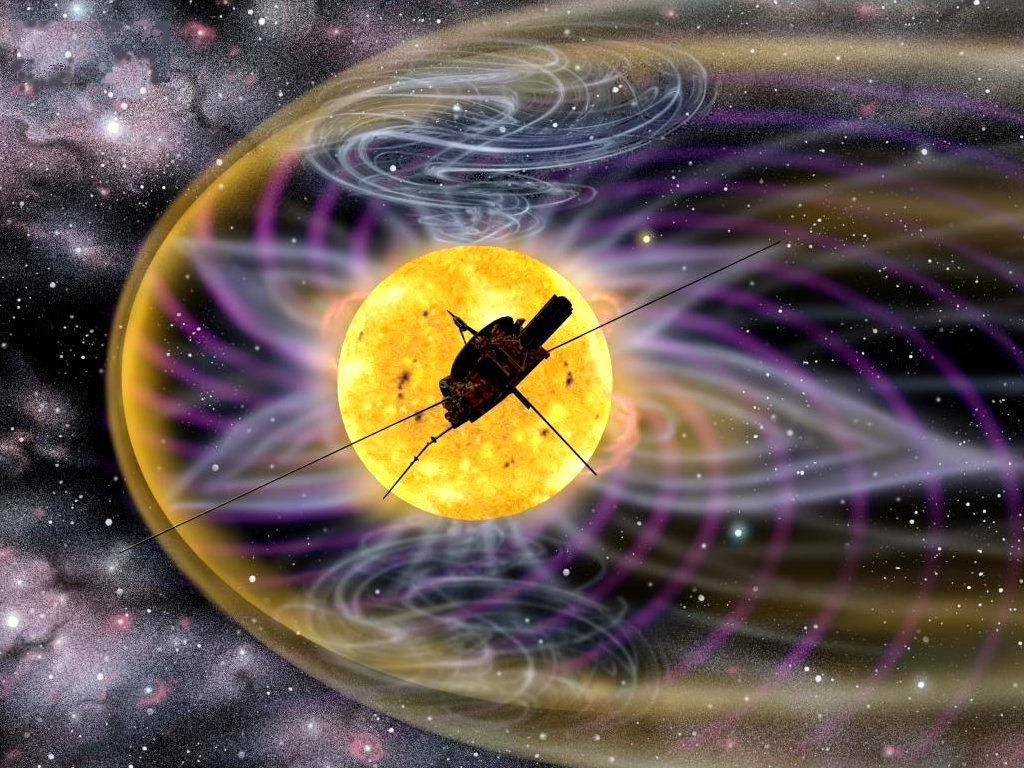
solar magnetic fieldTo see is to know — that’s an old science and engineering principle that has been around for most of the history of human technological progress. If you hypothesize you can develop a theory about a topic. If you have a theory, it isn’t much good unless you test it. Testing, it seems, isn’t always easy nor is it infallible. And once in a while, when testing your theories, you come up with a real head-scratcher. Like why is the Sun’s south pole cooler than it’s north pole? Why does that hold true regardless of the solar magnetic field’s north-south orientation?

Image: Ulysses and the Solar Magnetic Field (click image for full-size view) ESA Solar Image Gallery

I know, I know! It must be industrial pollution on planet Earth and greenhouse gasses . . . well, maybe Al Gore can explain it better.

Continue reading…

Google Meets NASA

I worry when a large, politically left-leaning enterprise like Google teams up with a government bureaucracy like NASA. True, I support most of the Space Programs, but wonder if this will pan out.

Google and NASA Ames will focus on making the most useful of NASA’s information available on the Internet. Real-time weather visualization and forecasting, high-resolution 3-D maps of the moon and Mars, real-time tracking of the International Space Station and the space shuttle will be explored in the future.
Well, it sounds like fun, but . . .

Continue reading…

STEREO Sends First Solar Images

For the first time since its October Launch, the twin-spacecraft STEREO project is producing and sending back images of the Sun. Projects like these are important to understanding the effects of the Sun on our climate and environment. The more that we know about this, the better we are able to further disarm global climate alarmist fantasies about anthropogenic effects.

Image right: A close up of loops in a magnetic active region. These loops, observed by STEREO’s SECCHI/EUVI telescope, are at a million degrees C. This powerful active region, AR903, observed here on Dec. 4, produced a series of intense flares over the next few days. Credit: NASA

Continue reading…