Some especially intense auroras resulting from solar flares associated with sunspot 930 were visible from outer space via an Air Force satellite. Here’s the story from SpaceWeather.com:
AURORAS FROM SPACE: How bright were the auroras of Dec. 14th? As bright as city lights and easily seen from space. A US Air Force DMSP satellite took this picture from orbit 830 km above the United States:
The bright arc stretching from Montana to Maine is the aurora Borealis. In many places it completely overwhelms the city lights below.
“The DMSP satellite has the ability to detect auroral light at night,” says Paul McCrone of the Air Force Weather Agency at Offutt AFB in Nebraska. “These images are mosaics of various DMSP overflights on Dec. 12-13, Dec. 13-14, and Dec 14-15. The Dec. 14th image is quite striking.”
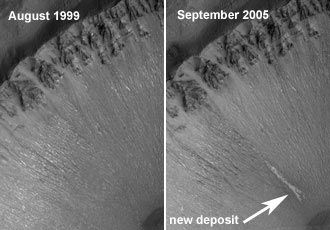 Image right: A new gully deposit in a crater in the Centauri Montes Region. Image credit: NASA/JPL/Malin Space Science Systems
  There’s a lot of interesting things to see in the sky today – the bad news is they’re all happening in the direction of the Sun and impossible to see without special equipment. The good news, however, is that there are ways to see these events without looking directly at the Sun, which is ill-advised and likely dangerous to your vision.
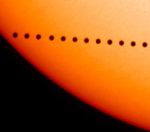 Don’t get your hopes up for a spectacular view of this event. Even with
 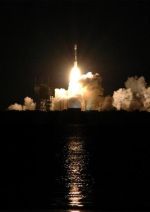 The twin spacecraft mission STEREO blasted off from Cape Canaveral in a nighttime launch last night. STEREO, which stands for Solar TErrestrial RElations Observatory, is a two-spacecraft mission to observe solar activity from two vantage points in orbit around the sun. the spacecraft, identified as A (ahead) and B (behind), will head for the Moon to get a gravitational “slingshot” into orbit. B will be flung into orbit behind the Earth while A will return to the Moon for another boost into orbit ahead of Earth. This separation in space provides a unique view of the Sun from orbits with a similar distance from the Sun as the Earth, while imaging from points away from our planet. The spacecraft will assume their stations near