Rocket Science

The Rings of Saturn

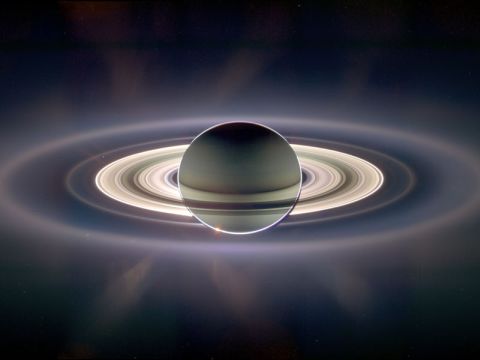
This photo, taken by the Cassini-Huygens Probe shows Saturn’s rings as we’ve never seen them. Taken from behind the planet while the Sun was eclipsed, the photo reveals that there are more rings than previously believed.

Funny things happen when you get the illumination coming from behind an object. Damsel once took a photo of Air Force One that gave the illusion of a transparent vertical stabilizer.

Read the whole story: NASA Finds Saturn’s Moons May be Creating New Rings

Space Radiation Storm

During the years 1999 & 2000 the solar maximum occurred; the time of an 11-year cycle when the Sun exhibits greatest activity. This was the first chance for the Xray Camera on SOHO to observe solar activity at maximum. On July 14, 2000, the camera recorded one of the largest Xray flares to date. In review, this article from NASA recalls the ensuing storm and it’s effects on our planet.

Space Radiation Storm

July 14, 2000 — This morning NOAA satellites and the orbiting Solar and Heliospheric Observatory (SOHO) recorded one of the most powerful solar flares of the current solar cycle. Space weather forecasters had been predicting for days that an intense flare might erupt from the large sunspot group 9077, and today one did.

“Energetic protons from the flare arrived at Earth about 15 minutes after the eruption,” says Gary Heckman, a space weather forecaster at the NOAA Space Environment Center. “This triggered a category S3 radiation storm.”

Right: This SOHO animation of an X-class solar flare was recorded by the spacecraft’s Extreme-ultraviolet Imaging Telescope at 195 angstroms. This recording nicely shows a flare, followed by a torrent of energetic particles that arrived about 15 minutes later, creating snow on the images as the particles bombarded the camera’s electronic detectors. A second flare does not create as much noise. The duration of this sequence is almost a minute, so keep watching.

According to NOAA space weather prediction scales, an S3 storm can cause the following effects on satellites: single-event upsets, noise in imaging systems, permanent damage to exposed components/detectors, and decrease of solar panel currents. It can also expose air travelers at high latitudes to low levels of radiation, the equivalent of a brief chest x-ray.

[more]

Presently, the sun is between maxima. Although the sun is fairly quiet now, there can still be the occasional flare up.

Discovery to Launch on July 4th?

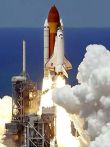
UPDATE: All Systems were GO and Discovery blasted off this afternoon! Godspeed to the Astronauts.

Image: Discovery clears the pad on liftoff — FoxNews.com

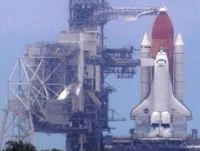
Discovery is on the pad and poised for a Fourth of July launch. NASA gives it a sixty-percent chance of launching.

NASA – Space Shuttle

Discovery’s a “Go” for Independence Day

After analysis of available data, the Mission Management Team has given a “go” for Tuesday’s launch of Space Shuttle Discovery to the International Space Station.

During a routine inspection Sunday night after the draining of the external fuel tank, a crack was discovered in the foam near a bracket that holds the liquid oxygen feedline in place. It is believed that the rain experienced during Sunday’s launch attempt caused water to run down the feedline and form ice near the top of the strut next to the feedline bracket. As the tank warmed and expanded, the ice that formed most likely pinched the foam on the top of the strut, causing a crack and eventual loss of the small piece of foam. The Mission Management Team met Monday at 6:30 p.m. EDT to discuss the results of the information before making a final decision regarding Tuesday’s launch attempt.

Extensive analysis showed that the area around the crack is intact and there is no concern for heating as there is adequate foam in place on the strut. Additional borescope inspection of the tank revealed that the bracket has no cracks.

Currently, there is a 60 percent chance of favorable launch weather for Tuesday and a 40 percent chance of favorable weather for Wednesday according to Air Force First Lt. Kaleb Nordgren of the 45th Weather Squadron. If the weather cooperates this will be the first Independence Day launch of a space shuttle!

A Fourth of July Discovery Launch would nicely compliment STS-4 Columbia‘s Fourth of July, 1982 landing at Edwards AFB in California.

SpaceLine.org — July 4, 1982 – 9:09:31 a.m. PDT at Runway 22, Edwards Air Force Base, California. Rollout distance was 9,878 feet. Rollout time was 73 seconds. Mission duration was 7 days, 1 hour, 9 minutes, 31 seconds. Landing occurred during the 113th orbit.

This was the first landing on the 15,000-foot concrete runway at Edwards.

I was lucky enough to have been on Rogers Dry Lake on July 4th, 1982 and witnessed the arrival of STS-4 at Edwards and also to observe NASA’s 747 piggy-back departure with another of the Space Shuttle Fleet in tow that same Day – spectacular! President Reagan was there that day, although I didn’t get close enough to see him.

Hubble Back in Operation

Since the James Webb Space Telescope is a ways off, I’m delighted to see the engineers get the Hubble Space Telescope back in operation.

From NASA:

NASA Issues Hubble Space Telescope Status Report
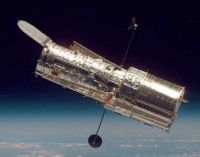
NASA engineers successfully activated the Advanced Camera for Surveys at 9:12 a.m. EDT Friday aboard the agency’s Hubble Space Telescope. Checkout was completed at 10:20 a.m. EDT with science observations scheduled to resume Sunday, July 2.

“This is the best possible news,” said Ed Ruitberg, deputy associate director for the Astrophysics Division at NASA’s Goddard Space Flight Center, Greenbelt, Md. “We were confident we could work through the camera issue, and now we can get back to doing more incredible science with the camera.”

Engineers began uploading commands to the instrument Thursday, June 29, in an effort to restore operational status. A pre-programmed observing timeline for normal camera science operations will begin executing at approximately 8 p.m. EDT on July 2.

Engineers received indications on Monday, June 19, that power supply voltages were out of acceptable limits, causing the camera to stop functioning. The instrument was taken off line, so engineers could study the problem and determine the appropriate remedy. Hubble observations continued using other onboard science instruments.

The third-generation Hubble instrument consists of three electronic cameras, filters and dispersers that detect light from the ultraviolet to the near infrared. Astronauts installed the camera during a servicing mission in March 2002. It was developed jointly by Goddard, Johns Hopkins University, Baltimore; Ball Aerospace, Boulder, Colo.; and the Space Telescope Science Institute, Baltimore.

For information about the Hubble Space Telescope, visit:

http://www.nasa.gov/hubble
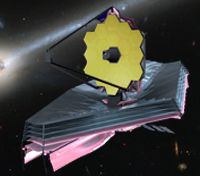
About the James Webb Space Telescope:

The James Webb Space Telescope (JWST) is a large, infrared-optimized space telescope, scheduled for launch in 2013. JWST will find the first galaxies that formed in the early Universe, connecting the Big Bang to our own Milky Way Galaxy. JWST will peer through dusty clouds to see stars forming planetary systems, connecting the Milky Way to our own Solar System. JWST’s instruments will be designed to work primarily in the infrared range of the electromagnetic spectrum, with some capability in the visible range.

JWST will have a large mirror, 6.5 meters (21.3 feet) in diameter and a sunshield the size of a tennis court. Both the mirror and sunshade won’t fit onto the rocket fully open, so both will fold up and open only once JWST is in outer space. JWST will reside in an orbit about 1.5 million km (1 million miles) from the Earth.

JWST will orbit the L2 Lagrange Point, in the vicinity of the WMAP probe we blogged about yesterday.

Back to the Bang

Scientists believe the Big Bang occurred because of an observed “cosmological background radiation” seen in all directions from the vantage point of Earth. Since June, 2001, a space-based instrumented observation platform called the Wilkinson Microwave Anisotropy Probe (WMAP) has been collecting data that allows scientists to literally look back in time and space to virtually witness the birth of the universe.

In the video below, you will see a journey back through space/time starting from the WMAP probe in it’s orbit and continuing outward past Mars, the Asteroid Belt, Jupiter, Saturn, through the Oort cloud and into interstellar space. The journey continues through a “local” nebula in Orion and thence out of the Milky Way and past thousands of galaxies back into the time of primordial blue giant stars and ultimately past the “dark ages” and into the afterglow of the Big Bang. Then, brilliant light and, finally, darkness at “before the beginning of time.”

Please take this thrilling journey back to the beginning of time: (press to play)

Video courtesy NASA’s WMAP website
Audio — “Visions” from Distant Spirits — Scott August

Some history about WMAP:

WMAP was launched on June 30, 2001 from the Cape Canaveral Air Force Base aboard a Delta II rocket.

WMAP completed its prime 2 years of mission operations in its L2 orbit by September 2003. Meanwhile, the 2002 and 2004 Astronomy and Physics Senior Review granted WMAP mission extensions, endorsing the proposed 8-years of mission operations, to end September 2009.

In February 2003 the WMAP Team released a set of 13 papers (241 journal pages) along with flight data from the first year of observations of the CMB. In March 2006, the WMAP Team released 3-year data, including full polarization data, and papers describing the data processing, systematic error analyses, calibration, and other critical aspects of the experiment.

And, finally, a schematic diagram of the trip you just took back over more than thirteen and a half billion years in about a minute!

Schematic of the cosmic chronology

Images and video courtesy of NASA

Spouting More Hot Air than Al Gore

Who are Al Gore and his enviroloons going to blame for this reckless discharge of greenhouse gasses?

From Astronomy Picture of the Day:

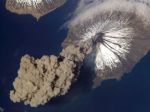
An Alaskan Volcano Erupts

What is happening to that volcano? It’s erupting! The first person to note that the Aleutian Cleveland Volcano was spewing ash was astronaut Jeffrey N. Williams aboard the International Space Station. Looking down on the Alaskan Aleutian Islands two weeks ago, Williams noted, photographed, and reported a spectacular ash plume emanating from the Cleveland Volcano. Starting just before this image was taken, the Cleveland Volcano underwent a short eruption lasting only about two hours. The Cleveland stratovolcano is one of the most active in the Aleutian Island chain. The volcano is fueled by magma displaced by the subduction of the northwest-moving tectonic Pacific Plate under the tectonic North America Plate.

Image and story courtesy NASA and APOD

Huge 4th of July Display — on Jupiter!

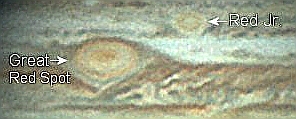
And, on an astronomical scale, it IS huge! We reported in a previous article, See Spot Run about the two red spots on Jupiter, Great Red and Red, Jr. Time to get the backyard telescope out and get it tuned up for this!

NASA – Huge Storms Converge

June 5, 2006: The two biggest storms in the solar system are about to go bump in the night, in plain view of backyard telescopes.

Storm #1 is the Great Red Spot, twice as wide as Earth itself, with winds blowing 350 mph. The behemoth has been spinning around Jupiter for hundreds of years.

Storm #2 is Oval BA, also known as “Red Jr.,” a youngster of a storm only six years old. Compared to the Great Red Spot, Red Jr. is half-sized, able to swallow Earth merely once, but it blows just as hard as its older cousin.

[more]