Rocket Science

Droids in Space

I’m sure there is a purpose in all this besides a science project . . .

NASA – Droids on the ISS

Six years ago, MIT engineering Professor David Miller showed the movie Star Wars to his students on their first day of class. There’s a scene Miller is particularly fond of, the one where Luke Skywalker spars with a floating battle droid. Miller stood up and pointed: “I want you to build me some of those.”

So they did. With support from the Department of Defense and NASA, Miller’s undergraduates built five working droids. And now, one of them is onboard the International Space Station (ISS).

Inset image: MIT undergrads flight-test a prototype droid onboard NASA’s KC-135 reduced gravity aircraft.

[Read More]

Didn’t NASA Astronauts refer to the reduced gravity aircraft as the “vomit comet?”

Toto, We’re not in Barstow Anymore

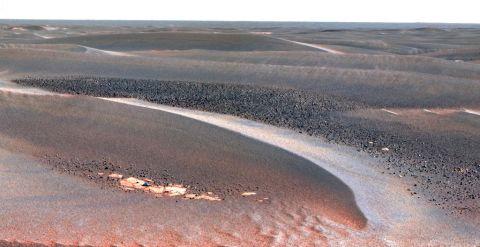
Finally! The Mars Rover “Opportunity” returned an image of the Martian Landscape that doesn’t look like it was taken in the Mojave Desert. The eerie textures and coloring lend an other-worldliness appearance to this image, unlike the images that comedian Dennis Miller asserts “Looks like Barstow!”

Photo Courtesy NASA/JPL-Caltech

Click here for a Larger Image.

As NASA’s Mars Exploration Rover Opportunity continues to traverse from “Erebus Crater” toward “Victoria Crater,” the rover navigates along exposures of bedrock between large, wind-blown ripples. Along the way, scientists have been studying fields of cobbles that sometimes appear on trough floors between ripples.

They have also been studying the banding patterns seen in large ripples.This view, obtained by Opportunity’s panoramic camera on the rover’s 802nd Martian day (sol) of exploration (April 27, 2006), is a mosaic spanning about 30 degrees. It shows a field of cobbles nestled among wind-driven ripples that are about 20 centimeters (8 inches) high.

This is a false-color rendering that combines separate images taken through the panoramic camera’s 753-nanometer, 535-nanometer and 432-nanometer filters. The false color is used to enhance differences between types of materials in the rocks and soil.

OK — I admit that this is a “false color” image and isn’t representative of the natural sunlight on Mars, but if you were to pump sunlight up to the amount the Earth gets, you just might get a picture like this.

The Sky is NOT Falling – Yet

NASA – NASA Satellites Observe Comet’s Trail

There will be no tsunamis, firestorms or mass extinctions to spoil your Memorial Day weekend.

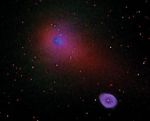
Image right:This infrared image from NASA’s Spitzer Space Telescope shows the broken Comet skimming along a trail of debris left during its multiple trips around the sun. On the lower right lies the Ring Nebula, coincidentally in the same direction as the cometary fragment.

Despite speculation that Comet 73P/Schwassmann-Wachmann 3 will strike the Earth on May 25, neither the main comet nor any of its more than 40 fragments pose a danger to Earth.

“We are very well acquainted with the trajectory of Comet 73P Schwassmann-Wachmann 3,” said Donald Yeomans, manager of NASA’s Near-Earth Object Program Office. “There is absolutely no danger to people on the ground or the inhabitants of the International Space Station, as the main body of the object and any pieces from the breakup will pass many millions of miles beyond the Earth.”

However, you can see the comet falling apart right before your very eyes, thanks to NASA’s Hubble Space Telescope, Swift X-Ray and Spitzer Space Telescope.

Click on the Space Rocks page for an animated preview of the next large comet impact.

Space Monkeys

This is sort of a neat little gadget. It would be nice to have one of these handy for help around the house and garden too.

NASA – Limber Robot Might Hitchhike to Space

Lemurs, those wide-eyed, active, monkey-like animals running around the island in the movie “Madagascar,” are known for their ability to leap. A robotic lemur being tested at NASA’s Jet Propulsion Laboratory moves more slowly, but might someday take its own giant leap – by going into space with astronauts.

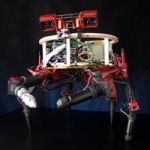
Image right: The crawling robot, Lemur

“Lemur,” short for the Limbed Excursion Mechanical Utility Robot, was originally conceived to help maintain future spacecraft and space stations. It weighs in at just 26 pounds (12 kilograms) and is small enough to hitch a ride on the space shuttle or NASA’s planned crew exploration vehicle.

“Lemur could be an astronaut’s pet monkey,” says JPL engineer Brett Kennedy, principal investigator for the robotic project. “It can perform tasks that are too small for astronauts to do easily. It’s built to get into the nooks and crannies of a structure.”

[more]

See Spot Run

The newly-spawned “Red Spot Jr.” Jovian storm system appears that it will overtake “Big Red” in early July. Note the “significant climate change” reference in the article.

From New Scientist:

Hubble watches Jupiter’s ‘Red Spot Races’

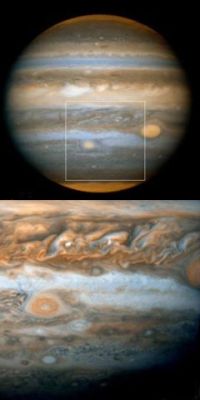
Hubble has sent back the clearest pictures yet of Jupiter’s new red spot.

The storm, dubbed “Red Spot Junior” is roughly half the diameter of the Great Red Spot, a huge storm that has churned away on Jupiter for at least 400 years – when humans first started observing the gas giant planet.

On 8 April 2006, the Hubble Space Telescope’s Advanced Camera for Surveys took new pictures of the baby storm, which was initially known as White Oval BA before it changed to the same salmon hue as the Great Red Spot (see “Jupiter opens a second red eye”) . The storm formed when three white oval storms merged between 1998 and 2000. Those white storms existed for about 60 years.

Image – NASA – Hubble photos of (top) Jupiter and (bottom) Red Jr.

The red colouring could come from material brought up from deeper within Jupiter’s atmosphere and then altered by the Sun’s radiation. If this is indeed what is happening, it may be a sign that the storm is intensifying.

The newly released images may give weight to the idea that Jupiter is in the middle of significant climate change. Temperatures at some latitudes could be changing by over 5°C, scientists suggest.

Another link to climate is that Red Spot Jr is forming at a latitude of 34° south. Theory has it that this is the where the transfer of heat from the equator to the pole grinds to a halt.

Hmmmmm. It must be all them Jovian SUVs trucking around beneath the clouds causing this colossal climate change.

Update: NASA’s Astronomy Picture of the Day has a nice close up picture showing Jupiter and both red spots.

STS-1 Pilot Crippen Awarded Medal of Honor

I was very fortunate to have been on Rogers Dry Lake at Edwards AFB on the day that Crippen and Young arrived on the lakebed in STS-1. The landing happened so quickly that I was astonished. From the twin sonic booms overhead to the touchdown on the lake seemed almost instantaneous — but I shall never forget it. I purchased a button from a lakebed entrepreneur that said “I SAW A SPACESHIP LAND ON EARTH.”I attached the button to my old cowboy hat that I wore in the desert sun. I still have that button somewhere . . .

Commander John Young received his award in 1981, and Crippen’s award was overdue in my opinion. Congratulations Bob Crippen!

NASA — First Shuttle Pilot Crippen Gets Congressional Space Medal of Honor

Former NASA astronaut Bob Crippen, pilot on the first space shuttle mission in 1981, has been honored with the nation’s highest award for spaceflight achievement, the Congressional Space Medal of Honor.

Yesterday evening, at a gala celebrating the 25th anniversary of the first Space Shuttle mission, Robert Crippen became the 28th astronaut in history to be awarded the Congressional Space Medal of Honor.

The surprise presentation by NASA Administrator Michael Griffin was made before the gathered audience at the National Air and Space Museum, including Crippen’s STS-1 commander and 1981 medal recipient John Young.

“This medal, awarded by the Congress of the United States, commemorates publicly what all of us who know Bob Crippen already understood: he is an authentic American hero,” said Griffin.

“It was such a surprise. I am totally overwhelmed,” said Crippen in a statement released after the ceremony. “Just look at the names of the people who are on the list. They are heroes in the truest sense of the word and I can’t believe someone would think to include me in such distinguished company. I’m so honored.”

The award commends astronauts whose efforts in space exemplify actions of tremendous benefit to mankind. The medal, which has also been given to astronauts who died in the line of duty, was last presented in 2004 to the crew of STS-107. The award was first given in 1978 to astronauts Neil Armstrong, Frank Borman, Pete Conrad, John Glenn, Alan Shepard, and posthumously to Virgil “Gus” Grissom.

ACE in the Sky

Although extremely rare, auroras are occasionally seen in Southern California. I can recall a time when I saw the red glow in the northern sky from Palos Verdes Peninsula.

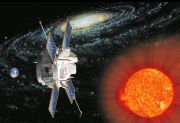
A space probe called Advanced Composition Explorer (ACE), measures attributes of the solar wind. ACE is useful to forecast (short term – an hour or so) fluctuations in the solar wind that may cause power-grid outages and extraordinary auroras under the right conditions. SpaceWeather.com points out that there are no plans to replace this resource when it ceases to function. From SpaceWeather.com:

COMMENTS, PLEASE: NASA’s ACE spacecraft is almost four years past its intended lifetime. Although ACE measurements of the solar wind flowing past Earth are crucial to space weather forecasts, there is no plan to replace ACE when the craft ceases to function. NOAA is seeking public comment on this state of affairs. If you enjoy auroras, please let them know that ACE needs a successor.

The ACE Caltech Website has this additional information about ACE:

From a vantage point approximately 1/100 of the distance from the Earth to the Sun ACE performs measurements over a wide range of energy and nuclear mass, under all solar wind flow conditions and during both large and small particle events including solar flares. ACE provides near-real-time solar wind information over short time periods. When reporting space weather ACE can provide an advance warning (about one hour) of geomagnetic storms that can overload power grids, disrupt communications on Earth, and present a hazard to astronauts.

ACE orbits the [Lagrange] L1 libration point which is a point of Earth-Sun gravitational equilibrium about 1.5 million km from Earth and 148.5 million km from the Sun. With a semi-major axis of approximately 200,000 km the elliptical orbit affords ACE a prime view of the Sun and the galactic regions beyond. The spacecraft has enough propellant on board to maintain an orbit at L1 until ~2019.