
Because of rainclouds in our area, we missed this spectacular light show last evening. However, SpaceWeather.Com, published a couple of nice images of the light show.
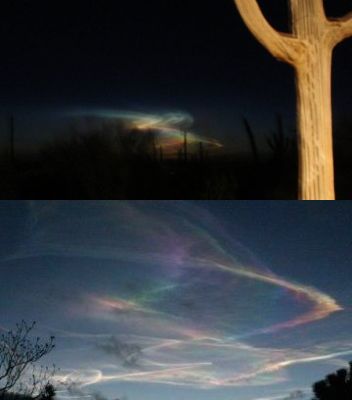
Photos from SpaceWeather.Com
From Spaceflight Now:
Six tiny satellites sped into space Friday evening aboard an ultra-fast rocket booster, beginning a five-year mission to examine Earth’s atmosphere and the underlying hints of climate change by employing a novel technique.
The $100 million COSMIC mission that partners the U.S. and Taiwan roared away from the wet and foggy Space Launch Complex 8 on the southern end of Vandenberg Air Force Base in California at 6:40 p.m. PDT (9:40 p.m. EDT; 0140 GMT).
The Orbital Sciences Minotaur rocket was gone in a flash, almost instantly disappearing from view of launch pad cameras. The liftoff was delayed an hour-and-a-half after an initial countdown attempt was aborted because of a problem with the system monitoring rocket data.
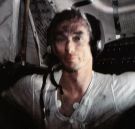 April 4, 2006: Thirty-plus years ago on the moon, Apollo astronauts made an important discovery: Moondust can be a major nuisance. The fine powdery grit was everywhere and had a curious way of getting into things. Moondust plugged bolt holes, fouled tools, coated astronauts’ visors and abraded their gloves. Very often while working on the surface, they had to stop what they were doing to clean their cameras and equipment using large–and mostly ineffective–brushes.
 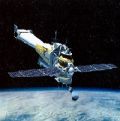 A Russian communications satellite appears to have been struck by “a sudden external impact”. Its operators say the extent of the damage caused means the satellite will be sent into “space disposal orbit”.
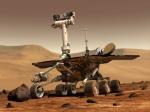 Spirit continued to make progress toward “McCool Hill” despite a reduction in solar energy and problems with the right front wheel. The team plans to have the rover spend the winter on the hill’s north-facing slopes, where the tilt toward the sun would help maximize daily output by the solar panels. On Spirit’s 779th sol, or Martian day (March 13, 2006), the drive actuator on the right front wheel stalled during a turn to adjust the position of the rover’s antennas. The stall ended the day’s drive, which brought Spirit 29 meters (95 feet) closer to McCool, still approximately 120 meters (390 feet) away.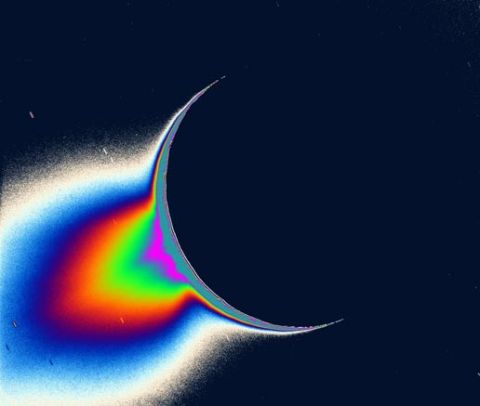
 If you step out this evening or or tomorrow evening, you might catch a glimpse of the seldom-seen planet – Mercury. Known as the
 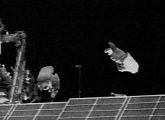 SUITSAT IS SILENT: Space is cold–apparently too cold for SuitSat’s batteries. The Earth-orbiting spacesuit stopped transmitting shortly after it was thrown overboard from the International Space Station on Feb. 3rd. Probable cause: lack of power.