Rocket Science

Moondust and Gunpowder?

This is from the third installment of Science@NASA’s Apollo Chronicles.

NASA – Apollo Chronicles: The Smell of Moondust

January 30, 2006: Moondust. “I wish I could send you some,” says Apollo 17 astronaut Gene Cernan. Just a thimbleful scooped fresh off the lunar surface. “It’s amazing stuff.”

Feel it—it’s soft like snow, yet strangely abrasive.

Taste it—”not half bad,” according to Apollo 16 astronaut John Young.

Sniff it—”it smells like spent gunpowder,” says Cernan.

How do you sniff moondust?

Right: At the end of a long day on the moon, Apollo 17 astronaut Gene cernan rests inside the lunar module Challenger. Note the smudges of dust on his longjohns and forehead. Photo credit: Jack Schmitt.

[more]

SuitSat

This is just plain weird science.

NASA – SuitSat

January 26, 2006: One of the strangest satellites in the history of the space age is about to go into orbit. Launch date: Feb. 3rd. That’s when astronauts onboard the International Space Station (ISS) will hurl an empty spacesuit overboard.

The spacesuit is the satellite — “SuitSat” for short.

“SuitSat is a Russian brainstorm,” explains Frank Bauer of NASA’s Goddard Space Flight Center. “Some of our Russian partners in the ISS program, mainly a group led by Sergey Samburov, had an idea: Maybe we can turn old spacesuits into useful satellites.” SuitSat is a first test of that idea.

Image: ISS astronaut Mike Finke spacewalks in a Russian Orlan spacesuit in 2004. SuitSat will have no one inside.

[More]

This must be the Russians’ idea of a publicity stunt. I liked the space lottery idea better.

Russian brainstorm – bah – brainfart is more like it.

See suitsat.org for pass times and details if you’re into this.

Space Lottery

Lottery: a tax on mathematically-challenged people.

I found this concept to be interesting. From SPACE.com:

A Space Lottery: An Idea Whose Time Has Come

I suggest a National Space Lottery as a new way of funding space flight systems, promoting space tourism and paying for the tickets of those who would fly. Many have spoken of our goals in space, but few offer ways to pay for them. The following proposal offers a possible solution.

The National Space Society should promote creation of a National Space Lottery. Ideally, this might become an International Space Lottery, and would offer the possibility of space flight, as a prize, to every man, woman and child on earth.


A Space Lottery would generate enormous worldwide publicity, a new fascination with space. Prizewinners would be followed like those of modern “Reality TV” shows. An International Space Lottery would be ideal. People all over the world, rich and poor, would share in the possibility of a ride into space. Space tourism could soon become a reality. Men, women and children everywhere sense that the destiny of humanity is elsewhere, and want to be part of the dream.

New Horizons off to Pluto

Today, the New Horizons spacecraft was launched from the Cape Canaveral Launch Complex. It looked spectacular on NASA’s streaming video!

From NASA:

NASA – New Horizons

After launch aboard a Lockheed-Martin Atlas V rocket, the New Horizons spacecraft set out on a journey to the edge of the solar system. Liftoff occurred Jan. 19, 2006 at 2:00:00 p.m. EST from Launch Complex 41 at Cape Canaveral Air Force Station in Florida. New Horizons is headed for a distant rendezvous with the mysterious planet Pluto almost a decade from now.

Space artist Dan Durda was commissioned to do artist’s renditions for the project and thinks that New Horizons could encounter this view of Pluto and Charon while looking back toward the Sun when it arrives in a decade:

Stardust Home After 2.88 Billion Mile Voyage

The Stardust probe landed safely in Utah this morning, bringing with it cometary and interstellar particles collected over a nearly 3 billion mile journey. After the recovered capsule is returned to Houston, it will be opened and the process of analysis will begin. Home PC users are being asked to help with locating and identifying recovered particles.

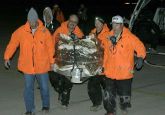
NASA’s Stardust sample return mission returned safely to Earth when the capsule carrying cometary and interstellar particles successfully touched down at 2:10 a.m. Pacific time (3:10 a.m. Mountain time) in the desert salt flats of the U.S. Air Force Utah Test and Training Range.

“Ten years of planning and seven years of flight operations were realized early this morning when we successfully picked up our return capsule off of the desert floor in Utah,” said Tom Duxbury, Stardust project manager at NASA’s Jet Propulsion Laboratory, Pasadena, Calif. “The Stardust project has delivered to the international science community material that has been unaltered since the formation of our solar system.”

. . .

The sample return capsule’s science canister and its cargo of comet and interstellar dust particles will be stowed inside a special aluminum carrying case to await transfer to the Johnson Space Center, Houston, where it will be opened. NASA’s Stardust mission traveled 2.88 billion miles during its seven-year round-trip odyssey. Scientists believe these precious samples will help provide answers to fundamental questions about comets and the origins of the solar system.

My money’s on finding traces of the same heavy elements we see on our own planet and in spectrographs of astronomical objects throughout the universe.

Read NASA’s Comet Tale Draws to a Successful Close in Utah Desert for the entire story.

Preview: Weapons of the 21st Century

New technologies using the electromagnetic spectrum show promise for better, more effective weapons to defend America – but only if the government provides the funding and support.

From Space.Com:

E-Weapons: Directed Energy Warfare In The 21st Century
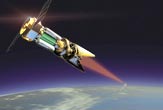
LOS ALAMOS, New Mexico — There is a new breed of weaponry fast approaching—and at the speed of light no less. They are labeled “directed-energy weapons” and may well signal a revolution in military hardware—perhaps more so than the atomic bomb.

Directed-energy weapons take the form of lasers, high-powered microwaves, and particle beams. Their adoption for ground, air, sea, and space warfare depends not only on using the electromagnetic spectrum, but also upon favorable political and budgetary wavelengths too.

That’s the outlook of J. Douglas Beason, author of the recently published book: The E-Bomb: How America’s New Directed Energy Weapons Will Change the Way Wars Will Be Fought in the Future (Da Capo Press, October 2005).Beason previously served on the White House staff working for the President’s Science Advisor (Office of Science and Technology Policy) under both the Bush and Clinton Administrations.

This concept particularly intrigued me in that it also has potential in the area of law enforcement. Think of applications where a taser might be used, or in a hostage or standoff situation:

Then there’s Active Denial Technology—a non-lethal way to use millimeter-wave electromagnetic energy to stop, deter, and turn back an advancing adversary. This technology, supported by the U.S. Marines, uses a beam of millimeter waves to heat a foe’s skin, causing severe pain without damage, and making the adversary flee the scene.

Sizzle, you asshole!

And God forbid that advertisements or worse, Hip-Hop/Rap get delivered via this medium:

Beason said that one blue sky idea of his own he tagged “the voice from heaven”. By tuning the resonance of a laser onto the Earth’s ionosphere, you can create audible frequencies. Like some boom box in the sky, the laser-produced voice could bellow from above down to the target below: “Put down your weapons.”

The article concludes with the inevitable problem of bureaucracy holding technology back (emphasis added):

History lesson

Late last year, speaking before the Heritage Foundation in Washington, D.C., Beason told his audience that laser energy, the power sources, beam control, as well as knowledge about how laser beams interact with Earth’s atmosphere are quite mature. The technology is ready to shift into front line warfare status.

“The good news is that directed-energy exists. Directed-energy is being tested and within a few years directed-energy is going to be deployed upon the battlefield,” Beason reported. “But the bad news is that acquisition policies right now in this nation are one more gear toward evolutionary practices rather than revolutionary practices.”

Visionaries win wars…and not bureaucrats. We’ve seen this through history,” Beason observed.

You can be assured that non-visionary bureaucrats (Ted Kennedys, Barbara Boxers and John Kerrys) will fight any new technologies tooth and nail.

Stardust to Return to Earth

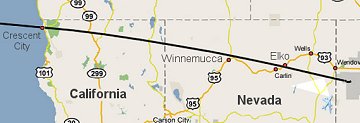
NASA’s Stardust capsule is scheduled to streak across western skies over a path from Crescent City, California, Winnemucca and Elko, Nevada to its touchdown point in western Utah. The probe will return minute particles collected during it’s journey in space.

One of my daily visits, SpaceWeather.com had this information:

FIREBALL ALERT: On Sunday morning, Jan. 15th, between 1:56 and 1:59 a.m. PST, a brilliant fireball will streak over northern California and Nevada. It’s NASA’s Stardust capsule, returning to Earth with samples of dust from Comet Wild 2. The best observing sites are near Carlin and Elko, Nevada, where the man-made meteor is expected to shine as much as 60 times brighter than Venus.

The flight path of the Stardust capsule

The fireball might be widely visible from parts of Oregon, Idaho and Utah as well as California and Nevada: observing tips. NASA is interested in videos and photos of the re-entry, which could help researchers learn more about, e.g., the physics of heat shields. Got data? Send it here.

After the spacecraft returns, volunteers will analyze the micrographs by looking for “needles” in “haystacks” – minute particles, few and far between – from electronic images distributed for analysis, similar to the Search for Extra Terrestrial Institute’s distributed processing of SETI data. You can volunteer and maybe be part of the team at Stardust@Home.