
Rocket Science

SOHO Marks 10th Year

One of my top 10 things to be thankful for is technology, which gives mankind insights into the unknown. One of these technological wonders is SOHO, the Solar and Heliospheric Observatory Satellite located at Earth’s inner Lagrangian point.

From SpaceWeather.com:

10 YEARS OF SOHO: Where would we be without SOHO? The orbiting Solar and Heliospheric Observatory (SOHO) keeps a ’round-the-clock eye on the sun and is crucial to space weather forecasting. Thousands of our readers have witnessed auroras only because SOHO spotted an incoming CME [coronal mass ejection] in time for us to issue an alert.

So it is with pleasure and appreciation that we wish a happy 10th anniversary to the SOHO team, whose spacecraft was launched on Dec. 2nd, 1995. Originally planned as a two year mission, SOHO is now entering its second decade. Amazing.

And an article from Astronomy Picture of the Day indicates that operations are planned to continue until 2007, at which time SOHO will have been in position to observe a complete 11-year solar cycle (which, as we all know, is responsible for climate change and other phenomena – not the puny efforts of mankind who the moonbat left blame for the mythical global warming).
Private Sector Lunar Plan to Compete with NASA

From SPACE.comPrivate Sector, Low-Cost Lunar Plan Unveiled

A newly released study has focused on how best to return people to the Moon, reporting that future lunar missions can be done for under $10 billion – far less than a NASA price tag.

The multi-phased three-year study was done by a private space firm, SpaceDev of Poway, California, and concluded that safe, lower cost missions can be completed by the private sector using existing technology or innovative new technology expected to be available in time to support human exploration of the Moon in the near-future.

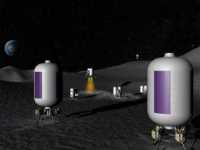
Artist rendition of the “rocket chair,” designed to lower people and equipment onto the lunar surface. credit: Spacedev
Fraction of time/cost

NASA has tallied its future lunar mission costs, projecting a figure of $104 billion over 13 years.

According to SpaceDev’s chief, Jim Benson, the private group has found that a more comprehensive series of missions could be completed in a fraction of the time and for one-tenth of the cost of the NASA estimate.

Each mission, as envisioned by SpaceDev, would position a habitat module in lunar orbit or on the moon’s surface. The habitat modules would remain in place after each mission and could be re-provisioned and re-used, thus building a complex of habitats at one or more lunar locations over time, according to a press statement on the study findings.

Benson also noted: “We are not surprised by the significant cost savings that our study concludes can be achieved without sacrificing safety and mission support.”

So – just what does NASA attribute the extra costs to?

Computer Brains in Space

In my job, making our products rad-hard is essential; use of TMR (triple-modular redundancy) and SECDED (single error correction/double error detection) are common practices in spacecraft systems design.

Perhaps science can develop a similar technology for the moonbat tinfoil-hat and koolaid crowd who are continuously bombarded by “radiation’ from the hard-left.

Excerpt from NASA – Computer Brains in Space:

When your computer behaves erratically, mauls your data, or just “crashes” completely, it can be frustrating. But for an astronaut trusting a computer to run navigation and life-support systems, computer glitches could be fatal.

Unfortunately, the radiation that pervades space can trigger such glitches. When high-speed particles, such as cosmic rays, collide with the microscopic circuitry of computer chips, they can cause chips to make errors. If those errors send the spacecraft flying off in the wrong direction or disrupt the life-support system, it could be bad news.
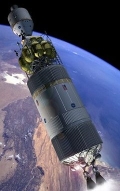
Right: The humans inside this spacecraft aren’t the only ones who need protection from space radiation; their computers do, too.

To ensure safety, most space missions use radiation hardened computer chips. “Rad-hard” chips are unlike ordinary chips in many ways. For example, they contain extra transistors that take more energy to switch on and off. Cosmic rays can’t trigger them so easily. Rad-hard chips continue to do accurate calculations when ordinary chips might “glitch.”

Hauling Ass – er – Asteroid, that is

From SPACE.com — Gravity-Powered Asteroid Tractor Proposed to Thwart Impact:

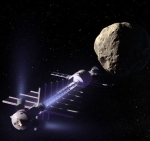
A concept spacecraft could use gravity to tow asteroids away from a collision course with earth. Credit: Dan Durda – FIAAA / B612 Foundation.
An asteroid the size of two football fields could wipe out a large city or set off a series of tsunamis across the world. The threat of such an Earth-smashing asteroid has lead scientists to dream up several methods of defending the planet against such a catastrophe.

Solutions have ranged from pushing the asteroid with a spacecraft to mounting a thruster on its surface. But pushing it would require too much fuel and could break up the asteroid. Also, asteroids rotate, which could complicate the firing of a surface thruster.

Now, two NASA astronauts have presented a plan for an “asteroid tractor”—an unmanned, 20-ton spacecraft that uses the invisible bond of gravity to gently pull an asteroid into a new, non-threatening orbit.

Read more.

Related item: check out my Space Rocks animation.

UPDATE: The Space Tractor is featured on today’s Astronomy Picture of the Day.

Take a Trip to the Moon

OK – Fire up your Quicktime® Players and take a trip to the Moon with NASA.

Before the end of the next decade, NASA astronauts will again explore the surface of the moon. And this time, we’re going to stay, building outposts and paving the way for eventual journeys to Mars and beyond. There are echoes of the iconic images of the past, but it won’t be your grandfather’s moon shot.

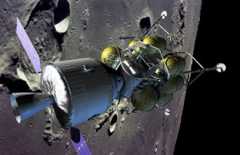
Image left: NASA’s new crew exploration vehicle in lunar orbit. Artist’s concept by John Frassanito and Associates.

This journey begins soon, with development of a new spaceship. Building on the best of Apollo and shuttle technology, NASA’s creating a 21st century exploration system that will be affordable, reliable, versatile, and safe.

The centerpiece of this system is a new spacecraft designed to carry four astronauts to and from the moon, support up to six crewmembers on future missions to Mars, and deliver crew and supplies to the International Space Station.

The new crew vehicle will be shaped like an Apollo capsule, but it will be three times larger, allowing four astronauts to travel to the moon at a time.

This is very cool.

Mars Madness!

With the closest approach until 2018 of the planet MARS this month, you might want to bone up on Martian lore and history (from an Earthbound perspective). This is a link to a very entertaining and informative site called Mars Madness!

Astronaut Walt Cunningham – Ambassador of Exploration

From SPACE.com — Astronotes

NASA will honor former astronaut Walt Cunningham as an “Ambassador of Exploration,” an award which provides recognition for the astronauts of the space agency’s first manned spaceflight programs: Mercury, Gemini and Apollo.

On Friday, October 7, at 12:00 p.m. EDT (1600 GMT), NASA officials will present Cunningham with the award, a lucite-encased moon rock, at the Frontiers of Flight Museum in Dallas. He is donating the rock to the museum, which presently displays the Apollo 7 Command Module on loan from the Smithsonian Institution in Washington, DC.

Read More . . .

This is too cool! Walt Cunningham’s family lived up the street from us when I was a kid. One of his sisters used to babysit my brother and me and another sister went to the same high school I did. Congratulations Walt Cunningham!