

Rocket Science

Moving Day

paradiseI have been reassigned to another job in another location. I hate to move. All that packing up, making arrangements to transfer the services, etc. Even with the aid of an administrator, changing job assignments where a physical move from one facility to another is a pain.

That having been said, the job change is a good thing. It takes me out of the ‘doghouse,’ a less-than-desirable ‘Dilbert’-style cubicle facility and puts me into an office tower in a well-known beach town. My office will have a door that closes and locks and walls that go to the ceiling. There are two windows (a corner office) with a view of a local park and a shopping mall.
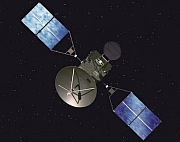
birdAs for the old job, the product line is a very good thing. Decoupling from that fact, the skill set for the job I was doing required little other than some fundamental knowledge of computers and a little analysis. Not to brag, but it was not much of a challenge and didn’t take full advantage of my experience.

The new job is similar to systems that I worked on in the past. My domain knowledge and skill set dovetail perfectly with this project. Literally, a return to the true definition of ‘aerospace engineering.’ I could tell you more about it, but then . . . well, you know.
Watching for the International Space Station

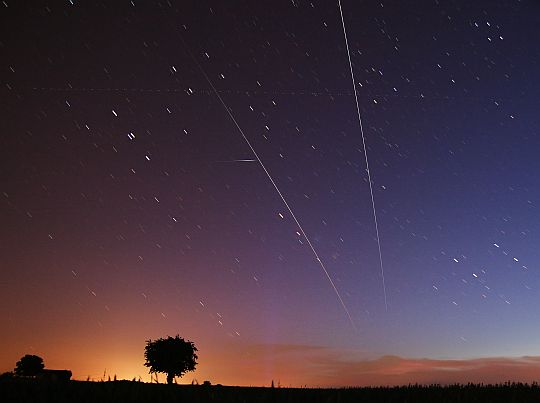
Over the next several evenings, the International Space Station currently with Shuttle Discovery docked, will make dramatic passes overhead. I regularly visit a site called SpaceWeather.com; the site features articles and widgets about things going on in space. I tuned into the feature that predicts satellite passes for individual locations (based on zip or postal code) and found these for my zip code:


Date....Rise........dir.duration.el..magnitude
June 05 10:03:34 pm NNW 10:05:44 30° -1.3 (very bright)
June 07 09:12:24 pm NNW 09:14:32 31° -1.4 (very bright)
June 08 09:34:02 pm WNW 09:36:22 59° -2.6 (very bright)
June 10 08:42:33 pm WNW 08:44:54 67° -2.8 (very bright)

I’ll be looking at the times specified. I wouldn’t want to miss an opportunity to see something like this nice image from APOD:

streaks

Guess Who’s Going to the ISS Tomorrow?

Buzz Lightyear of Toy Story 2 fame

Story from NASA:

Buzz Lightyear to Soar with Discovery

Seven astronauts who will fly into orbit aboard space shuttle Discovery will have comfortable seats for the climb into space. An eighth space ranger won’t have a seat at all. In fact, he will be packed tight inside a box and won’t even get to enjoy the ride up.

But it’s nothing veteran spaceman Buzz Lightyear can’t overcome.

The good news is that he’ll have some sports shows to listen to, along with a host of jerseys that have been to the Champs Elysees in Paris for the Tour de France and to the Super Bowl.

More accustomed to soaring among the galaxies on fold-out wings and a backpack rocket, Lightyear will take to space on Discovery’s STS-124 mission stowed inside a locker in Discovery’s crew compartment. The 12-inch-tall action figure is flying as part of a partnership between NASA and Disney Parks to encourage students to pursue studies in science, technology and mathematics, one of NASA’s main educational goals.

Flight of the Phoenix – Part III

In Part II, I posted a neat little video that shows the final landing sequence and initial deployment of panels and sensors. I’m hoping that I will be able to watch the control center during final approach and landing. I expect it will be on the NASA Channel – I’m going to check into that for sure.

Image and excerpt below courtesy of NASA.

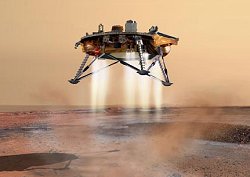
PhoenixMay 13, 2008: NASA’s Phoenix Mars Lander is preparing to end its long journey and begin a three-month mission to taste and sniff fistfuls of Martian soil and buried ice. The lander is scheduled to touch down on the Red Planet on Sunday, May 25th.
Phoenix will enter the top of the Martian atmosphere at almost 13,000 mph. In seven minutes, the spacecraft must complete a challenging sequence of events to slow to about 5 mph before its three legs reach the ground. Confirmation of the landing could come as early as 7:53 p.m. EDT.

Right: An artist’s concept of NASA’s Phoenix Mars Lander a moment before its 2008 touchdown on the arctic plains of Mars. Pulsed rocket engines control the spacecraft’s speed during the final seconds of descent.

“This is not a trip to grandma’s house. Putting a spacecraft safely on Mars is hard and risky,” said Ed Weiler, associate administrator for NASA’s Science Mission Directorate at NASA Headquarters in Washington. “Internationally, fewer than half of all attempts to land on Mars have succeeded.”

Rocks large enough to spoil the landing or prevent opening of the solar panels present the greatest known risk. However, images from the High Resolution Imaging Science Experiment (HiRISE) camera on NASA’s Mars Reconnaissance Orbiter, detailed enough to show individual rocks smaller than the lander, have helped lessen that risk.

“We have blanketed nearly the entire landing area with HiRISE images,” said Ray Arvidson of Washington University in St. Louis, chairman of the Phoenix landing-site working group. “This is one of the least rocky areas on all of Mars and we are confident that rocks will not detrimentally impact the ability of Phoenix to land safely.”

First American in Space

Alan ShepardIt’s hard to believe that it’s been that long. I remember listening to the launch and recovery on the radio while in a shop class in high school.

From NASA:

May 5, 1961

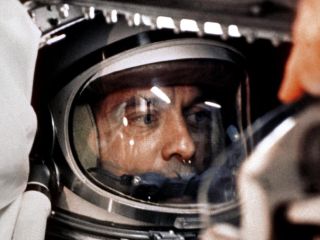
Forty-seven years ago today, astronaut Alan Shepard became the first American in space. He launched aboard his Mercury-Redstone 3, named Freedom 7, to make an historic 15-minute suborbital flight.

This image shows Shepard in capsule before launch. After several delays and more than four hours in the capsule, Shepard was ready to go, and he famously urged mission controllers to ‘fix your little problem and light this candle.’

Flight of the Phoenix – Part II

NASA Video – click > to play.

May 25th is the target date for the landing of NASA’s Phoenix Mars Lander, whose mission is to explore the Martian arctic plain. NASA adjusted the lander’s trajectory in April to refine the final approach to the planet.

Check out this really cool video of the landing and post-landing phase of the mission.

Launched in August 2007, Phoenix is a stationary lander equipped with a trench-digging robotic arm to bite into the Martian surface and scoop up samples of nearby soil and water ice. The probe’s top-mounted suite of ovens and wet chemistry instruments are designed to help determine whether its arctic plain landing site – a region similar in latitude to central Greenland or northern Alaska on Earth – could have once proven habitable for primitive life.

I’m looking forward to a safe landing for Phoenix. This will be the first Mars lander to use a retro-rocket to cushion the landing since the Mars rovers landed using the balloon-bounce landing technique over 1500 ‘sols’ (Martian days) ago.

Solar Minimum

The Sun is at solar minimum these days. That is, the eleven year solar cycle is passing through the period of lowest activity. Yet there is this spectacular activity revealed by the STEREO (Ahead) solar probe in this video from the SOHO website.

A close-up of the Sun from the STEREO (Ahead) spacecraft showing a pair of active regions (that appear as brighter regions) with some interesting activity over a two-day period (April 5-6, 2008). Two surges of material burst out from the region to the left, and the second surge appears to break away from its magnetic bindings.

Not long after, particles from one area along the Sun’s edge rise up and, following unseen magnetic field lines, connect with another area before material above each area spirals alone. None of these events caused any solar storming.

It never ceases to amaze me that our stellar companion is downplayed by the left in its contribution to global climate.