Rocket Science

Liftoff

Last evening, we paused the DVD player to watch the liftoff of Space Shuttle Discovery. After a couple of aborted countdowns earlier in the week, Discovery, once again, roared into space from the Florida Coast.

Damsel snapped this image with her camera just at the moment of liftoff. Click to enlarge.

liftoff.jpg

From NASA:

With seven astronauts and a host of experiments and equipment on board, space shuttle Discovery completed a flawless ascent into orbit Friday night to begin a two-day chase of the International Space Station. With Commander Rick “C.J. ” Sturckow at the controls, the shuttle lifted off on-time at 11:59 p.m. EDT from NASA’s Kennedy Space Center in Florida. The crew will rendezvous and dock with the station Sunday and the crew will begin transferring equipment to the outpost during the 13-day mission.

NASA Mocks Stephen Colbert

C.O.L.B.E.R.T.NASA Rejected ‘Colbert’ as the name of ISS Node 3 and named it “Tranquility” in commemoration of the first manned Lunar landing in 1969. Colbert did not come away empty-handed though, since the ISS treadmill has been dubbed the ‘Combined Operational Load Bearing External Resistance Treadmill,’ or COLBERT.

From NASA:

The International Space Station module formerly known as Node 3 has a new name. After receiving more than a million responses in an online poll, NASA is naming the node “Tranquility.”

The name Tranquility was chosen from thousands of suggestions submitted by participants on www.nasa.gov. The “Help Name Node 3” poll asked people to vote for the module’s name either by choosing one of four options listed by NASA or offering their own suggestion. Tranquility was one of the top ten suggestions submitted by respondents to the poll, which ended March 20.

Colbert, as you may recall, prompted his fan base to write in ‘Colbert’ as the name for Node 3. NASA received a lot of “Colbert” support, but selected “Tranquility.”

I, for one, am amused by the way it turned out. Although NASA was trying to gracefully placate Colbert with this treadmill business, it seems like a smackdown to me.

Click on the logo above to see the full-sized version (courtesy NASA).

Kepler Spacecraft Launch

kepler.jpgLast evening, we tuned into NASA TV to watch the launch of the Kepler Spacecraft. The countdown procedures went as originally anticipated and the launch was successful.

Kepler’s mission is to statically observe a patch of our galaxy consisting of roughly one hundred thousand stars. The instrumentation consists of a photometer which will monitor the emissions of the stars to try and detect extra-solar planets. The spacecraft can detect the slight dimming of a star as a planet passes in front of it.

Of course, the orbits of such planets would have to be at an angle where the transit would align with Kepler’s line of sight. I’m hoping that the NASA scientists factor the probability of alignment into their equation to determine the planetary count.

The image above (click to enlarge) is an artist’s rendering of what our galaxy might look as viewed from outside our Galaxy. Our sun is about 25,000 light years from the center of our galaxy. The cone illustrates the neighborhood of our galaxy that the Kepler Mission will search to find habitable planets. Credit: Jon Lomberg.

The Las Vegas Boom

Landsat 5, one of several Landsat Earth-observing spacecraft has been operational for 25 years and counting. Originally intended for a three-year mission, this bird is still ticking. One of the more startling observations made by the Landsat program is a 25 year visual history of Las Vegas urban expansion.

vegas-boom.jpg

Images courtesy and © NASA/USGS. Click image for larger view.

A Desert City Blooms

In the 25 years that Landsat 5 has been in orbit, the desert city of Las Vegas has gone through a massive growth spurt. The outward expansion of the city is shown here with a series of false-color images. The dark purple grid of city streets and the green of irrigated vegetation grow out in every direction into the surrounding desert. These images were created using reflected light from the shortwave infrared, near-infrared, and green portions of the electromagnetic spectrum (Landsat 5 TM bands 7,4,2).

Credit: NASA/USGS

McCarran FieldNotice the runways at Las Vegas McCarran Airport (Just below the center of the urban mass), barely visible in 1984, now clearly visible in 2009, as it has been surrounded by industrial growth.

Methane on Mars

Scientists don’t yet know enough to say with certainty what the source of the Martian methane is, but this artist’s concept video depicts several possibilities. In this video, conjecture is offered for several possibilities. First, meteoric debris reacting with atmospheric particles possibly generating methane, next comet and meteor impacts creating chemical reactions resulting in methane production. Third, subsurface water, carbon dioxide and the planet’s internal heat combine to release methane, and, finally, living microbes actively producing methane as a waste product.

Whatever the process is, there is clear evidence that Mars is ‘farting’ methane.

STS-126

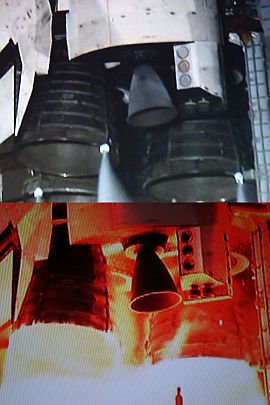
liftoff.jpgSTS-126 is on the way to the ISS. Damsel snapped these from the TV before and after engine ignition.

This is the NASA account the launch thus far:

Go for Launch!
Fri, 14 Nov 2008 04:46:20 PM PST

NASA’s mission managers have announced a “go” for launch! The countdown for the STS-126 mission has entered its final moments. Automatic systems at the launch pad will remove the remaining equipment out of the way of space shuttle Endeavour so it can make its climb into space.

Endeavour Soars Into the Night Sky!
Fri, 14 Nov 2008 05:07:21 PM PST

Space shuttle Endeavour roared off Launch Pad 39A at NASA’s Kennedy Space Center on a spectacular tower of smoke and flames. The STS-126 mission is an extremely ambitious undertaking, highlighting four spacewalks and delivering the heaviest payload in shuttle history.

External Tank and Boosters Away!
Fri, 14 Nov 2008 05:09:23 PM PST

The giant orange tank that provided fuel for Endeavour’s climb into space is now empty and is jettisoning from the shuttle. As the tank falls away and descends toward Earth, the tank’s on-board cameras record the process. About two minutes into flight, the solid rocket boosters propelling Endeavour higher into space have successfully separated and gracefully fallen away. Each booster has a parachute packed in its frustum that will automatically deploy after entering Earth’s atmosphere to slow the descent into the ocean. Endeavour has safely attained orbit and NASA mission managers have given the command to proceed with main engine cutoff, also known as MECO. Less than 10 minutes after launch, Endeavour was orbiting around Earth. Within 24 hours, Endeavour will meet up and dock with the International Space Station.

Flight of the Phoenix – Part IV

After nearly a half-year, Mars lander and science robot Phoenix goes silent. I posted about this interesting project in ‘Flight of the Phoenix’ Parts I, II, and III. This is the finale, although there is a very remote chance the robot could ‘phone home’ one last time.

Watch the video to see the Phoenix Mars approach and landing animation (courtesy NASA).

From NASA:

NASA Video – click > to play.

Mars Phoenix Lander Finishes Successful Work on Red Planet

WASHINGTON — NASA’s Phoenix Mars Lander has ceased communications after operating for more than five months. As anticipated, seasonal decline in sunshine at the robot’s arctic landing site is not providing enough sunlight for the solar arrays to collect the power necessary to charge batteries that operate the lander’s instruments.

Mission engineers last received a signal from the lander on Nov. 2. Phoenix, in addition to shorter daylight, has encountered a dustier sky, more clouds and colder temperatures as the northern Mars summer approaches autumn. The mission exceeded its planned operational life of three months to conduct and return science data.

The project team will be listening carefully during the next few weeks to hear if Phoenix revives and phones home. However, engineers now believe that is unlikely because of the worsening weather conditions on Mars. While the spacecraft’s work has ended, the analysis of data from the instruments is in its earliest stages.

Read the rest here.