Rocket Science

Sunspots Are Returning

solar disc

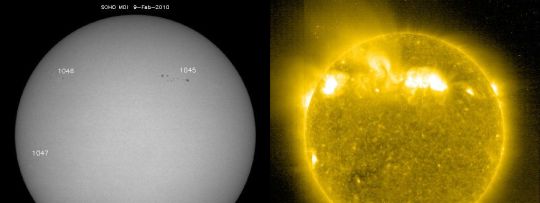
It looks like the solar activity is starting to increase. This is the first day in a while where there are three sunspots visible on the Earth-facing side of the sun. These images are from the SOHO spacecraft. The left panel is the visible light snapshot and the right panel is energy being emitted in a narrow band of ultraviolet. You can’t see UV, but it’s common knowledge that it is a major cause of skin damage.

Just how solar activity affects the climate isn’t well understood, but there is correlation between sunspot numbers and the climate.

I don’t know about you, but I am sure there are a lot of Americans rooting for warmer weather tonight. That includes us, even though we’re California weather wimps according to Breda.

The Latest from SOHO

soho-images.pngI have programmed several favorite websites (other than the blogs) that I like to visit daily. One of those is the NASA Solar and Heliospheric Observatory (SOHO) website.

A favorite feature of mine, is the Very Latest SOHO Images page. On this page, I can see the solar disc in four different Extreme ultraviolet Imaging Telescope (EIT) wavelengths of light, two images (Continuum and Magnetogram) from the Michelson Doppler Imager (MDI), and two fields of view from the Large Angle and Spectrometric COronagraph (LASCO).

The Latest Images page is where I can see what’s happening on and around the Sun in near real time. Today’s EIT images tell me that there are active regions on both the left and right sides of the disc. The active region on the right will be rotating out of view soon, while the one on the left will move toward the center of the disc. The MDI images reveal no large sunspots – the remnants of sunspot 1035 are just coming into view in the upper left. The LASCOs reveal a couple of interesting things – there are Coronal Mass Ejections associated with both active regions seen in the EIT images and the planet Mercury passed in front of and below the Sun a few days ago.

The New Hubble Optics

Being a long-time astronomy enthusiast, I am very glad that the Hubble Space Telescope is busily producing magnificent images such as this one of Barred Spiral Galaxy NGC 6217, seen on today’s Astronomy Picture of the Day:

barred.jpg

From the HST website:

For the past three months, scientists and engineers at the Space Telescope Science Institute and Goddard have been focusing, testing, and calibrating the instruments. Hubble is one of the most complex space telescopes ever launched, and the Hubble servicing mission astronauts performed major surgery on the 19-year-old observatory’s multiple systems. This orbital verification phase was interrupted briefly July 19 to observe Jupiter in the aftermath of a collision with a suspected comet.

Hubble now enters a phase of full science observations. The demand for observing time will be intense. Observations will range from studying the population of Kuiper Belt objects at the fringe of our solar system to surveying the birth of planets around other stars and probing the composition and structure of extrasolar planet atmospheres. There are ambitious plans to take the deepest-ever near-infrared portrait of the universe to reveal never-before-seen infant galaxies that existed when the universe was less than 500 million years old. Other planned observations will attempt to shed light on the behavior of dark energy, a repulsive force that is pushing the universe apart at an ever-faster rate.

Click on the image above to enlarge.

Solar Tsunamis

There are signs that the current solar cycle, presently in a relatively low activity state, is on the move to become more active as we enter the second year of the eleven-year cycle. This is a movie of an event captured last February that scientists are calling a “solar tsunami.” It is a towering wave of plasma that lifts itself more than the width of the Earth above the solar surface and hurls massive amounts of solar matter into space.

From NASA:

The twin STEREO spacecraft confirmed their reality in February 2009 when sunspot 11012 unexpectedly erupted. The blast hurled a billion-ton cloud of gas (a “CME”) into space and sent a tsunami racing along the sun’s surface. STEREO recorded the wave from two positions separated by 90o, giving researchers an unprecedented view of the event:

tsunami.gif

Above: A solar tsunami seen by the STEREO spacecraft from orthogonal points of view. The gray part of the animation has been contrast-enhanced by subtracting successive pairs of images, resulting in a “difference movie.”

Please note that this is actual science and not the filtered version that you get from, say, the University of East Anglia Climate Research Unit. You can click on the movie above to see a larger version.

STEREO Solar Globe Movie

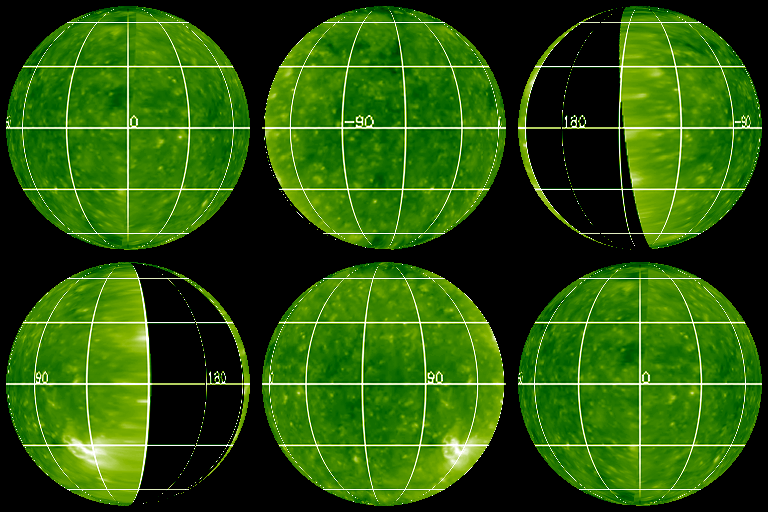
solar-movie.gifOver at the STEREO Solar observation website, they now feature an animated image of most of the solar globe. From the vantage points of the STEREO Ahead and Behind spacecraft, images are processed into this movie of the globe. Note the hot regions near the right edge just before the blank region – those spots are not in view of the SOHO spacecraft which sees the sun from the same angle as the Earth from its station at L1, the first Lagrangian point between the Earth and Sun.

From the STEREO website:

STEREO consists of two space-based observatories – one ahead of Earth in its orbit, the other trailing behind. With this new pair of viewpoints, scientists will be able to see the structure and evolution of solar storms as they blast from the Sun and move out through space.

This movie shows a spherical map of the Sun as it currently appears, formed from a combination of the latest STEREO Ahead and Behind beacon images. The movie starts with the view of the Sun as seen from Earth, with the 0 degree meridian line in the middle. The map then rotates through 360 degrees to show the part of the Sun not visible from Earth. The black wedge shows the part of the Sun not yet visible to the STEREO spacecraft.

Solar Prominence in Stereo

The STEREO project, a constellation of two identical solar probes, one ahead of the Earth (STEREO A) and one behind the Earth (STEREO B), simultaneously imaged a solar prominence from their divergent perspectives. This video was featured on NASA’s SOHO Pick of the Week.

The video below shows the mass ejection in synchronized timing from ahead and behind the Earth.

In the left panel (behind), you can see the event emerging from near the top of the solar disk, while on the right panel (ahead) it is occurring above the solar horizon. In these times when there are few sunspots, the old solar machine is still cranking out the good old nuclear fusion.