Rocket Science

Solar Eclipse as Seen From SDO

sdo-transit.jpgAn Interesting eclipse occurred earlier this month when the moon passed between the Solar Dynamics Observatory and the Sun. This is the first recorded lunar/solar eclipse taken by SDO although earth/solar eclipses happen often. SDO is like the Hubble Space Telescope but is totally devoted to solar activity.

The image at the right shows the partially-eclipsed solar disk (courtesy NASA – click to enlarge). I also uploaded a close-up image in which the mountains along the lunar limb can be discerned against the solar disc. This demonstrates the excellent resolution of the instruments aboard SDO.

The following is taken from the SDO website where you can download and watch a Quicktime video of the eclipse.

This was a first for SDO and it was visually engaging too. On October 7, 2010, SDO observed its first lunar transit when the new Moon passed directly between the spacecraft (in its geosynchronous orbit) and the Sun. With SDO watching the Sun in a wavelength of extreme ultraviolet light, the dark Moon created a partial eclipse of the Sun.

These images, while unusual and cool to see, have practical value to the SDO science team. Karel Schrijver of Lockheed-Martin’s Solar and Astrophysics Lab explains: “The very sharp edge of the lunar limb allows us to measure the in-orbit characteristics of the telescope e.g., light diffraction on optics and filter support grids. Once these are characterized, we can use that information to correct our data for instrumental effects and sharpen up the images to even more detail.”

The Sky is Falling

Just wait for all the Chicken Little types to try and blame this obviously solar-related phenomenon on Anthropogenic CO2 production. From NASA Science:

A Puzzling Collapse of Earth’s Upper Atmosphere

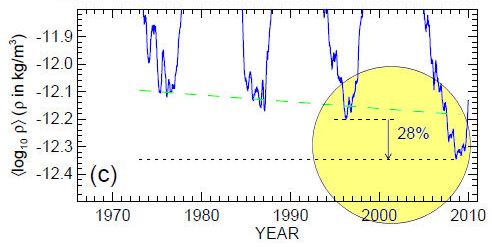
July 15, 2010: NASA-funded researchers are monitoring a big event in our planet’s atmosphere. High above Earth’s surface where the atmosphere meets space, a rarefied layer of gas called “the thermosphere” recently collapsed and now is rebounding again.

“This is the biggest contraction of the thermosphere in at least 43 years,” says John Emmert of the Naval Research Lab, lead author of a paper announcing the finding in the June 19th issue of the Geophysical Research Letters (GRL). “It’s a Space Age record.”

graphs_circle.jpg

Image: Atmospheric Density over time.

The collapse happened during the deep solar minimum of 2008-2009—a fact which comes as little surprise to researchers. The thermosphere always cools and contracts when solar activity is low. In this case, however, the magnitude of the collapse was two to three times greater than low solar activity could explain.

“Something is going on that we do not understand,” says Emmert.

Gee . . . Ya think?

First Light for the Solar Dynamics Observatory

These images are just astounding . . .

prom.jpgApril 21, 2010: Warning, the images you are about to see could take your breath away.

At a press conference today in Washington DC, researchers unveiled “First Light” images from NASA’s Solar Dynamics Observatory, a space telescope designed to study the sun.

“SDO is working beautifully,” reports project scientist Dean Pesnell of the Goddard Space Flight Center. “This is even better than we could have dreamed.”

Launched on February 11th from Cape Canaveral, the observatory has spent the past two months moving into a geosynchronous orbit and activating its instruments. As soon as SDO’s telescope doors opened, the spacecraft began beaming back scenes so beautiful and puzzlingly complex that even seasoned observers were stunned.

Be sure to click on the image above to view full-size and then go to the SDO Website.

Apollo-13 — 41 Years Later

apollo-13.jpgThe Apollo-13 astronauts safely returned to Earth on April 17, 1970. Today commemorates the 41st anniversary of the dramatic conclusion to what must have been the most tedious and frightening events in space exploration history.

NASA launched Apollo-13 to be the third manned landing on the Moon. Two days into the mission, an oxygen tank on board the command module exploded, causing the end of the planned mission and initiated a dramatic space rescue effort, both back on Earth and on board the spacecraft.

The flight was commanded by James A. Lovell, with John L. “Jack” Swigert command module pilot, and Fred W. Haise lunar module pilot. The three astronauts and the Apollo-13 ground crew pieced together a rescue plan. Despite limited power, loss of cabin heat, shortage of potable water, and the critical need to jury-rig the carbon dioxide removal system, the crew returned safely to Earth on April 17, and the mission was termed a “successful failure”.

During the early 1990’s (I don’t remember the exact date), the Management Club at the company where I worked, invited Fred Haise to speak at one of our dinner meetings. He brought along a slide show and much anecdotal history of the Apollo-13 events. Haise recounted his time as an adviser to Bill Paxton, who played the role of Haise in the Apollo-13 film. Needless to say, the movie strayed from the business-like conduct of the astronauts in favor of dramatics, but the story line went more-or-less like the actual events, according to Haise.

After the presentation, I stepped to the podium (along with most everyone else there) and shook the hand of a real space hero.

F-35 JSF First Flight

Before I retired, I had the opportunity to work on a lot of very interesting and exotic aerospace projects. I worked on projects involving everything from Intercontinental Ballistic Missile systems to Airborne Multimode Radar systems to Geosynchronous Communications Satellite systems. I developed electronics for Electro-optical systems such as Forward Looking Infrared imaging, Laser Rangefinders, Target Designators and Guidance. I developed software for Automated Test Equipment, Cockpit Simulators, Global Communications Satellites and more. Hell – I even was co-inventor on the Barbie Piano project when I briefly worked at Mattel Toys.

Fewer things make me more proud than when a project I worked on gets some press for making a milestone. Although I had more to do with the avionics equipment for the Joint Strike Fighter than the flight systems, it still gives me pride to see the first flight milestone. This is a magnificent aircraft with a host of exotic systems and capabilities. I could tell you about them, but then – well – you know . . .

Chocolate Rocks on Mars

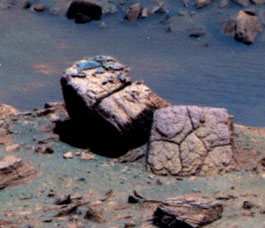
chocolate.jpgCubical rocks lie in a spot designated “Chocolate Hills” by the JPL team. These remind me of stones quarried to build ancient structures on our planet.

Excerpt from the Mars Rover website:

Opportunity at a sweet spot on Mars

This rock has a thick, dark-colored coating that is interesting to scientists because many of the rocks in the surrounding area have the same mysterious dark stuff. The coating could be remnants of a layer that was changed by the action of water and weather or, it could be a layer of rock that melted when a meteor (less than a foot across) impacted Mars, ejecting this rock and others and creating the crater “Concepcion”. Knowing its origins will help them understand the history of Mars. Opportunity’s mission is to figure out the “ingredients” of this morsel by studying the chemicals in it.

The article is silent about the shape of the rocks.