Of course, the left will ignore the hard science and embrace the “blame US industry” and “blame Bush” for not signing up for the flawed Kyoto Accord.
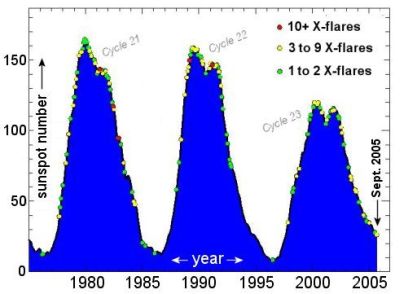
Unusually high solar “X-flare” activity may explain the unusually intense 2005 hurricane season. The numbers and intensity of the flares since the last solar maximum have relentlessly bombarded the Earth with high-energy particles and magnetic flux. The effect of these flares includes a high number of hurricanes, and lightning in the eyewalls of the most intense storms.
First, the cause:
NASA – Solar Minimum Explodes
 [On September 7, 2005] a huge sunspot rounded the sun’s eastern limb. As soon as it appeared, it exploded, producing one of the brightest x-ray solar flares of the Space Age. In the days that followed, the growing spot exploded eight more times. Each powerful “X-flare” caused a shortwave radio blackout on Earth and pumped new energy into a radiation storm around our planet. The blasts hurled magnetic clouds toward Earth, and when they hit, on Sept 10th and 11th, ruby-red auroras were seen as far south as Arizona. (Photo: the skies above Payson AZ on Sept. 11, 2005. Photo credit: Chris Schur.)
. . .
“That’s a lot of activity,” says solar physicist David Hathaway of the National Space Science and Technology Center in Huntsville, Alabama.
Compare 2005 to the most recent Solar Max: “In the year 2000,” he recalls, “there were 3 severe geomagnetic storms and 17 X-flares.” 2005 registers about the same in both categories. Solar minimum is looking strangely like Solar Max.
One unusual effect:
NASA – Electric Hurricanes
January 9, 2006: The boom of thunder and crackle of lightning generally mean one thing: a storm is coming. Curiously, though, the biggest storms of all, hurricanes, are notoriously lacking in lightning. Hurricanes blow, they rain, they flood, but seldom do they crackle.
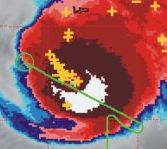 Surprise: During the record-setting hurricane season of 2005 three of the most powerful storms–Rita, Katrina, and Emily–did have lightning, lots of it. And researchers would like to know why.
Right: An infrared GOES 11 satellite image of Hurricane Emily. Yellow + and – symbols mark lightning bolts detected by the North American Lightning Detection Network. The green line traces the path of the ER-2 surveillance aircraft.
Lightning has been seen in hurricanes before. During a field campaign in 1998 called CAMEX-3, scientists detected lightning in the eye of hurricane Georges as it plowed over the Caribbean island of Hispaniola. The lightning probably was due to air forced upward — called “orographic forcing” — when the hurricane hit the mountains.
“Hurricanes are most likely to produce lightning when they’re making landfall,” says Blakeslee. But there were no mountains beneath the “electric hurricanes” of 2005—only flat water.
For more about our opinions on global warming and for more reference articles, see this article.

The County of Los Angeles Fire Department, Lifeguard Division, in partnership with the County of Los Angeles Department of Beaches and Harbors and the University of Southern California Sea Grant Program has created a network of web cameras weather stations and water thermometers to aid in staffing beaches, tracking rescue activity, creating public education materials, and collecting environmental data for use in pursuing our common goals of protecting and educating the public, safeguarding property and preserving the environment. Devices are installed along the 72 mile Los Angeles coastline and connected to the Fire Department’s Wide Area Network allowing Operational Captains to accurately assess staffing needs at secluded, under served beaches from anywhere on the network through a web browser.