Environment

Solar Activity

sunspots.jpg

New sunspot 1520 has rotated into view and is producing C class solar flares according to SpaceWeather.com. They also expect M class and possibly X class flares as the sunspot rotates toward the mid-solar southern latitudes.

I took this image this morning from Wickenburg, Arizona using my Canon SX40 and a Rainbow Symphony solar filter. I annotated the sunspot numbers with my Irfanview graphic editor. Click on the image to enlarge.

Update: 07/11/2012 The group is now closer to facing Earthward.

Curve Billed Thrasher Hatchlings

hatchlings.jpg

Two of the three eggs in the thrashers nest hatched sometime between last evening and this afternoon. I peeked into the nest and saw these two almost naked chicks. We believe the third egg is left over from the last brood and is not going to hatch. If it does not hatch, I will get a pair of kitchen tongs and take it out of the nest after these two chicks are fully-fledged. Click on the image to enlarge.

UPDATE: The third egg hatched today (7/6/12).

Courtyard Bird Feeder

feedbag.jpgWe brought one of the garden crook stands back from the California house last week. Bob installed it just outside of the courtyard in front of the house where we can see it from the great room.

The other feeders are on the hill behind the house on the far side of the RV drive. You have to be on the patio or look out the kitchen window to see those. With the warmer summer temperatures, we decided that we could do some bird watching from inside where it’s a lot cooler.

Image: Nijer seed feeder on the crook. Click to enlarge.

I had not known about Nijer seed feeders until my last dentist appointment. His office had one of these feeders outside the exam room window and it was covered with little goldfinches chowing down.

I looked up Nijer seed on the internet today. The seeds are grown in Asia and Africa and have to be imported. Because of “parasite seeds” from destructive weeds and such can accompany the Nijer seeds, the product must be heat and pressure treated before importation. I guess that’s why Nijer seed is a bit more expensive compared to other bird seed.

We have seen several goldfinches helping themselves in the morning and afternoon. We don’t see any at midday because of the warm temperatures. It was 108° here today (again).

Nest Duty

nest-duty.jpg

I took this photo of one of the curve-billed thrasher parents sitting in the nest today. Damsel peeked in the nest earlier and saw that the three eggs still had not hatched. The cholla where the bird is sitting is about 20 feet in front of the courtyard where I captured the image. Click to enlarge.

More Eggs in the Thrasher Nest

thrasher-eggs.jpg

Much to our surprise, there are three new eggs in the nest where we watched the curve billed thrashers fledge two chicks this spring. I was out in the front of the house taking pictures when I peeked in the nest in our cholla cactus and saw the eggs. In the photo, note the white strands of dental floss; we recycle our floss in the outdoors just for the reason that birds will build nests using string, floss and anything else they can find.

I’m not sure if thrashers raise multiple sets of chicks in a year; the bird book and Wikipedia were silent on that issue. We will be watching to see if these hatch in the next couple of weeks and get more pictures of thrasher chicks if we can. Click on the image to enlarge.

Sunspot AR1504

spot1504.jpgI made my daily stop at spaceweather.com where they profiled a giant sunspot (AR1504) region that might be capable of producing solar flares. I grabbed the camera and the solar filter and proceeded out to the courtyard to take this photo of the sun. Each spot visible on the solar surface is two or more Earth diameters in width.

Image: Sunspot region AR 1504. Click image to enlarge.

The article talks about a ‘beta-gamma-delta’ magnetic field that harbors energy for strong solar flares. Since the huge sunspot complex is directly facing Earth, there may be atmospheric fireworks resulting in auroras and possible interference or disruption of power grids.

We know that the current solar cycle is quite a bit less intense than the last one, but we might wonder if some of these regions might also contribute to our planet’s climate as they have done in the past.

Asian Aerosols and US Climate Change

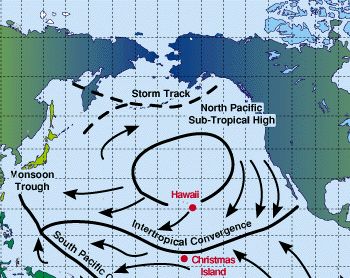
circle.jpgI learned through World Climate Report that a group at the National Center for Atmospheric Research, Boulder, Colorado, wrote a paper outlining “Potential Impacts of Asian carbon aerosols on future US warming.”

The paper postulates that Asian emissions have a greater effect on climate change in the US than US emissions do. It would seem that the EPA’s efforts to regulate carbon in the country would be rendered moot by the NCAR report.

Image: atmospheric circulation in the north Pacific Ocean

The climate along the Pacific coast of the US is affected by air and ocean current circulation way more than Asian carbon. That’s why temperatures along the coasts of western states remain relatively stable – cooler in summer and warmer in winter than most places in the contiguous US.

Now, after doing all the numbers in terms of atmospheric volume versus greenhouse gasses, the actual impact of Asian, as well as US emissions, do very little to affect the climate. Urban Heat Islands and solar activity have far more effect on the environment.

It seems to us that the efforts by the paper’s authors, even though it short-circuits the measures taken in the US by the EPA, is just another attempt at “proving” Anthropogenic Global Warming is reality. We’re still saying that AGW is bullsh*t.
