Culture

West Beaches

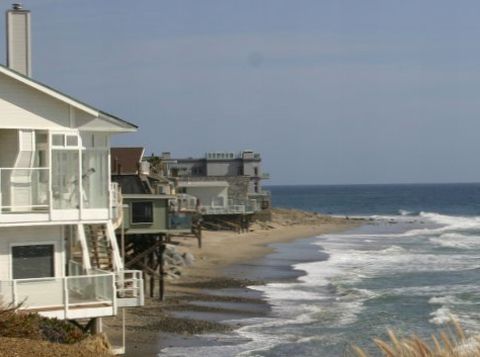
There are miles and miles of scenic beaches in western Los Angeles County. During our recent excursion to the Ronald Reagan Presidential Library, we took the time to return via the shoreline. I snapped these pictures as we passed beautiful beaches and homes.

This is a shot of Zuma Beach with Point Dume in the distance.

These beach front homes are just west of Malibu – I wonder how much these guys have to pay per year for tsunami insurance? Can one even get tsunami insurance?

Daylight Saving Time

Do not forget to set your clocks ahead this weekend.

Why are we doing this?

In the US, DST was used during the first and second world wars to (ostensibly) conserve energy; during WWII it was referred to as “war time.” DST has value in temperate zones where the daylight to darkness ratio changes considerably from summer to winter. This allows for the human sleep/awake cycle to generally align better with darkness/daylight. The intended effect is less energy consumption. There are some critical arguments against this, however.

Prior to 1966, states and localities were allowed their own discretion whether to use DST locally. After that, the US established the Uniform Time Act that mandated the use of DST; states that wanted to be exempt could do so by passing a state law. During President Nixon’s administration the energy crisis prompted the government to extend DST; this, however turned out to be a bad thing; people and kids were going to work and school in the dark during wintertime. The mandate was overturned thereafter.

In 2007, DST will begin on the second Sunday in March and extend to the first Sunday of November, but if no energy savings can be shown from the extension after the U.S. Department of Energy completes a study of impact of the change, Congress may revert back to the schedule set in 1986 after that.

Why do some states and territories not observe DST?

Arizona (except for the Navajo Nation), Hawaii, Puerto Rico, Virgin Islands, Guam, and American Samoa do not observe DST and stay on “standard time” all year. If you’ve ever spent any time in the summer sun in those regions you probably understand why another hour of sunlight might be undesirable.

And don’t get me started on DST management in Indiana.

Happy St. Patrick’s Day

This is how we are celebrating the day: roast corned beef with cabbage and potato bake (and carrots and parsnips). A special horseradish sauce spiced up the beef and a frosty mug of Killian’s Irish Red beer to cool it off. MMMM MMMM! This is adapted from an Emeril Lagasse recipe which you can find on the Food Network cable channel.

All About “Beware the Ides of March”

In case you were wondering . . .

From WikiPedia:

Ides of March

In the Roman calendar the Ides of March fell on the 15th day of the Roman month of Martius. The word ides comes from a Latin word that means to divide. The ides is simply the middle of the month.

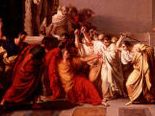
Image: Vincenzo Camuccini, Mort de César, 1798.

Although the Roman calendar was eventually displaced by the modern days of the week around the 3rd century, the Ides continued to be used in a vernacular sense for centuries afterwards. When Shakespeare wrote the famous line “Beware the Ides of March!” in his play Julius Caesar in 1599, he did so in the reasonable assumption that his audience would know the date of Caesar’s death and so have a good idea of what the Ides were.

The date is famous because Julius Caesar was assassinated on the Ides of March, 44 BC. Because of Shakespeare’s play Julius Caesar and its line “Beware the Ides of March”, the Ides of March has had a sense of doom. But in Roman times the Ides of March was simply the normal way of referring to March 15.

More from InfoPlease:

The term Ides comes from the earliest Roman calendar, which is said to have been devised by Romulus, the mythical founder of Rome. Whether it was Romulus or not, the inventor of this calendar had a penchant for complexity. The Roman calendar organized its months around three days, each of which served as a reference point for counting the other days:

  • Kalends (1st day of the month)
  • Nones (the 7th day in March, May, July, and October; the 5th in the other months)
  • Ides (the 15th day in March, May, July, and October; the 13th in the other months)

The remaining, unnamed days of the month were identified by counting backwards from the Kalends, Nones, or the Ides. For example, March 3 would be V Nones—5 days before the Nones (the Roman method of counting days was inclusive; in other words, the Nones would be counted as one of the 5 days).

Happy Days Flashback

Steve Marconi, a free-lance writer and resident in our area, prepared a list of “amenities we didn’t have in 1951.” I enjoyed reading the article in the Daily Breeze and want to pass along a few of my favorites from Steve’s List:

• The remote control. Television itself was fairly new, but it didn’t take long to come up with the remote — the two-legged kind Dad operated by lying on the couch (we called it a davenport back then) and saying, “Stevie, turn the TV to Channel 4.”

• The F-word. Oh, we had it all right, but you never heard it in polite company. Refined women never said it, and if kids said it, well, have you ever wondered what soap tastes like?

• Self-serve gasoline stations. They were called “service” stations because someone actually came out and pumped your gas, washed your windows and checked your oil. That was what service was. And you could ask for directions because the serviceman could speak English. Really.

• Timeouts. Back when kids actually respected their elders and didn’t talk back to parents, we had corporal punishment. At home that could mean a belt or a switch or the nearby kitchen spoon applied to the bottom. At school that meant swats with a paddle, not just a visit to the office. For most, it worked. For some, it meant years of therapy.

• Whiteboards. There is an entire generation of students that hasn’t had the excruciating pleasure of hearing fingernails scrape across an old-fashioned slate chalkboard. Think amplifier feedback that raises the hair on the back of your neck — only worse.

• Body piercings. Disfiguring your face, tongue and other body parts used to be considered a form of torture. We thure were thtupid back then.

• Tattoos. Amazing how what used to define a sailor or a criminal has become a fashion statement.

[read the rest of the article]

If you enjoyed these few, please read the rest. It’s certainly worth your time.

Space Scientist Reviews King Kong

Imagine my surprise when I found an article on Space.com that was, in effect, a movie review. The article was entertaining, humorous and was written from a scientific perspective:

SPACE.com — Big Apes and Bad Biology

[ . . . ]

Skull Island’s a happening place. Sauropods stampede to a booming death, insect carnivores the size of phone booths writhe out of the swamps, and Kong – stricken by the sight of blonde hair – develops an inappropriate interest in the one woman who’s aboard ship. Eventually, the entrepreneurs who have initiated this less-than-idyllic odyssey capture Kong and take him back to Manhattan as an E-coupon sideshow attraction.

Let me give that a bit of emphasis: these guys find an island filled with living, prehistoric dinosaurs. And they bring back the mammal.

Now some will see this classic cinema tale as a touching love story between two primates who share their affections but only 98% of their genes. A recent opinion piece in the New York Times suggested that this film was motivated by Soviet experiments in the 1920s designed to produce a human-chimpanzee hybrid (in an attempt to discredit religion, while simultaneously offending chimp family values). Then there’s the now-forgotten prewar habit of bringing back wild beasts and natives from distant lands to exhibit as living exotica. As recently as 1931, you could observe caged humans (Africans and Inuit were favorites) on display in Europe.

[more]

Yep, long after slavery was abolished in this country, enlightened Europeans kept people of color in cages – and these days they preach to America about our so-called injustices – but I digress – that’s not the point of the article. I just thought it was yet another good example of Euro-hypocrisy.