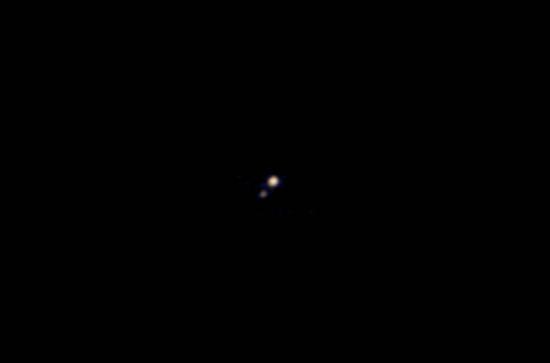
On Friday, I managed to photograph Venus and Mercury, our two sunward neighboring planets, which were only about 0.7° apart in the western sky just after sunset. It’s a good thing that I got this photo then, because the rainclouds rolled in the next morning and have been with us since, at least in the evening hours. The two planets continued their close proximity for a couple of days, but now are rapidly separating. Click on the image to enlarge.
Astronomy
Winter Solstice
Happy First Day of Winter! Although the seasonal temperatures are going to continue to be cool or cold, the good news is that the days from this point forward (in the northern hemisphere) will be getting longer until the June Summer Solstice.
I got a screenshot from Archaeoastronomy dot com showing the position of the Earth in our orbit today. In ninety days when we arrive at the vernal equinox, the weather should be warm and the flowers on the cacti will be opening.
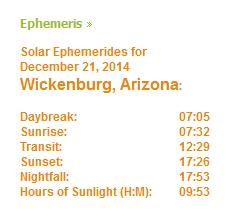
I also put a screenshot from the ephemeris on our family blog to the right, showing the less than ten hours of daylight that we get here on this day. As I mentioned above, the days will now be getting longer. The times shown in the graphic are Arizona local.
Adios AR 2192 (For Now)
I went out to the courtyard to photograph the last image of the great sunspot of 2014, AR 2192 before it rotates out of Earth view. According to the article below, there is a possibility of the spot to return to the Earth-facing side of the solar disk in a couple of weeks. Click on the image to enlarge.
From SpaceWeather.com:
SUPER-SUNSPOT PREPARES TO DEPART: The biggest sunspot in nearly 25 years is about to leave the solar disk.
. . .
As AR2192 approaches the sun’s horizon, it is no longer facing Earth. However, the odds of an Earth-directed radiation storm are higher than ever. The reason is, the western limb of the sun is well-connected to Earth. Solar magnetic fields springing out of that region spiral back to our planet. If a sunspot passing through the area explodes, those spiralling magnetic fields can funnel energetic particles in our direction.
In only a few days, the behemoth sunspot will begin a 2-week transit of the far side of the sun, carried around by the sun’s 27-day rotation. However, that doesn’t mean we’ve seen the last of this magnificent active region. Big sunspots typically persist for two or three solar rotations before they decay. After it leaves, AR2192 will return in November.
Partial Solar Eclipse
Damsel and I watched periodically as the new moon partially obscured the sun today. The eclipse stats for Phoenix (according to NASA) are as follows (Times MST):
- Eclipse begins: 14:21
- Maximum eclipse: 15:38
- Eclipse ends: 16:45
- Sun altitude: 24°
- Sun azimuth: 236°
- Magnitude: 0.449
- Obscuration: 0.331
The three-image panel above shows the lunar disc (left to right) just appearing, near maximum obscuration and just disappearing. I used the same setup today as I did for the 2012 annular eclipse and transit of Venus. Click on the image to enlarge.
The terms “magnitude” and “obscuration” above (I infer) refer to the percentage of penetration of the lunar shadow across the solar disc and the percentage of of the total solar area blocked by the moon. Those numbers (more or less) can be seen in the middle image above near max eclipse. I assume that the azimuth and altitude (elevation above horizon) are for maximum eclipse time.
We were blessed with beautiful, clear skies during the event and enjoyed yet another one of God’s wonders from our desert home. We’re still planning to be in a position to see the August, 2017 total solar eclipse event.
Now THAT’s a Sunspot!
We are going to have a partial solar eclipse tomorrow afternoon. I went out this morning to take some practice shots of the sun and it just so happens that major sunspot AR 2192 is transiting the nearside of the solar disc. There are several other smaller sunspots visible. Click on the image to enlarge.
As for the eclipse, there are some details about it on NASA.
And more about this giant sunspot at SpaceWeather.com:
Earth-effects could increase in the days ahead. AR2192 has an unstable ‘beta-gamma-delta’ magnetic field that harbors energy for powerful explosions, and the active region is turning toward Earth. NOAA forecasters estimate at 65% chance of M-class flares and a 20% chance of X-flares during the next 24 hours.
Watch for some of our eclipse photos here after the event.
UPDATE: Sunspot 2192 has moved to the right and is in a position almost directly facing the Earth. Click here to view photo taken 23 Oct 14.
Ninth Blogiversary on Autumnal Equinox 2014
It seems like it has been longer, but today, which coincides with the Autumnal Equinox, is the ninth anniversary of the CB&D blog. Since we had our own internet service provider and domain/website, we skipped the Blogger/Blogspot routine and went for a self-hosted weblog using a somewhat inferior publishing platform, the name of which I forget, and upgraded to WordPress® shortly afterwards. Some of the very early posts were lost in the process of upgrading, but the ones we managed to recover are still in the database on the ISP’s server. This post marks the 6326th blog entry into the WordPress database. That is a lot of hot air!
To us, the weblog has been a way to archive our activities and to log events as they take place. Sort of like an on-line diary, if you will. Every once in a while, I will dig back into the archives to try and locate something we knew happened in the past and usually can find what I’m seeking with the platform’s built-in search engine.
We may not post as often as we did in the past (life has its complications), nor do we post as politically as in the past, but we plan to continue using the weblog as a journal of events, a repository for a few of the Damsel’s photos and whatever whim suits us. We’re independent of social media (Bookface, Twatter, etc.), so there won’t be any repression of our thoughts unless the First Amendment is repealed – which this administration is rapidly seeking to do.
We should be here for a while . . .
Supermoon
Last night, we had the first of three so-called supermoons this summer. It is the phenomenon where the moon appears to subtend a larger angle in the sky due to it’s close proximity to the Earth. We’re due to have another, even larger supermoon on August 10th.
From Wikipedia
A supermoon is the coincidence of a full moon or a new moon with the closest approach the Moon makes to the Earth on its elliptical orbit, resulting in the largest apparent size of the lunar disk as seen from Earth. The technical name is the perigee-syzygy of the Earth-Moon-Sun system. The term “supermoon” is not astronomical, but originated in modern astrology. The association of the Moon with both oceanic and crustal tides has led to claims that the supermoon phenomenon may be associated with increased risk of events such as earthquakes and volcanic eruptions, but the evidence of such a link is widely held to be unconvincing.
The most recent occurrence was on July 12, 2014. The next and closest supermoon of 2014 will be on August 10.
The opposite phenomenon, an apogee-syzygy, has been called a micromoon, though this term is not as widespread as supermoon.
Although the reference to supermoons causing earthquakes is “held to be unconvincing,” I still remember the 1971 Sylmar quake which occurred the morning after a supermoon. I remain completely unconvinced that anything other than terrestrial tectonic plate movement had anything to do with that event.