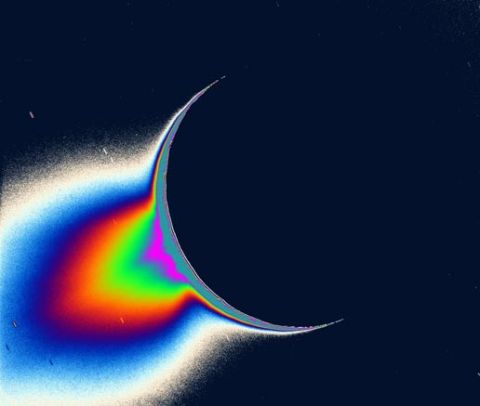
Although extremely rare, auroras are occasionally seen in Southern California. I can recall a time when I saw the red glow in the northern sky from Palos Verdes Peninsula.
A space probe called Advanced Composition Explorer (ACE), measures attributes of the solar wind. ACE is useful to forecast (short term – an hour or so) fluctuations in the solar wind that may cause power-grid outages and extraordinary auroras under the right conditions. SpaceWeather.com points out that there are no plans to replace this resource when it ceases to function. From SpaceWeather.com:
COMMENTS, PLEASE: NASA’s ACE spacecraft is almost four years past its intended lifetime. Although ACE measurements of the solar wind flowing past Earth are crucial to space weather forecasts, there is no plan to replace ACE when the craft ceases to function. NOAA is seeking public comment on this state of affairs. If you enjoy auroras, please let them know that ACE needs a successor.
The ACE Caltech Website has this additional information about ACE:
From a vantage point approximately 1/100 of the distance from the Earth to the Sun ACE performs measurements over a wide range of energy and nuclear mass, under all solar wind flow conditions and during both large and small particle events including solar flares. ACE provides near-real-time solar wind information over short time periods. When reporting space weather ACE can provide an advance warning (about one hour) of geomagnetic storms that can overload power grids, disrupt communications on Earth, and present a hazard to astronauts.
ACE orbits the [Lagrange] L1 libration point which is a point of Earth-Sun gravitational equilibrium about 1.5 million km from Earth and 148.5 million km from the Sun. With a semi-major axis of approximately 200,000 km the elliptical orbit affords ACE a prime view of the Sun and the galactic regions beyond. The spacecraft has enough propellant on board to maintain an orbit at L1 until ~2019.
 April 11, 2006: Ancient people didn’t have TV or electric lights. So, when the sun went down every night, they got their entertainment by watching the sky. And it was entertaining. Without city lights to interfere, the Milky Way was spectacular. Meteors flitted across the sky. Zodiacal lights chased the sunset.
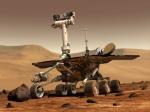 Spirit continued to make progress toward “McCool Hill” despite a reduction in solar energy and problems with the right front wheel. The team plans to have the rover spend the winter on the hill’s north-facing slopes, where the tilt toward the sun would help maximize daily output by the solar panels. On Spirit’s 779th sol, or Martian day (March 13, 2006), the drive actuator on the right front wheel stalled during a turn to adjust the position of the rover’s antennas. The stall ended the day’s drive, which brought Spirit 29 meters (95 feet) closer to McCool, still approximately 120 meters (390 feet) away.
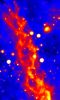 Magnetic forces at the center of the galaxy have twisted a nebula into the shape of DNA, a new study reveals.
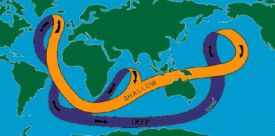 In the article, they refer to the “ocean conveyor belt” which is an attribute of ocean circulation patterns. These patterns can alter the climate in certain areas . For example, the Gulf Stream portion of the “conveyor” keeps Northwestern Europe more temperate than normal for a high-latitude area. Likewise, Hawaii is cooler than many 20th latitude tropical areas due to the California Current, another segment of the “belt.” Left: Illustration of ocean circulation “conveyor belt” – NASA
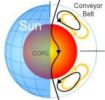 The sun’s conveyor belt is a current, not of water, but of electrically-conducting gas. It flows in a loop from the sun’s equator to the poles and back again. Just as the Great Ocean Conveyor Belt controls weather on Earth, this solar conveyor belt controls weather on the sun. Specifically, it controls the sunspot cycle.
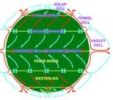 I think the comparison between the solar circulation and Earth’s ocean circulation is interesting, but the circulation of solar plasma is probably more analogous to the