Astronomy

Screwy “Second Moon” Leaving Earth

Few of us know that planet Earth has been host to a “second moon” for the past seven years. And now, this fickle little rock is going to move along. An Earth-orbit-crossing Space Rock got a little too close to the gravitational influence of our planet and has been screwing around for the past few years — but not for long.

NASA – Corkscrew Asteroids

June 9, 2006: News flash: Earth has a “second moon.” Asteroid 2003 YN107 is looping around our planet once a year. Measuring only 20 meters across, the asteroid is too small to see with the unaided eye—but it is there.

This news, believe it or not, is seven years old.

“2003 YN107 arrived in 1999,” says Paul Chodas of NASA’s Near Earth Object Program at JPL, “and it’s been corkscrewing around Earth ever since.” Because the asteroid is so small and poses no threat, it has attracted little public attention. But Chodas and other experts have been monitoring it. “It’s a very curious object,” he says.

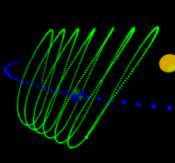
Right: The typical corkscrew path of an Earth Coorbital Asteroid.

[more]
Huge 4th of July Display — on Jupiter!

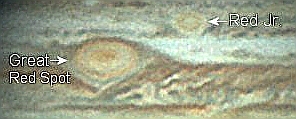
And, on an astronomical scale, it IS huge! We reported in a previous article, See Spot Run about the two red spots on Jupiter, Great Red and Red, Jr. Time to get the backyard telescope out and get it tuned up for this!

NASA – Huge Storms Converge

June 5, 2006: The two biggest storms in the solar system are about to go bump in the night, in plain view of backyard telescopes.
Storm #1 is the Great Red Spot, twice as wide as Earth itself, with winds blowing 350 mph. The behemoth has been spinning around Jupiter for hundreds of years.

Storm #2 is Oval BA, also known as “Red Jr.,” a youngster of a storm only six years old. Compared to the Great Red Spot, Red Jr. is half-sized, able to swallow Earth merely once, but it blows just as hard as its older cousin.

[more]

Binary Space Rocks Pass Earth Today


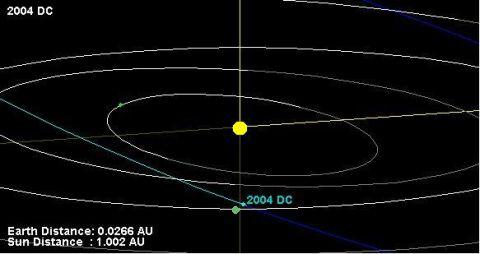
Like ships passing in the night, pair of space rocks zooms past Earth today at a distance of (only) 2.5 million miles. Dubbed Asteroid 2004 DC, the pair were not known to be a pair until radar reflections off the asteroid were detected by the Arecibo radar/radio telescope (remember the movie “Contact?”).

The green dot in the center near the bottom of the image below (from a NASA orbit simulation) is planet Earth. The scale of the image is such that the asteroid looks very close to our planet, but it is at quite a safe distance.

From SpaceWeather.com:

BINARY ASTEROID: Asteroid 2004 DC is flying by Earth today about 2.5 million miles away. Yesterday, astronomers using the giant Arecibo radar in Puerto Rico pinged the asteroid and discovered that it is actually two asteroids–a 60m rock orbiting a 300m rock. Researchers estimate that one in six near-Earth asteroids are binaries.

Toto, We’re not in Barstow Anymore

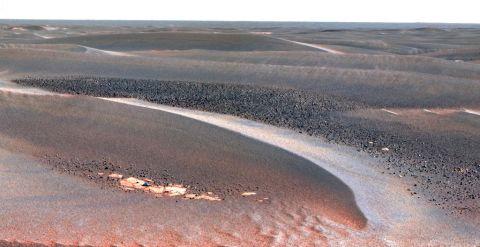
Finally! The Mars Rover “Opportunity” returned an image of the Martian Landscape that doesn’t look like it was taken in the Mojave Desert. The eerie textures and coloring lend an other-worldliness appearance to this image, unlike the images that comedian Dennis Miller asserts “Looks like Barstow!”

Photo Courtesy NASA/JPL-Caltech

Click here for a Larger Image.

As NASA’s Mars Exploration Rover Opportunity continues to traverse from “Erebus Crater” toward “Victoria Crater,” the rover navigates along exposures of bedrock between large, wind-blown ripples. Along the way, scientists have been studying fields of cobbles that sometimes appear on trough floors between ripples.

They have also been studying the banding patterns seen in large ripples.This view, obtained by Opportunity’s panoramic camera on the rover’s 802nd Martian day (sol) of exploration (April 27, 2006), is a mosaic spanning about 30 degrees. It shows a field of cobbles nestled among wind-driven ripples that are about 20 centimeters (8 inches) high.

This is a false-color rendering that combines separate images taken through the panoramic camera’s 753-nanometer, 535-nanometer and 432-nanometer filters. The false color is used to enhance differences between types of materials in the rocks and soil.

OK — I admit that this is a “false color” image and isn’t representative of the natural sunlight on Mars, but if you were to pump sunlight up to the amount the Earth gets, you just might get a picture like this.

The Sky is NOT Falling – Yet

NASA – NASA Satellites Observe Comet’s Trail

There will be no tsunamis, firestorms or mass extinctions to spoil your Memorial Day weekend.
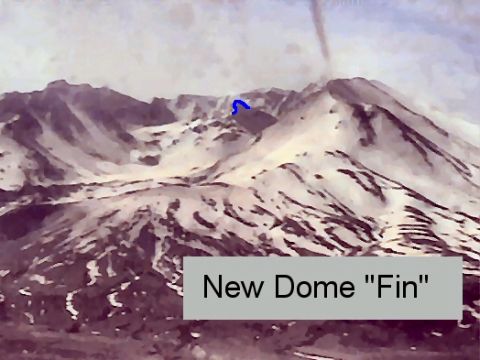
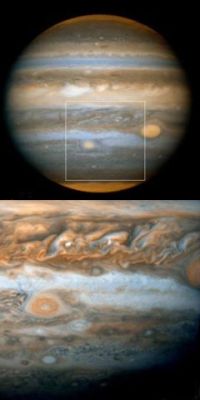
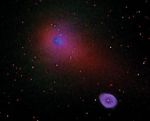
Image right:This infrared image from NASA’s Spitzer Space Telescope shows the broken Comet skimming along a trail of debris left during its multiple trips around the sun. On the lower right lies the Ring Nebula, coincidentally in the same direction as the cometary fragment.

Despite speculation that Comet 73P/Schwassmann-Wachmann 3 will strike the Earth on May 25, neither the main comet nor any of its more than 40 fragments pose a danger to Earth.

“We are very well acquainted with the trajectory of Comet 73P Schwassmann-Wachmann 3,” said Donald Yeomans, manager of NASA’s Near-Earth Object Program Office. “There is absolutely no danger to people on the ground or the inhabitants of the International Space Station, as the main body of the object and any pieces from the breakup will pass many millions of miles beyond the Earth.”

However, you can see the comet falling apart right before your very eyes, thanks to NASA’s Hubble Space Telescope, Swift X-Ray and Spitzer Space Telescope.

Click on the Space Rocks page for an animated preview of the next large comet impact.

See Spot Run

The newly-spawned “Red Spot Jr.” Jovian storm system appears that it will overtake “Big Red” in early July. Note the “significant climate change” reference in the article.

From New Scientist:

Hubble watches Jupiter’s ‘Red Spot Races’

Hubble has sent back the clearest pictures yet of Jupiter’s new red spot.

The storm, dubbed “Red Spot Junior” is roughly half the diameter of the Great Red Spot, a huge storm that has churned away on Jupiter for at least 400 years – when humans first started observing the gas giant planet.

On 8 April 2006, the Hubble Space Telescope’s Advanced Camera for Surveys took new pictures of the baby storm, which was initially known as White Oval BA before it changed to the same salmon hue as the Great Red Spot (see “Jupiter opens a second red eye”) . The storm formed when three white oval storms merged between 1998 and 2000. Those white storms existed for about 60 years.

Image – NASA – Hubble photos of (top) Jupiter and (bottom) Red Jr.

The red colouring could come from material brought up from deeper within Jupiter’s atmosphere and then altered by the Sun’s radiation. If this is indeed what is happening, it may be a sign that the storm is intensifying.

The newly released images may give weight to the idea that Jupiter is in the middle of significant climate change. Temperatures at some latitudes could be changing by over 5°C, scientists suggest.

Another link to climate is that Red Spot Jr is forming at a latitude of 34° south. Theory has it that this is the where the transfer of heat from the equator to the pole grinds to a halt.

Hmmmmm. It must be all them Jovian SUVs trucking around beneath the clouds causing this colossal climate change.

Update: NASA’s Astronomy Picture of the Day has a nice close up picture showing Jupiter and both red spots.