Astronomy

Space Radiation Storm

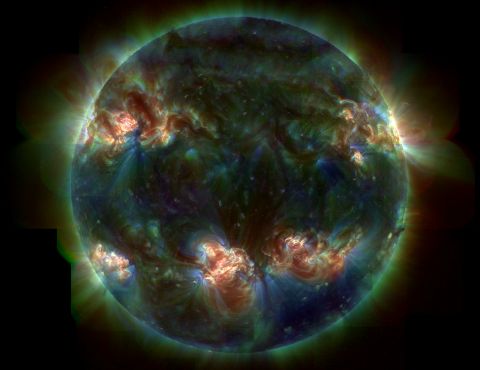
During the years 1999 & 2000 the solar maximum occurred; the time of an 11-year cycle when the Sun exhibits greatest activity. This was the first chance for the Xray Camera on SOHO to observe solar activity at maximum. On July 14, 2000, the camera recorded one of the largest Xray flares to date. In review, this article from NASA recalls the ensuing storm and it’s effects on our planet.

Space Radiation Storm

July 14, 2000 — This morning NOAA satellites and the orbiting Solar and Heliospheric Observatory (SOHO) recorded one of the most powerful solar flares of the current solar cycle. Space weather forecasters had been predicting for days that an intense flare might erupt from the large sunspot group 9077, and today one did.

“Energetic protons from the flare arrived at Earth about 15 minutes after the eruption,” says Gary Heckman, a space weather forecaster at the NOAA Space Environment Center. “This triggered a category S3 radiation storm.”

Right: This SOHO animation of an X-class solar flare was recorded by the spacecraft’s Extreme-ultraviolet Imaging Telescope at 195 angstroms. This recording nicely shows a flare, followed by a torrent of energetic particles that arrived about 15 minutes later, creating snow on the images as the particles bombarded the camera’s electronic detectors. A second flare does not create as much noise. The duration of this sequence is almost a minute, so keep watching.

According to NOAA space weather prediction scales, an S3 storm can cause the following effects on satellites: single-event upsets, noise in imaging systems, permanent damage to exposed components/detectors, and decrease of solar panel currents. It can also expose air travelers at high latitudes to low levels of radiation, the equivalent of a brief chest x-ray.

[more]

Presently, the sun is between maxima. Although the sun is fairly quiet now, there can still be the occasional flare up.
Perspective

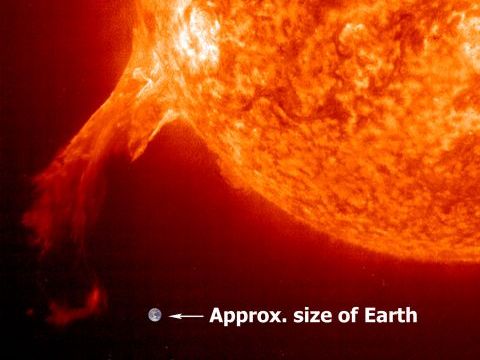
The following composite picture illustrates the significance of mankind’s contribution to global warming.

Photo courtesy of NASA/SOHO via Astronomy Picture of the Day

Try and picture all the tiny little critters on the surface of planet Earth trying to compete with a Solar Coronal Mass Ejection for climate effects. This sort of puts the relative significance of fossil fuel consumption in perspective, doesn’t it?

Close Encounter of the Hoax Kind

Somebody out there is circulating a three-year-old tip about a close encounter between Mars and Earth. The tip is about the 2003 Mars-Earth encounter. This August, Mars will be a long, long way away, at about seven times the 2003 distance.

From SpaceWeather.com

BEWARE THE MARS HOAX: Just when you thought it was safe to read your email, a new Mars Hoax is spreading. The widely-circulated message tells us “the Red Planet is about to be spectacular. On August 27th, Mars … will look as large as the full Moon.” Not!
Fact: On August 27, 2006, Mars will be on the other side of the solar system, 385 million km from Earth and very dim. So forget about Mars. If you want to see something truly astronomical on August 27th, look east before dawn for a pretty conjunction of Venus and Saturn.

More information from NASA (from about a year ago).

Hubble Back in Operation

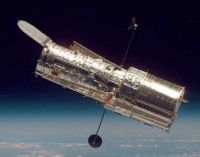
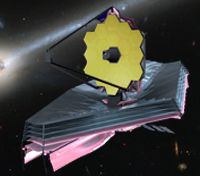
Since the James Webb Space Telescope is a ways off, I’m delighted to see the engineers get the Hubble Space Telescope back in operation.

From NASA:

NASA Issues Hubble Space Telescope Status Report

NASA engineers successfully activated the Advanced Camera for Surveys at 9:12 a.m. EDT Friday aboard the agency’s Hubble Space Telescope. Checkout was completed at 10:20 a.m. EDT with science observations scheduled to resume Sunday, July 2.
“This is the best possible news,” said Ed Ruitberg, deputy associate director for the Astrophysics Division at NASA’s Goddard Space Flight Center, Greenbelt, Md. “We were confident we could work through the camera issue, and now we can get back to doing more incredible science with the camera.”

Engineers began uploading commands to the instrument Thursday, June 29, in an effort to restore operational status. A pre-programmed observing timeline for normal camera science operations will begin executing at approximately 8 p.m. EDT on July 2.

Engineers received indications on Monday, June 19, that power supply voltages were out of acceptable limits, causing the camera to stop functioning. The instrument was taken off line, so engineers could study the problem and determine the appropriate remedy. Hubble observations continued using other onboard science instruments.

The third-generation Hubble instrument consists of three electronic cameras, filters and dispersers that detect light from the ultraviolet to the near infrared. Astronauts installed the camera during a servicing mission in March 2002. It was developed jointly by Goddard, Johns Hopkins University, Baltimore; Ball Aerospace, Boulder, Colo.; and the Space Telescope Science Institute, Baltimore.

For information about the Hubble Space Telescope, visit:

http://www.nasa.gov/hubble

About the James Webb Space Telescope:

The James Webb Space Telescope (JWST) is a large, infrared-optimized space telescope, scheduled for launch in 2013. JWST will find the first galaxies that formed in the early Universe, connecting the Big Bang to our own Milky Way Galaxy. JWST will peer through dusty clouds to see stars forming planetary systems, connecting the Milky Way to our own Solar System. JWST’s instruments will be designed to work primarily in the infrared range of the electromagnetic spectrum, with some capability in the visible range.

JWST will have a large mirror, 6.5 meters (21.3 feet) in diameter and a sunshield the size of a tennis court. Both the mirror and sunshade won’t fit onto the rocket fully open, so both will fold up and open only once JWST is in outer space. JWST will reside in an orbit about 1.5 million km (1 million miles) from the Earth.

JWST will orbit the L2 Lagrange Point, in the vicinity of the WMAP probe we blogged about yesterday.

Back to the Bang

Scientists believe the Big Bang occurred because of an observed “cosmological background radiation” seen in all directions from the vantage point of Earth. Since June, 2001, a space-based instrumented observation platform called the Wilkinson Microwave Anisotropy Probe (WMAP) has been collecting data that allows scientists to literally look back in time and space to virtually witness the birth of the universe.

In the video below, you will see a journey back through space/time starting from the WMAP probe in it’s orbit and continuing outward past Mars, the Asteroid Belt, Jupiter, Saturn, through the Oort cloud and into interstellar space. The journey continues through a “local” nebula in Orion and thence out of the Milky Way and past thousands of galaxies back into the time of primordial blue giant stars and ultimately past the “dark ages” and into the afterglow of the Big Bang. Then, brilliant light and, finally, darkness at “before the beginning of time.”

Please take this thrilling journey back to the beginning of time: (press to play)

Video courtesy NASA’s WMAP website
Audio — “Visions” from Distant Spirits — Scott August

Some history about WMAP:

WMAP was launched on June 30, 2001 from the Cape Canaveral Air Force Base aboard a Delta II rocket.

WMAP completed its prime 2 years of mission operations in its L2 orbit by September 2003. Meanwhile, the 2002 and 2004 Astronomy and Physics Senior Review granted WMAP mission extensions, endorsing the proposed 8-years of mission operations, to end September 2009.

In February 2003 the WMAP Team released a set of 13 papers (241 journal pages) along with flight data from the first year of observations of the CMB. In March 2006, the WMAP Team released 3-year data, including full polarization data, and papers describing the data processing, systematic error analyses, calibration, and other critical aspects of the experiment.

And, finally, a schematic diagram of the trip you just took back over more than thirteen and a half billion years in about a minute!

Schematic of the cosmic chronology

Images and video courtesy of NASA

Space Rock Lunar Impact Video

Not having an atmosphere to ward off small meteoroids, the Moon’s surface is under constant bombardment by space rocks. NASA scientists are now collecting data about impactors on the Moon with an eye on problems they may cause future Lunar explorers.

NASA – A Meteoroid Hits the Moon

June 13, 2006: There’s a new crater on the Moon. It’s about 14 meters wide, 3 meters deep and precisely one month, eleven days old.

NASA astronomers watched it form: “On May 2, 2006, a meteoroid hit the Moon’s Sea of Clouds (Mare Nubium) with 17 billion joules of kinetic energy—that’s about the same as 4 tons of TNT,” says Bill Cooke, the head of NASA’s Meteoroid Environment Office in Huntsville, AL. “The impact created a bright fireball which we video-recorded using a 10-inch telescope.”

Right: A meteoroid hits the Moon.
[Click here or on the image to see the video]

Lunar impacts have been seen before–“stuff hits the Moon all the time,” notes Cooke–but this is the best-ever recording of an explosion in progress.

[Read more]

Image courtesy NASA.

Hat tip to Dr. Tony Phillips of SpaceWeather.com