Caving into the almighty quest for capital, a famous London company will shut down a popular planetarium & science exhibit in favor of shows featuring celebrities. In essence, celestial stars are out, superficial stars are in.
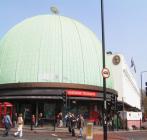 February 22, 2006 The stars at one of central London’s well-known tourist attractions will go dark for good this July. Madame Tussauds waxworks, the owner of the London Planetarium, has decided to close the facility as the company shifts its focus from science education to entertainment. The planetarium (renamed the Auditorium) will soon replace its shows with programs about celebrities.
Built in the 1950s, the London Planetarium seats around 330 under its green 18-meter (60-foot) dome. Although Madame Tussauds had cut the screenings of its shows to just one 10-minute program called “Journey to Infinity,” the planetarium has remained very popular with local schoolchildren and their teachers.
“The London Planetarium has inspired generations of schoolchildren,” notes Robin Scagell, vice president of Britain’s Society for Popular Astronomy. “Many parents can still remember their first visit to it when they were young. To lose the planetarium now would be a tragedy.”
The Royal Observatory’s new, state-of-the-art 120-seat planetarium in Greenwich Park, about 30 minutes from downtown London by boat or rail, is currently under construction and won’t be completed until early 2007. “The only other planetarium of any size within striking distance of London,” says Scagell, “is the South Downs Planetarium near Chichester on the South Coast, about 60 miles from the capital, which is certainly not readily accessible unless you happen to be in the area.”
“I don’t think the Madame Tussauds management wants to sell or lease out the London Planetarium,” he adds. “It’s a valuable bit of real estate in a very expensive part of the world, and I’m sure they want to hang on to it. The dome itself is not a listed building, that is, not protected as being of historic or architectural value, but I doubt that they would want to pull it down just yet.”
It’s a shame to trade science for sensationalism. Most celestial stars are in their main sequence and will glow for billions of years to come. Terrestrial stars might be compared to final sequence giant stars, which have only a short time left before they collapse into the dwarfs they are all destined to become.

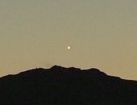 If you step out this evening or or tomorrow evening, you might catch a glimpse of the seldom-seen planet – Mercury. Known as the Incredible Shrinking Planet, Mercury is about to slip back out of sight as it disappears behind the Sun until it emerges later this year.

 NASA’s Stardust sample return mission returned safely to Earth when the capsule carrying cometary and interstellar particles successfully touched down at 2:10 a.m. Pacific time (3:10 a.m. Mountain time) in the desert salt flats of the U.S. Air Force Utah Test and Training Range.
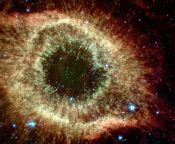 Over six hundred light years from Earth, in the constellation Aquarius, a sun-like star is dying. Its last few thousand years have produced the Helix Nebula (NGC 7293), a well studied and nearby example of a Planetary Nebula, typical of this final phase of stellar evolution. Emission in this infrared Spitzer Space Telescope image of the Helix comes mostly from the nebula’s molecular hydrogen gas. The gas appears to be clumpy, forming thousands of comet-shaped knots each spanning about twice the size of our solar system. Bluer, more energetic radiation is seen to come from the heads with redder emission from the tails, suggesting that they are more shielded from the central star’s winds and intense ultraviolet radiation. The nebula itself is about 2.5 light-years across. The Sun is expected to go through its own Planetary Nebula phase … in another 5 billion years.

 LONG NIGHTS MOON: