Astronomy

It’s Official: The Sun is A Sphere

From the STEREO website:

February 6, 2011: It’s official: The sun is a sphere.

On Feb. 6th, NASA’s twin STEREO probes moved into position on opposite sides of the sun, and they are now beaming back uninterrupted images of the entire star—front and back.

“For the first time ever, we can watch solar activity in its full 3-dimensional glory,” says Angelos Vourlidas, a member of the STEREO science team at the Naval Research Lab in Washington, DC.

“This is a big moment in solar physics,” says Vourlidas. “STEREO has revealed the sun as it really is–a sphere of hot plasma and intricately woven magnetic fields.”

Each STEREO probe photographs half of the star and beams the images to Earth. Researchers combine the two views to create a sphere. These aren’t just regular pictures, however. STEREO’s telescopes are tuned to four wavelengths of extreme ultraviolet radiation selected to trace key aspects of solar activity such as flares, tsunamis and magnetic filaments. Nothing escapes their attention.

[more]

STEREO Spacecraft at Solar Opposition This Weekend

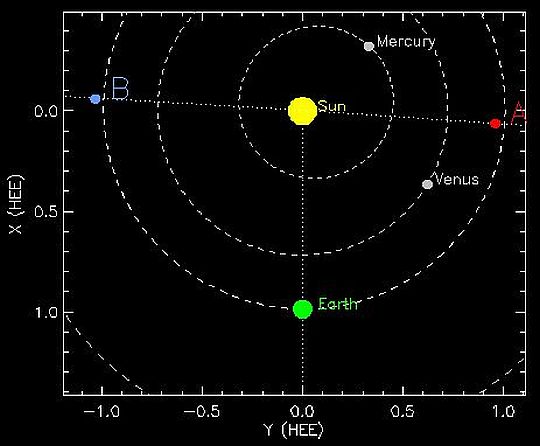
Why would that be significant? Well, it would allow for a full 4PI (360×360°) view of the sun. The animated movie of the sun on STEREO’s Website currently has a gap in the coverage of the sun. The spacecraft are in a heliocentric orbit drifting away from the Earth, one leading and one lagging. This diagram shows the current position of spacecraft A (ahead) and B (behind). The scale is in astronomical units, the average distance between the earth and sun.

Sun-monitoring instrumentation on spacecraft like SOHO and STEREO have gone a long way in discovering what makes the sun behave in mysterious ways. Also, the data coming back (when not intentionally distorted by the IPCC, the CRU or NASA’s James Hansen) can be used to chart the relationship between solar activity and global climate.

whereis.jpg

NOTE: This is the second posting of this article (the original article posted June 16, 2010) because the actual opposition will take place this weekend on Sunday, February 6, 2011. I updated the position graphic for Ahead and Behind and added a NASA STEREO Teaser Video.

Blobs of Plasma Fall on the Sun

We have seen many coronal mass ejections from the sun in the past but this is the first video I have seen (that I can remember) where blobs of plasma seem to rain from a prominence. An amateur astronomer captured this video in Ocean Beach, CA.

Speaking of amateurs, NASA is soliciting reports from amateur radio operators to listen for NanoSail-D’s beacon signal at 437.270 MHz to verify that NanoSail-D is operating.

Video via SpaceWeather.com (repackaged in Flash®).

Non-Random Galactic Distribution

The Two Micron All Sky Survey (2MASS), using data from ground based telescopes in Arizona and Chile, plotted the locations of over a million galaxies. The amazing result shows that the locations of these galactic structures with respect to each other is that they are all locked into a gravitational dance that produces galaxies, galaxy groups and even larger superstructures in the universe. Read the article at Astronomy Picture of the Day.

million-galaxies.jpg

Image courtesy NASA/2MASS. Click image to enlarge.

Winter Solstice

At last the days will be starting to grow longer rather than shorter. This is a still screenshot from Archaeoastronamy.com who provides an interesting animated depiction of seasonal changes and cross-quarter celestial events.

solstice.jpg

Earth’s annual orbit is The Master Clock because the common yardstick of our lives is the year. Years are divided by the seasons just as calendars are segmented by months. Mechanical and digital timepieces measure intervals that split into hours, minutes and seconds each spin of our planet on its axis. Yet, it is the earth’s regular, rhythmic loop around the sun that standardizes our timeframe of reference, regardless of geographic distances separating us from our acquaintances or generational distances separating us from our ancestors.

Solar Activity Continues To Increase

In addition to two very active sunspots, this huge solar flare erupted this week.

From SOHO:

A very long solar filament that had been snaking around the Sun erupted (Dec. 6, 2010) with a flourish. STEREO (Behind) caught the action in dramatic detail in extreme ultraviolet light of Helium. It had been almost a million km long (about half a solar radius) and a prominent feature on the Sun visible over two weeks earlier before it rotated out of view. Filaments, elongated clouds of cooler gases suspended above the Sun by magnetic forces, are rather unstable and often break away from the Sun.