December 2005

Microseismic Emission Precursors

This may be of particular interest to those of us living near seismically active areas. Interpretation of microseismic emission precursors may represent a possible breakthrough on earthquake prediction:

Prelude to an Earthquake?

A geophysicist from the U.S. Department of Energy’s Lawrence Berkeley National Laboratory (Berkeley Lab) has identified possible seismic precursors to two recent California earthquakes, including the 1989 Loma Prieta earthquake that wreaked havoc throughout the Bay Area.

After sifting through seismic data from the two quakes, Valeri Korneev found a spike in the number of micro-earthquakes followed by a period of relative calm in the crust surrounding the quakes’ epicenters — months before the quakes occurred. Although more work needs to be conducted to determine whether other large quakes are foreshadowed by a similar rise and subsequent decline in small-magnitude tremors, Korneev’s analysis suggests that these peaks may be indicative of the total set of geological stresses that affect the timing and location of large earthquakes. Understanding this total stress picture may eventually make it be possible to predict destructive earthquakes within a much shorter time frame than currently possible.

Photo: 1989 Quake Damage to Interstate 880 – S.F. Chronicle

Peaks in seismic activity in the crust surrounding a fault could help signal the arrival of large earthquakes,” says Korneev of Berkeley Lab’s Earth Sciences Division. “These peaks may be a good mid-term precursor and allow authorities to declare alerts several months before earthquakes.”

Read the rest of the article at Science Blog: Prelude to an Earthquake?
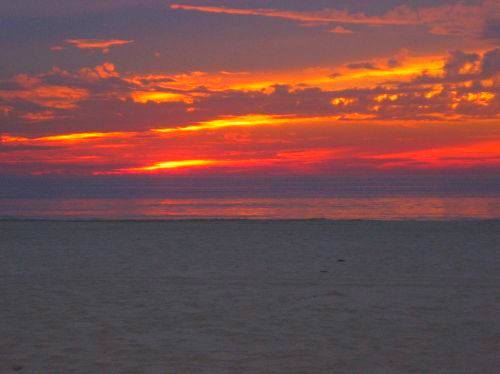
Sundown over the Pacific

Not much to say about this, other than I drove out of my way going home this evening to get this shot from Hermosa Beach.

Update: What I wouldn’t do for art! My detour made me late for happy hour with Damsel . . . I think it was worth it.

Server Outage

There was a glitch at our ISP today; the power went off for five minutes and after the backup came on it took another 45 minutes to recover/restore. Apologies if you weren’t able to connect.

It also affected the Never Forget graphic which is seen on many sites. Sorry for any problems it may have caused you.

Pearl Harbor Remembered

I found a fairly good rundown of the terrible events of December 7, 1941 at Infoplease: Pearl Harbor Remembered.

Excerpt:

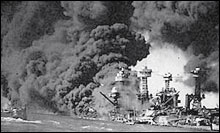
Dec. 7, 1941—at five minutes to eight o’clock, 183 Japanese warplanes ruined a perfectly fine Sunday morning on the island of Oahu in Hawaii. The first attack wave had reached the U.S. Pacific Fleet stationed at Oahu’s Pearl Harbor and for all intents and purposes, World War II began for the United States
Although the U.S. military forces in Pearl Harbor had been recently strengthened, the base was not at a state of high alert. Many people were just waking when the first bombs were dropped. No one was prepared to do battle.

The Birds of Baghdad

Michael Yon has a new article entitled “The Birds of Baghdad” at Michael Yon : Online Magazine. The article starts out:

I love birds. Everywhere, I notice the birds; often I hear their voices before seeing them. To my ears, the most beautiful singers are the mockingbirds. I can listen to their songs for hours and hours, especially in the springtime, when the bachelors are courting and they sing all night during the full moons. In cities, lovesick bachelors often mistake a streetlight for the full moon, and perch in a nearby tree, singing their hearts out.

Some people cannot sleep to the mockingbird, but to me there is no sweeter song. When I hear a mockingbird in the spring, I’m reminded of Louis Armstrong’s famous song, “What a Wonderful World.” On those full moon nights, I think to myself that the mockingbird is singing, I love you. Eventually, a female hears the song, and one by one, pairs form, nests are built from twigs and bits, and the circle of sweet songs continues.

Louis Armstrong’s “Wonderful World” is a favorite of Damsel’s and mine.

Mountaintop Vista

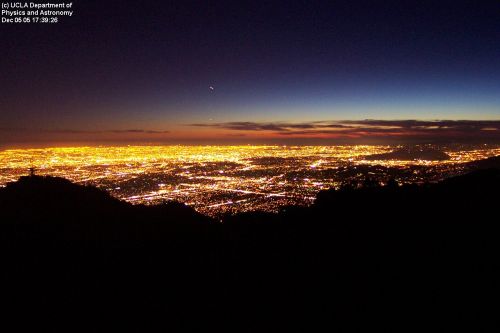
You can enjoy occasional views like this one when you point your browser to Mt. Wilson Towercam Image. This webcam is situated atop the UCLA 150 foot Solar Tower on Mount Wilson overlooking the Los Angeles area.

Of course, this is a very unusual day here, unobscured by the usual coastal haze and fog (and smog, of course). Damsel claims this picture to be an optical illusion and reminds people that California is a blue state and the weather isn’t worth the aggravation. Public schools suck, there are gangs, and traffic and … and … don’t move here (unless you’re a conservative).

Cardiac Christmas

Damsel told me on the chatroom a while ago that Christmas season is a prime time for cardiac arrest. I understood that very well when I stopped at the ATM next door during my lunchtime walk; the damn thing ate my bank card! And I have some Christmas shopping to do!

We're sorry; your card has been retained.
Please contact your financial institution

Now what? I called my credit union, and after wading through several layers of pushbutton menus, I was in touch with the all-important “your call is important to us” message, this time interlaced with credit union ads, which was marginally less irritating than the starved-bandwidth elevator music one usually gets.

Finally, I was in touch with an actual person who advised me that there was a network glitch, and the card was retained as invalid; she could order me a new card which would be “rushed” to me within five business days. “That’s no good,” I said, “I have no cash and shopping season is upon me!” “Well,” was the reply, “You can go to the institution that retained the card and ask them to return it to you; sometimes they will return them if you have proper ID.”

To make a long rant shorter, I went back next door to the customer service representative who cheerfully returned the card to me after checking my driver’s license. Now, why wouldn’t the ATM just regurgitate the card and advise me to check with my bank? I can see why some people become technophobes.