Gun Fun

I know that the guys and gals that participated in the Para Bloggers event at Blackwater had a lot of fun. We’re jealous that we didn’t have that opportunity, but we made do with our weekly trip to the range.

We always have a lot of fun when we go to our local indoor range. We generally start out with the handgun selection, usually 5 guns, one revolver – a .357 magnum or .38 special – and four pistols – two each of 9mm and .45 ACP. We put about fifty rounds – sometimes more – through the 9’s and 45’s and somewhat less through the revolver. At the end of the session, we break out the shotguns and put about 25 rounds through each of those – one 12 and one 20 gauge.

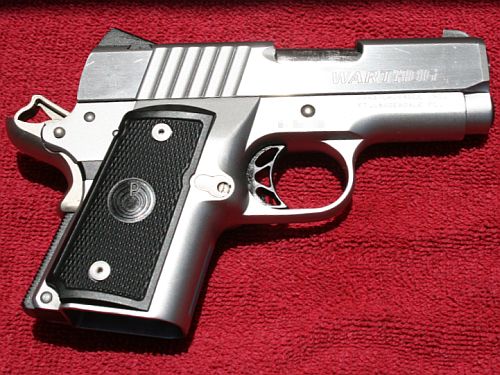
Here Damsel demonstrates her skills with her little S&W 442 .38 special, then with the Para Warthog .45 ACP semi-auto and finally with her 20 gauge Remington 870 express shotgun.

Crassula Red and Yellow

This succulent is called Crassula Falcata and is native to South Africa. These do well here in Southern California. This one has been growing in front of our house since my Mom brought me a cutting and I stuck it into the ground. Every year since then, it has had these bright red and yellow flower clusters and the fragrance is like fresh ocean air, slightly perfumed. Click for the biggie.

crassula.jpg

Mather Point – A Grand Canyon Panorama

On the south side of the Colorado River, the panorama at Mather Point extends from the lower end of Garden Creek taking in some of the Bright Angel Trail, over the deep canyon of Pipe Creek and eastwards to Cedar Ridge/O’Neill Butte, along which runs the South Kaibab Trail starting from the next point to the east – Yaki. Some of the Tonto Trail is also in view, near Pipe Creek. On the North Rim, the vista is centered on the long, straight Bright Angel Creek, flowing for 10 miles between a collection of tall red buttes and other ravines.

Text above borrowed from American Southwest dot net.

I took this photo from the trail between Mather point and the Grand Canyon Village. You can see a throng gathered on the point at the far right end of the panorama. Click on the image to see the full size image in the viewer.

mather-pan.jpg

The Girl Guns

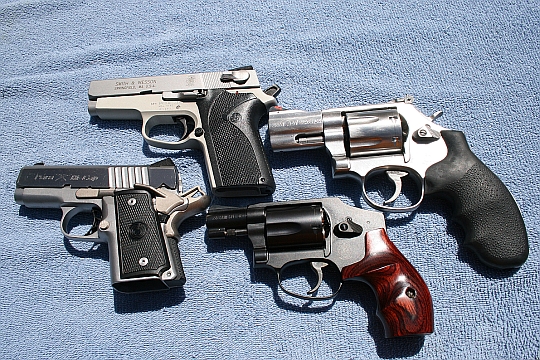
This is my current collection of hand guns. I took the picture after cleaning them up from the trip to the range. Clockwise from the top: S&W 908s 9mm, S&W 686 .357 magnum, S&W 442 .38 special and my Para Warthog .45 ACP. Not shown is my Remington 870 20 gauge shotgun.

girl-guns

I say my ‘current collection’ because that may change soon. Stay tuned.

Warthog Courtesy Call

WarthogI got a call today from Kerby Smith, the director of communications and public relations for Para Ordinance Firearms; he called to follow up on Damsel’s Warthog. Kerby arranged a factory return for the pistol after learning about the problems Damsel was having with it.

We talked about several issues concerning short-barrel .45s. We touched on the topics of lube and maintenance, ammunition, shooting procedures and what to do when you get a misfeed. Kerby seemed to be very knowledgeable about his product line and offered suggestions for us to get the best performance from the Warthog.

I have to say that the Warthog requires a little more in the way of TLC, but it is a very nice gun and Damsel loves it in spite of its history. I also have to say that I’m very impressed with Para’s support of their products and the lengths to which Kerby Smith went to make sure Damsel would be happy with the pistol.

Kerby mentioned that he will be participating in the Para-sponsored Bloggers event at Blackwater where Michael Bane, Ahab, Robb Allen, Sebastian, Say Uncle and others are headed this weekend. Have fun, guys and gals, shooting those Para Pistols.

Natural Varnish on Sheer Canyon Walls

Desert VarnishAlmost everywhere we went on our vacation through Utah and Arizona, we would see this natural desert varnish that forms on the walls of canyons like this one at Canyon del Muerto, a part of the Canyon de Chelly National Park. I took a series of photos to get this vertical panoramic view of the sheer cliff from the rim of the canyon all the way down to the native Ruins at the base.

From Wikipedia:

Desert varnish forms only on physically stable rock surfaces that are no longer subject to frequent precipitation, fracturing or sandblasting. The varnish is primarily composed of particles of clay along with iron and manganese oxides. There is also a host of trace elements and almost always some organic matter. The color of the varnish varies from shades of brown to black.

Originally scientists thought that the varnish was made from substances drawn out of the rocks it coats. Microscopic and microchemical observations, however, show that a major part of varnish is clay (which could only arrive by wind). Clay, then, acts as a substrate to catch additional substances that chemically react together when the rock reaches high temperatures in the desert sun. Wetting by dew is also important in the process.

Another important characteristic of desert varnish is that it has an unusually high concentration of manganese. Manganese is relatively rare in the earth’s crust, making up only 0.12% of its weight. In desert varnish, however, manganese is 50 to 60 times more abundant. This significant enrichment is thought to be caused by biochemical processes (many species of bacteria use manganese).

Even though it contains high concentrations of iron and manganese, there are no significant modern uses of desert varnish. However, some Native American tribes created petroglyphs by scraping or chipping away the dark varnish to expose the lighter rock beneath.

Desert varnish often obscures the identity of the underlying rock, and different rocks have varying abilities to accept and retain varnish. Limestones, for example, typically do not have varnish because they are too water soluble and therefore do not provide a stable surface for varnish to form. Shiny, dense and black varnishes form on basalt, fine quartzites and metamorphosed shales due to these rocks’ relatively high resistance to weathering.

Click on the image for the really big view.

Adobe Hacienda

We saw this house on old Route 66 between Seligman and Kingman, Arizona. I have always loved southwestern style architecture. This house is quite a bit like one that I would love to live in someday. On a quarter acre not too far out of town with a spectacular view would suit me fine.

adobe-hacienda.jpg